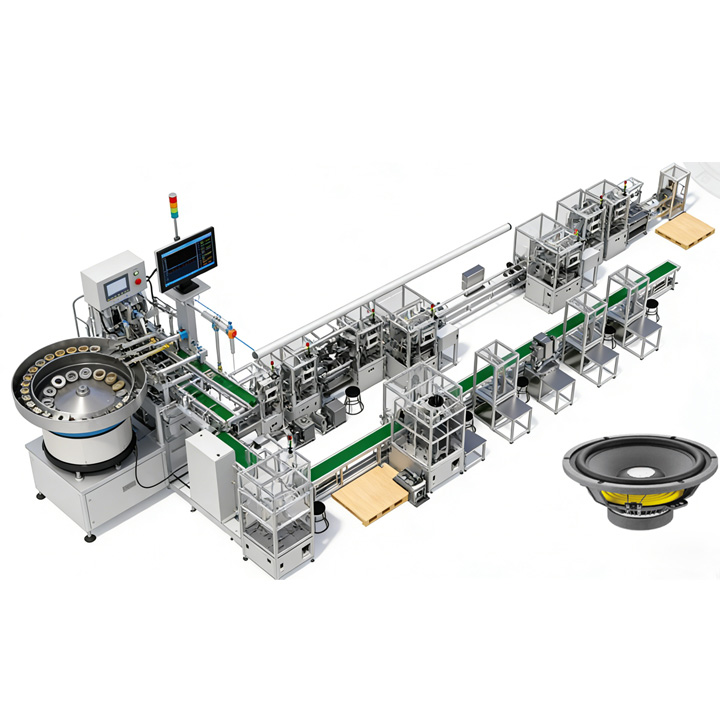
Speaker Automation Solutions

Speaker Automation Solutions

Speaker automation solution

JiuJu Automation - Speaker Automation Total Solution
Miniature Speaker Automation Line
Miniature Speaker Automation LineAiming at TWS/wearing device special miniature speakers, it integrates high-precision visual positioning (±0.01mm), piezoelectric dispensing, laser welding and other core processes to realize full automation of magnetic circuit assembly, sound film lamination, solder joint inspection and electrical performance testing. The single production line has a beat of 0.8s/piece and a daily capacity of 120,000 pieces, which saves 85% manpower compared with the manual production line, and the yield rate has increased from 95% to 99.8%, and it is suitable for the production of mainstream TWS earphone speakers such as AirPods, Huawei FreeBuds, and so on.
Small speaker automated production line
Small speaker automated production lineSuitable for headphones/smart speakers/tv speakers special small speakers, equipped with AI visual defect detection system (can identify 0.02mm tiny defects), fully automatic air tightness testing (pressure accuracy ± 0.01KPa), automatic winding and other modules, support multi-specification flexible production, changeover time <25 minutes. The production line adopts modularized design, which can be flexibly expanded according to customer's capacity demand.
Medium-sized speaker automation production line
Medium-sized speaker automation production lineFor car/home audio special medium-sized speakers, integrating six-axis collaborative robots, high-precision force-controlled assembly (±0.05N), full-frequency acoustic testing and other technologies, supporting eight specifications of speakers co-production, to meet the demand for small-lot, multi-variety production of car audio and smart home speakers. The production line is equipped with MES system, realizing real-time monitoring of production data and automatic warning of quality abnormality.

What Is the Fundamental Difference Between Automated and Manual Production?

The difference lies in what guarantees the result. A manual line relies on the operator's feel and experience, so parts drift within a batch. An automated line hands the actions to the equipment, turning pressure, displacement, adhesive volume and magnetizing energy into parameters that can be set, logged and checked.

喇叭自动化生产与人工生产相比有哪些优势?两种生产方式的主要差异是什么?(久巨自动化) / Automation vs Manual Production — Jiuju Automation

Even an experienced operator produces different parts in the morning and the afternoon, and a different operator differs more. This is not an attitude problem: human movement itself varies, and feel and attention fluctuate from day to day.

An automated line turns this into parameters. How much pressure, where displacement stops and how much adhesive is dispensed are written into a recipe, so it makes no difference who starts the machine. Variation moves from the operator's condition to the equipment's stability, and the latter can be measured, managed and traced.

So what automation really sells is not speed. Speed only pays when order books are full; consistency pays all year round, especially once customers start accepting deliveries by PPM.

One point worth clearing up: automation does not change the process. Gap width and adhesive volume are set by product design; equipment only repeats a settled process consistently. Buying equipment before the process is settled merely postpones the problem — it will still be there when the machine arrives.

Related

Need a solution costed against your own speaker specification? Call 400-626-8699, orbook a visit to our Shenzhen or Dongguan plantand watch a line run on site.

Previous. NEXT STORY.

Jiuju Automation · Factory: Dongguan, Guangdong, China · Company: Shenzhen, Guangdong, China · Tel: 400-626-8699