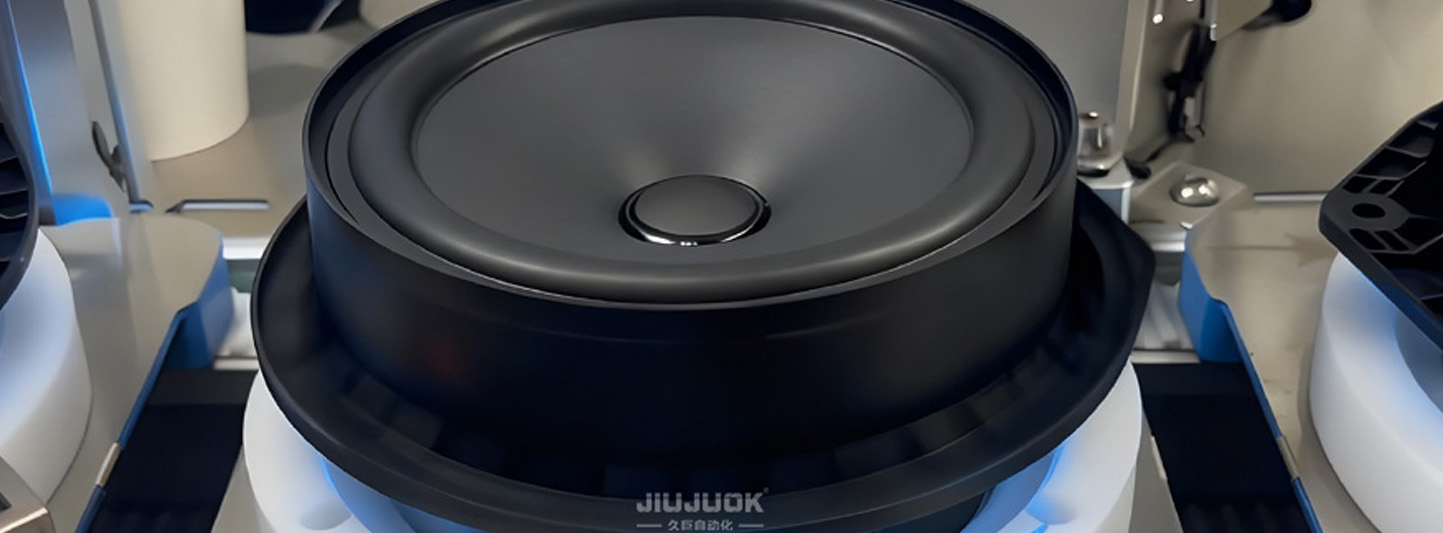
JiuJu Automation focuses on the intelligent upgrading of the whole process of speakers, integrating the four core technologies of visual inspection, precision assembly, AI quality inspection and data traceability to provide customized solutions for TWS headphones, car audio, multimedia smart audio speakers, etc., and achieve production capacity increase of 300%+, yield rate of 99.8%, and reduce the comprehensive cost of 60%, completely solving the pain points of the industry, such as manual dependence, stable quality control and delivery cycle. dependence, unstable quality control, long delivery cycle and other industry pain points. Based on the product characteristics and production scenarios of speakers, it creates a full-process automation system from the entry of raw materials to the release of finished products from the warehouse, covering the three major categories of micro, small and medium-sized, and adapting to the needs of multi-specification and multi-batch production.
A: The automated production of speakers has obvious advantages compared with manual production, mainly reflected in the following aspects:
Production efficiency: The production efficiency of automated production lines is usually 2-3 times higher than that of manual production lines. Automated equipment can run continuously for 24 hours without being affected by manual fatigue and emotion, which greatly improves the production efficiency. Product quality: automated production can realize high-precision positioning and assembly, product consistency is good, and the yield rate can reach more than 99.5%. While the product quality of manual production is affected by the operator's skills and experience, and the consistency is poor.
Cost control: Although the initial investment in automation equipment is large, it can significantly reduce labor costs in the long run. Generally speaking, automated production lines can save 60-80% of labor costs, and the payback period is between 1-3 years.
Production flexibility: Manual production has certain advantages when dealing with small quantities and multiple products. However, modern automated equipment through modular design and rapid changeover technology, can also achieve a high degree of production flexibility.
Management difficulty: automated production can realize digital management of the production process, real-time monitoring of production data, more scientific and efficient management. While manual production is more difficult to manage and prone to management loopholes.
With the rise of labor costs and technological advances, more and more companies are choosing automated production methods. However, for some special products or small batch production, manual production still has certain advantages.
Core view:
Core view: automated production of speakers has obvious advantages in terms of efficiency, quality and cost control, but the initial investment is large. Selection of production methods should be based on product characteristics, production scale and development planning for comprehensive consideration.
JiuJi Automation Advantage:
Jiuju AutomationJiuju Automation is an SRDI “Little Giant” Enterprise and has specialised in speaker automated assembly for 16 years, serving more than 2,500 customers. The company holds 256 technical patents and operates a 10,000 m² production base, offering one-stop solutions from standalone equipment to complete automated lines. Jiuju speaker automated assembly lines use high-precision vision positioning (±0.01 mm), AI-based inspection and fast changeover (<25 minutes), raising production efficiency by 300%+ and achieving a product yield of 99.8% with a 60% reduction in overall cost.
Frequently Asked Questions FAQ
Click a question to expand the answer
01What Is the Fundamental Difference Between Automated and Manual Production?
The difference lies in what guarantees the result.A manual line relies on operator feel and experience, so parts drift within a batch; an automated line hands the actions to the equipment, turning pressure, displacement, adhesive volume and magnetizing energy into parameters that can be set, logged and verified. This is not merely a question of speed.
02Does an automated line always need fewer people?
Labour saving is an outcome, not a premise.An automated line still needs operators, patrol inspection and maintenance staff, and the manning ratio depends on tray capacity, alarm rate and incoming stability. The real saving comes from fewer repetitive motions and less rework, not from replacing every person.
03How should the investment in an automated line be costed in full?
Four blocks: the equipment itself, tooling and fixtures, site services (power, air, flooring, dust extraction), and commissioning and training.The second is the most commonly underestimated: multi-variant production needs tooling per model, and its price and lead time both affect the schedule. Costing only the machine understates total investment.
04What are the hidden costs of a manual line?
Recruitment, training, supervision, rework, material loss and the risk of workplace injury.These are usually absorbed into manufacturing overhead, so no single line item shows them and they are easily underestimated. List them separately in any comparison, otherwise the automated line's advantages are understated and its disadvantages magnified.
05Is it true that changeover on an automated line is slower than manual?
In most cases, yes.An automated line has more adjustable stations and more parameters to re-confirm, so complete-line changeover takes 20 to 60 minutes; a manual line changes over by changing people and technique, which is quicker. In high-mix low-volume work, calculate changeover loss first, then judge whether the investment pays.
06Does a fault on an automated line stop the whole line?
It can, and that is an inherent cost of automation.On a manual line, one station stopping leaves the others working; on an automated line a single station fault can halt the line. Three measures reduce that risk: buffers at critical stations, spares for consumable parts, and fault self-diagnosis. All three must be designed in at the proposal stage.
07In which situations is a manual line still the better choice?
Three: very low annual volume with frequent changeovers; poor incoming consistency that cannot be improved in the short term; and products still being revised frequently.In these three cases equipment investment easily becomes a sunk cost. Standardising incoming material and freezing the process first is usually more effective than buying a line outright.
08Which quality problems does automation improve?
Mainly problems of repeatability: the same action performed identically each time, without drift from fatigue or mood.Typical examples are pressing depth, adhesive volume, riveting force and magnetizing energy. What it does not improve is judgement — fault recognition and sorting incoming parts still depend on people or inspection stations.
09How should labour savings be reported accurately?
Report the manning ratio, not a saving percentage.The manning ratio states how many people a line needs and what they do, and it can be checked; a saving percentage depends on the headcount and shift pattern of the existing line, and the same proposal differs widely between customers. A percentage divorced from the original line means nothing.
10How is payback calculated reliably?
Add two benefit streams and divide by the investment: capacity benefit = (new cycle time − current cycle time) × available hours × yield improvement; defect-cost saving = existing defect rate × output × loss per unit − post-automation defect cost.Use effective capacity, not the rated figure.
11Do automated lines place higher demands on incoming material?
They do.People can sort and adjust; a machine can only work within the tolerance it was set. Out-of-tolerance material shows up directly as jams, locating offset and poor adhesive bonds. That is why an automation project should fix the incoming standard first rather than adapt after the equipment arrives.
12Which metrics show whether automation is genuinely effective?
Three: effective output (cycle rate × uptime × yield), output per person (effective output ÷ actual headcount on shift), and fully loaded cost per unit (including depreciation, energy, consumables and rework).Looking only at a cycle-time gain leads easily to over-optimistic conclusions.
 Speaker automation jiujuauto












 简体中文
 English
 Tiếng Việt
 日本語
 한국어
 ไทย
 हिन्दी
 বাংলা
 Français
 Español de Perú
 Русский