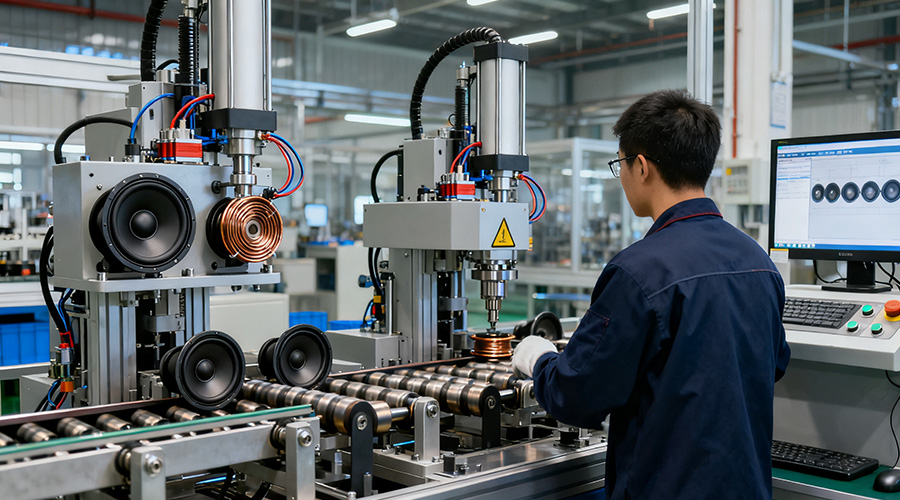
JiuJu Automation focuses on the intelligent upgrading of the whole process of speakers, integrating the four core technologies of visual inspection, precision assembly, AI quality inspection and data traceability to provide customized solutions for TWS headphones, car audio, multimedia smart audio speakers, etc., and achieve production capacity increase of 300%+, yield rate of 99.8%, and reduce the comprehensive cost of 60%, completely solving the pain points of the industry, such as manual dependence, stable quality control and delivery cycle. dependence, unstable quality control, long delivery cycle and other industry pain points. Based on the product characteristics and production scenarios of speakers, it creates a full-process automation system from the entry of raw materials to the release of finished products from the warehouse, covering the three major categories of micro, small and medium-sized, and adapting to the needs of multi-specification and multi-batch production.
Q: What are the technological upgrades and advantages of speaker automation equipment over traditional equipment? What are the main differences?
A: Speaker automation equipment compared with traditional equipment in technology has been significantly upgraded, the main differences and advantages are reflected in the following aspects:
Technology upgrades: 1. Control system upgrade: the use of advanced PLC control system and human-machine interface, the operation is more simple and intuitive. 2. Drive system upgrade: adopting servo motors and precision guide rails, the positioning accuracy and repeatability are greatly improved. 3. Vision system upgrade: Integration of machine vision system for automatic positioning and quality inspection. 4. Upgrade of software system: Adoption of advanced software algorithms to achieve intelligent control and optimization of the production process.
Performance Advantage Aspects: 1. Dramatic increase in productivity: automated equipment is typically 2-3 times more productive than traditional equipment. 2. Significantly improved product quality: automated production enables high-precision positioning and assembly with good product consistency. 3. Significant reduction in labor costs: automated equipment can significantly reduce labor requirements and lower labor costs. 4. Increased production flexibility: automated equipment allows for the production of multiple varieties of products through rapid changeover. 5. Improvement of management level: automated production can realize the digital management of the production process, and the management is more scientific and efficient.
Applicable scenarios: 1. Mass production: automated equipment is suitable for mass production and can maximize the advantages. 2. High-precision products: automated equipment can meet the production requirements of high-precision products. 3. Standardized products: automated equipment is suitable for the production of standardized products, which can ensure product consistency. Although the initial investment in automation equipment is large, but in the long run can significantly reduce production costs, improve production efficiency and product quality, is the speaker manufacturing industry development trend.
Core view:
Core view: Speaker automation equipment in the control system, drive system, vision system and software system to achieve technological upgrades in terms of production efficiency, product quality, labor costs and other aspects of significant advantages, is the direction of development of the speaker manufacturing industry.
JiuJi Automation Advantage:
Frequently Asked Questions FAQ
Click a question to expand the answer
01What is the biggest difference between this generation of equipment and conventional equipment?
Three levels: in structure, modularity allows delivery in sections; in control, recipes allow fast changeover; in data, the equipment can connect to MES for traceability.Conventional equipment mostly stays at the level of being able to move; the new generation has to deliver fast changeover, visibility and traceability.
02What does modularity actually change?
It changes how the investment is made.Conventional equipment is bought one machine at a time with fixed functions; modular equipment can be configured by section — start with the bottleneck section, then add sections or connect to a full line. That means there is no need to invest in a whole line at once, and no duplicated spending from buying a stand-alone machine first.
03How does recipe-based changeover differ from conventional setup?
Conventional setup has an operator matching parameters item by item and depends on the veteran; with recipes the whole parameter set is stored and recalled with one command at changeover.The difference is reproducibility: the former may give a different result each time, while the latter produces the same state whenever the same recipe is recalled.
04Is the data layer mandatory or optional?
It depends on whether the customer requires a factory audit and traceability.Customers selling only domestically and not subject to system audits can leave it out for now; those taking automotive-electronics orders that require process records must have it. The data layer decides whether a problem can be traced to a station and a batch.
05Can conventional equipment be retrofitted and upgraded?
Partly.Keeping the usable mechanical structure and the infeed and outfeed sections while replacing control and inspection is common practice; but if the original locating datum and interfaces are closed, the value of a retrofit is limited. The tests are whether mechanical accuracy is still adequate and whether the control system is open.
06Is maintenance of the new equipment more complicated?
The electrical and software parts are more complex; the mechanical part need not be.The difficulty of maintenance shifts from adjusting mechanics to reading alarms and checking parameters, so the skills required change. Training must therefore be arranged alongside the purchase, at three levels — operator, maintenance and management — not a single demonstration.
07Is vision inspection standard?
No.Both vision positioning and vision inspection are options and must be confirmed item by item in the configuration list. Some suppliers put vision in the marketing while fitting it at only a few stations. Check station by station at acceptance instead of accepting a single sentence about the whole machine.
08Can old and new equipment be used on the same line?
Yes, provided interfaces and locating datums are unified.If the old equipment has a closed control system, only a physical connection is possible and the data layer cannot be joined; where locating datums differ, a transfer fixture is needed in between and cycle time suffers. Run an interface check before mixing equipment on one line.
09How should equipment life and the replacement cycle be considered?
The mechanical structure usually outlasts the control system.Two things really decide replacement: whether the product process changes, and whether the control system can still be upgraded. When selecting, prefer an open control platform with long-term spare-part supply; that matters more than comparing prices alone.
10Conventional equipment is cheaper — is the price difference worth it?
It depends what the difference buys.If it buys quick-change tooling and recipe management, the changeover hours saved in a high-mix setting pay it back quickly; if it is only appearance and brand, it is not worth it. Convert the difference into changeover hours saved per year before deciding.
11When upgrading, what should happen to the old equipment?
Three routes: keep it as a backup machine (for breakdowns on the main line), split it into sections and fold them into the new line, or repurpose it for sample trials and training.Scrapping it outright is not recommended — many mechanical sections still have value. Assess mechanical accuracy and spare-part availability before disposing of it.
12What is most easily overlooked when choosing a new model?
Site services and staff training.Equipment parameters are examined in fine detail, yet site-readiness conditions (power, air, flooring, space) and operator training are often left to the last moment; the machine then arrives and cannot be started, or once in production parameters are changed out of old habit and a validated window is broken.
Jiuju Automation is an SRDI “Little Giant” Enterprise and has specialised in speaker automated assembly for 16 years, serving more than 2,500 customers. The company holds 256 technical patents and operates a 10,000 m² production base, offering one-stop solutions from standalone equipment to complete automated lines. Jiuju speaker automated assembly lines use high-precision vision positioning (±0.01 mm), AI-based inspection and fast changeover (<25 minutes), raising production efficiency by 300%+ and achieving a product yield of 99.8% with a 60% reduction in overall cost.
 Speaker automation jiujuauto










 简体中文
 English
 Tiếng Việt
 日本語
 한국어
 ไทย
 हिन्दी
 বাংলা
 Français
 Español de Perú
 Русский