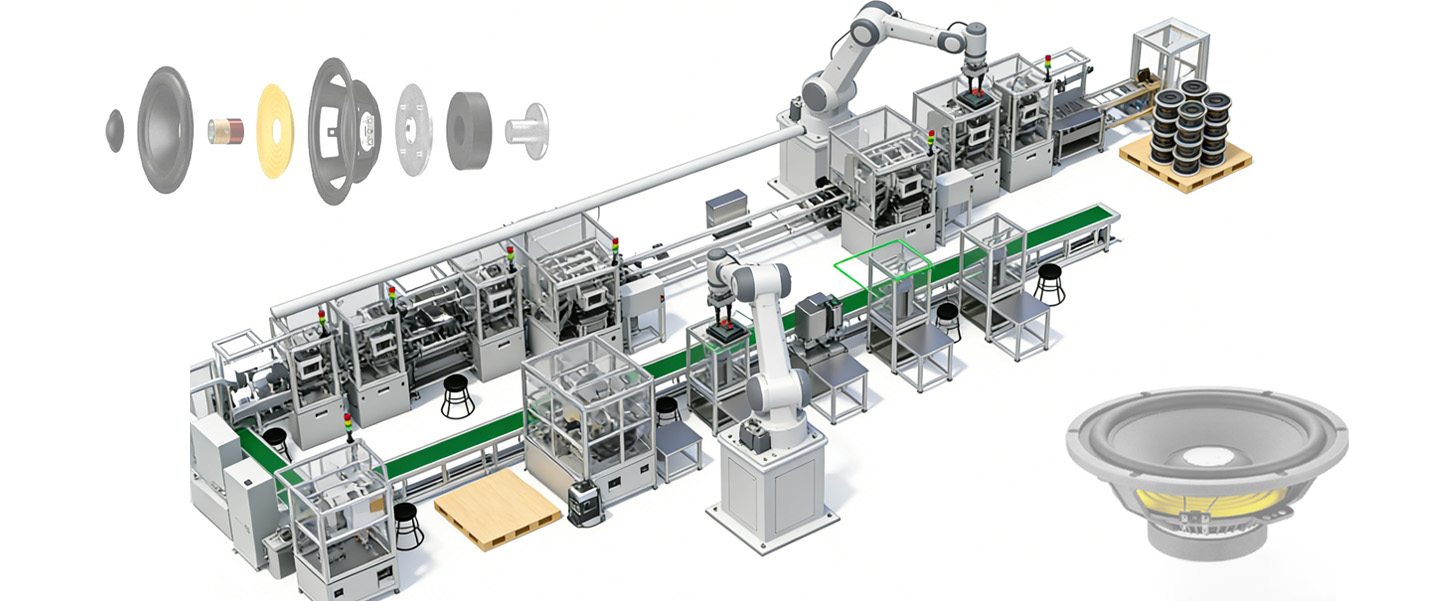
Voice coil offset (resulting in distortion of sound quality), uneven magnetization of the magnetic circuit (affecting sensitivity) is the core quality pain point of automated production, JiuJi Automation through the "Equipment Accuracy + Process Closed Loop Control" Solution:
Consistency of sound quality (such as sensitivity, frequency response curve) is the core competitiveness of the speaker enterprise, automated production compared to artificial has an absolute advantage:
The selection of inspection equipment needs to "match the product type + production tempo", JiuJi Automation offers "Customized Testing Solutions"The core steps are as follows:
Frequently Asked Questions FAQ
Click a question to expand the answer
01How is acoustic consistency assured?
By turning the key variables that affect sound into parameters that can be set, logged and verified: gap locating accuracy, voice-coil seating, dispensing volume and path, and magnetizing energy.On a manual line these depend on operator feel and drift within a batch; an automated line hands them to the machine and the recipe, so drift becomes detectable.
02How does equipment control differences the ear can hear?
It does not control the listening impression itself, but the physical quantities that produce it.Deviations in the frequency response curve usually come from four causes: uneven gap, off-centre voice coil, unstable adhesive volume and under-magnetization. Fix the process parameters for these four and the sources of audible difference narrow.
03How is gap uniformity assured?
Through the locating datum and tooling accuracy.In an internal-magnet structure the concentricity between magnet and washer determines the gap directly. Fixed tooling holds direction and position, with vision locating accurate to ±0.01 mm. Tooling wear is a common failure point and must be checked on a schedule; otherwise the parameters stay the same while the actual position has already shifted.
04What is the voice-coil locating accuracy?
The published figures for the company's micro-speaker line are ±0.01 mm locating accuracy, ≥99% coverage and ≥2000 UPH capacity.These three form one set of figures and describe that section of equipment, not the acoustic performance of a finished line. A complete line must be recalculated around its bottleneck station.
05Does variation in adhesive volume affect sound quality?
Yes.Too much adhesive runs into the gap and changes the equivalent mass and damping of the vibrating system; too little leaves the bond weak, and it separates under prolonged vibration. Dispensing volume per shot can be controlled to ±0.02 ml, provided adhesive viscosity is stable, the supply system is maintained on schedule and the needle is clear.
06What does under-magnetization cause?
Most directly, low sensitivity with large batch-to-batch variation.Whether magnetization is saturated cannot be read from the machine display; measure surface flux or magnetic flux and compare with the magnet data sheet. Common causes are fixture wear, capacitor ageing and batch variation in the magnet material — check the fixture and the energy first, before suspecting the material.
07Is acoustic testing performed on every unit?
It depends on whether an in-line acoustic test station is specified.With the station, every unit is tested: the response curve is compared against a reference and out-of-tolerance units are rejected automatically. Without it, only sampling is possible and consistency depends on process parameters. This must be written into the technical specification at the proposal stage so that acceptance does not founder on disagreement about what should be tested.
08How is a frequency response curve judged acceptable?
By window comparison against a reference curve: within the specified band, a measured curve that stays within the set tolerance passes.Tolerance and frequency band must be defined by the customer in the product specification; the equipment only samples and applies the verdict. A tolerance set too loose lets problems through, too tight rejects good units — this is the customer's decision.
09Where do consistency problems usually originate?
In order of frequency: incoming variation (magnet dimensions, coating, chipping), tooling wear, changes in adhesive viscosity, and decay of magnetizing energy.Of these four, only the last two can be compensated on the equipment side; the first two require incoming control. Treating the machine as a universal answer means the problem keeps returning.
10Compared with a manual line, where does the consistency difference show?
In two dimensions: within-batch and between-batch variation.Within-batch variation on a manual line comes mainly from operator condition and differs even within one shift; an automated line has small within-batch variation, but its between-batch variation depends more visibly on incoming material and consumables. The two have different problem structures and cannot be reduced to a question of which is steadier.
11How should incoming variation be handled?
Agree an incoming sampling standard in the contract and validate with sample workpieces.For micro parts, three checks matter most: stable dimensional tolerance, freedom from chipping and intact coating. None can be corrected at the machine; they can only be stopped at incoming inspection. Discovering batch variation in volume production costs far more in rework than early sampling.
12Are there quantifiable acceptance metrics?
Four are recommended: cycle-time attainment, yield (good units ÷ units fed, by batch and by defect mode), OEE and changeover time.The company's published figures are ≥99.5% yield and ≥85% uptime; the signed acceptance report governs in practice. Volume validation is a continuous 72-hour assessment.
 Speaker automation jiujuauto









 简体中文
 English
 Tiếng Việt
 日本語
 한국어
 ไทย
 हिन्दी
 বাংলা
 Français
 Español de Perú
 Русский