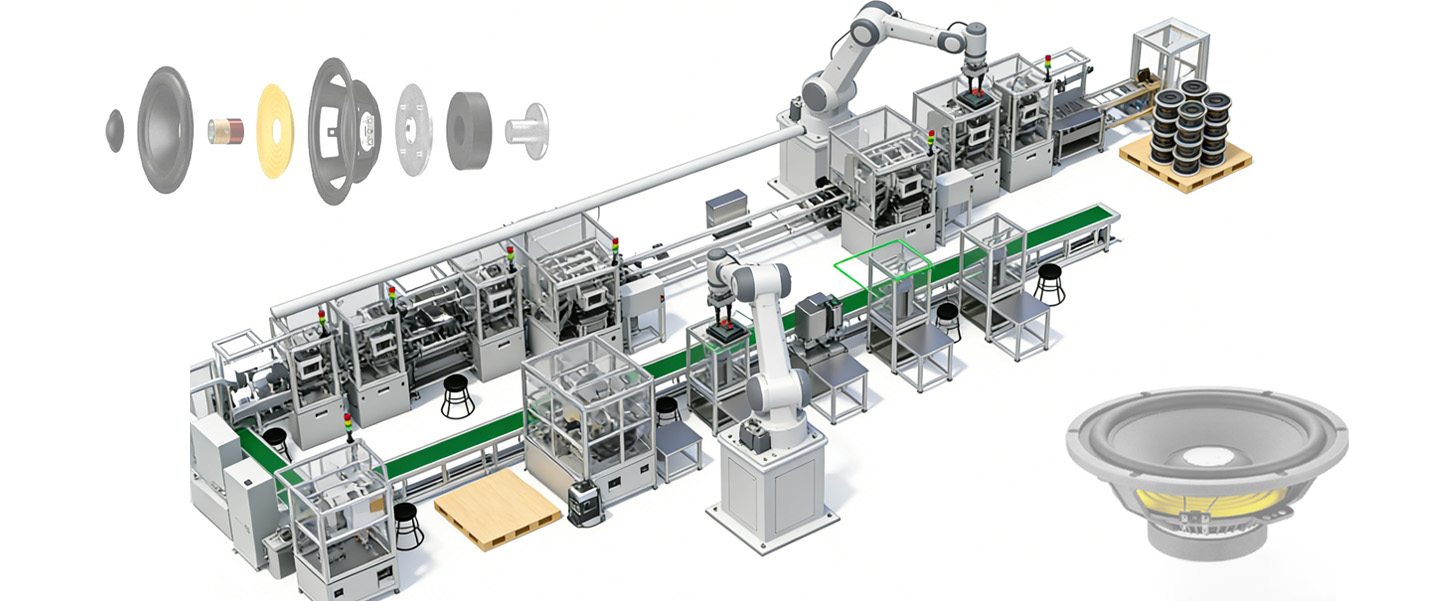
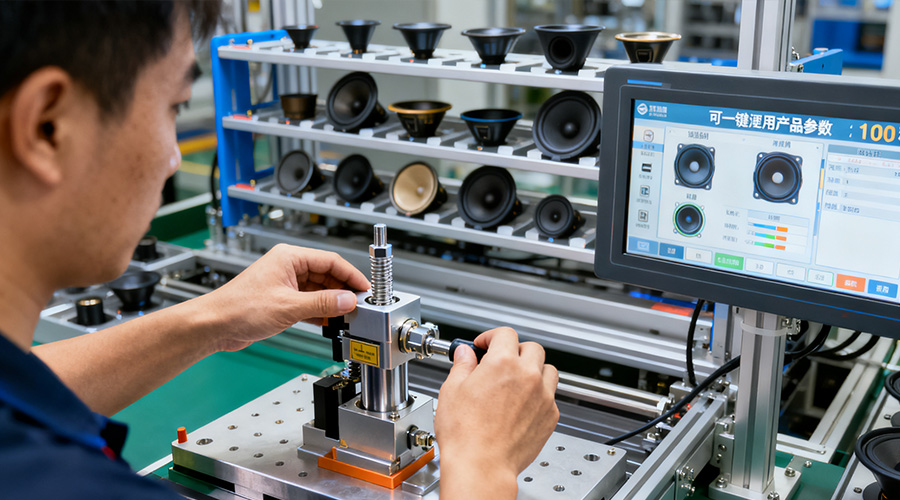
JiuJu Automation focuses on the intelligent upgrading of the whole process of speakers, integrating the four core technologies of visual inspection, precision assembly, AI quality inspection and data traceability to provide customized solutions for TWS headphones, car audio, multimedia smart audio speakers, etc., and achieve production capacity increase of 300%+, yield rate of 99.8%, and reduce the comprehensive cost of 60%, completely solving the pain points of the industry, such as manual dependence, stable quality control and delivery cycle. dependence, unstable quality control, long delivery cycle and other industry pain points. Based on the product characteristics and production scenarios of speakers, it creates a full-process automation system from the entry of raw materials to the release of finished products from the warehouse, covering the three major categories of micro, small and medium-sized, and adapting to the needs of multi-specification and multi-batch production.
Q1:The traditional speaker production line has low capacity and many bottlenecks, how much capacity can be improved after automation transformation? How to land specifically?
Answer:
Traditional speaker production lines (manual/semi-automated) generally have bottlenecks such as "process breaks, slow line changes, and manual errors", and the production capacity is usually in the range of 800-1200 pcs/hour. JiuJu automation for the speaker production process (magnetic circuit assembly, voice coil positioning, dispensing curing, testing and packaging) designed for the Customized automated production linesIn addition, it can realize 3 core enhancements:
Capacity Enhancement 50%-120%Take medium-sized speakers (20-50mm diameter) as an example, the production capacity of the automated production line can reach 1,500-3,000 pieces/hour, and with the intelligent scheduling system, the changeover time can be shortened from 30 minutes to 5 minutes;
Landing path (can be applied directly)::
Pre-diagnosis: Free on-site assessment of existing production line bottlenecks (e.g. low manual dispensing efficiency, poor magnetization consistency);
Solution Design: Configuration of "Automatic Magnetizer + High Precision Dispenser + Intelligent Assembly Line" with integrated vision positioning system (Repeat Positioning Accuracy ±0.01mm);
Trial production optimization: arrange engineers on-site debugging, according to the trial production data to adjust the parameters of the equipment (such as the amount of dispensing, assembly beat);
case supportAfter the transformation of an electro-acoustic enterprise, the production capacity was increased from 1,000 units/hour to 2,200 units/hour, and the defective rate was reduced from 3.2% to 0.8%.
Q2:How to balance capacity and flexibility with automated production line for small-lot, multi-model speaker production?
Answer:
Small-lot, multi-model production (e.g., customized speakers, multi-specification product lines) is the core pain point for electro-acoustic companies, and JiuJi Automation has been able to achieve this through its "Modular + Intelligent" solutions Breaking down conflicts:
Modular design: the production line is disassembled into "magnetic circuit module, voice coil module, detection module", individual modules can be debugged independently, only need to switch the program when replacing the product model (support 100 + model presets);
Intelligent adaptation: Equipped with PLC control system, it can automatically recognize the size and model of the speaker, adjust the dispensing path, assembly strength and other parameters, without manual re-adjustment;
Scenario: Especially suitable for small and medium-sized electro-acoustic enterprises, a single production line can cover the production of speakers with diameters of 10-100mm, and the batch quantity can be adapted from 500 pcs/batch to 100,000 pcs/batch.
Q3: After the automated production line is put into operation, how to avoid the problem of "capacity increase but defective rate increase"?
Answer:
The core of the balance between production capacity and quality lies in the "whole process quality control embedded", which is guaranteed by JiuJi automation program from 3 dimensions:
Equipment precision: The core equipment (such as voice coil positioning machine, air tightness testing machine) adopts imported servo motors and visual inspection system to ensure that the error of each process ≤ 0.02mm;
Real-time monitoring: The production line is integrated with MES system, which collects real-time data such as dispensing volume, magnetizing strength, assembly pressure, etc., and automatically alarms for abnormal situations (e.g., stopping the machine immediately for insufficient dispensing);
After-sales guarantee: provide free 1-year equipment operation and maintenance training, regular visits to calibrate the accuracy of the equipment to ensure long-term stable operation (industry average defective rate control within 1%).
Frequently Asked Questions FAQ
Click a question to expand the answer
01Output will not rise — what should be checked first?
The bottleneck station first, not the number of machines.The ceiling is set by the slowest process; faster stations elsewhere change nothing. Measure cycle time station by station (take the median of 20–30 consecutive cycles), find the longest, then check whether work-in-progress is piling up in front of it.
02How can the bottleneck be identified?
Three signals: work-in-progress keeps piling up before the station, the stations after it often wait for parts, and neither the operator nor the machine there has any idle gap.When all three appear, the bottleneck is confirmed. Judging by a station's nominal speed alone misleads, because actual cycle time also depends on changeover, replenishment and exception handling.
03How do cycle time and output relate?
Output = cycle time × uptime × yield.Many people watch cycle time only and ignore the other two. At 1000 PCS/H, 85% uptime and 99.5% yield, effective output is about 846 PCS/H. Nominal figures hold only under ideal conditions; scheduling on nominal values will always fall short.
04What usually causes low uptime?
Ranked by impact: changeover stops, breakdown stops, waiting-for-material stops, and quality-exception stops.The first three can be improved through management; the fourth depends on process capability. The company's published figure is uptime of 85% or above, and reaching it requires changeover design, spare-parts management and incoming-material stability together.
05How is changeover loss calculated?
Changeover loss = changeover duration × changeover frequency ÷ available hours.For example: 40 minutes per changeover, 3 changeovers a day, 480 available minutes — loss is 25%. That ratio decides whether a high-mix line pays, and whether secondary models deserve dedicated tooling.
06Does unstable incoming material drag output down?
It does, and it is often misdiagnosed as an equipment problem.Variation in incoming dimensions causes locating failures and jams, so the machine stops often; it looks like an unstable machine but the material is what is changing. The test: run one batch for two hours and count stops, then run another batch and compare — a clear difference means the material.
07Is changing a single station worthwhile?
It is, provided the station changed is the bottleneck.Shorten the bottleneck's cycle time and line output rises at once; change a non-bottleneck station and output does not move at all — only more work-in-progress piles up. This is the most common waste in line upgrades.
08Should capacity be added or speed raised?
It depends on the nature of the bottleneck.If the bottleneck is machine cycle time already near its design limit, adding capacity (more machines or another line) is more direct; if the bottleneck is changeover and stoppages, improve efficiency first and consider expansion later. The test is what share of the bottleneck's available hours is actual processing time.
09What are the ways to speed up an existing line?
Three: convert manual stations to automatic ones to remove operator-induced cycle variation; merge processes to cut handling and re-location; add buffers so the bottleneck never stops waiting for parts.The third costs least but delivers least; the first delivers most but costs most.
10When specifying a new line, how much margin should be reserved?
Size for target output 2 years out, not for current output — but do not leave more than double the margin.Excessive margin leaves equipment running at low load for long periods, produces a poor uptime figure and distorts costing. A 20%–30% capacity margin is advisable, with changeovers and shifts covering the rest.
11Where do capacity calculations most often go wrong?
Three frequent errors: using nominal cycle time instead of effective cycle time, ignoring changeover loss, and treating one machine's capability as the line's capability.The third is the most common — taking a magnetic-circuit machine's 3000 PCS/H as line output, when the line is limited by the soft-part and inspection sections and differs by several times.
12What data is needed before a line upgrade?
Four sets: headcount and shift pattern on the existing line, measured cycle time at each station, current yield and the main defect modes, and the target annual output with the model list.Without those four sets a proposal can only give ranges, not a specific configuration. They are also the inputs to any investment calculation.
 Speaker automation jiujuauto








 简体中文
 English
 Tiếng Việt
 日本語
 한국어
 ไทย
 हिन्दी
 বাংলা
 Français
 Español de Perú
 Русский