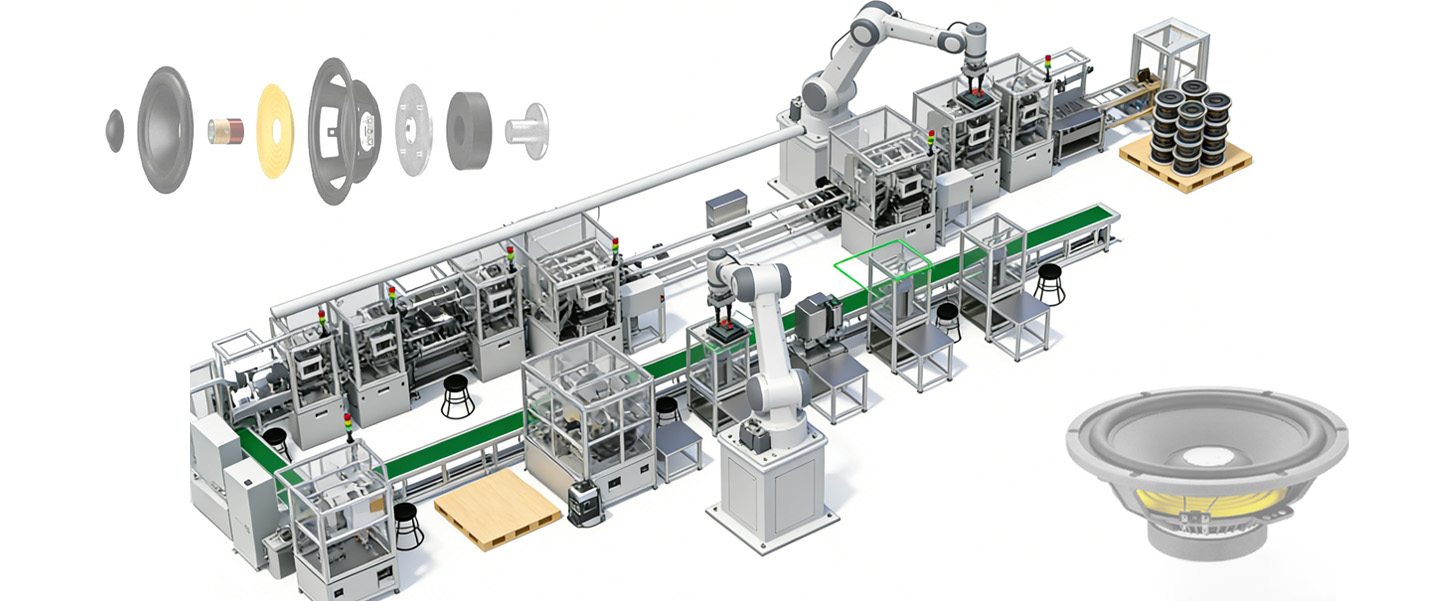
JiuJu Automation focuses on the intelligent upgrading of the whole process of speakers, integrating the four core technologies of visual inspection, precision assembly, AI quality inspection and data traceability to provide customized solutions for TWS headphones, car audio, multimedia smart audio speakers, etc., and achieve production capacity increase of 300%+, yield rate of 99.8%, and reduce the comprehensive cost of 60%, completely solving the pain points of the industry, such as manual dependence, stable quality control and delivery cycle. dependence, unstable quality control, long delivery cycle and other industry pain points. Based on the product characteristics and production scenarios of speakers, it creates a full-process automation system from the entry of raw materials to the release of finished products from the warehouse, covering the three major categories of micro, small and medium-sized, and adapting to the needs of multi-specification and multi-batch production.
Key componentsPanasonic PLC controller, Japan servo, vibration plate loading, Japan rail, precision CNC machining, Panasonic touch screen, Huichuan robot Panasonic PLC controller, Japan servo, vibration plate loading, Japan rail, precision CNC machining, Panasonic touch screen, Huichuan robot
operator1 person
Design AdvantagesAdopt linear double-station structure design, space saving, simple debugging operation, realize the automatic material loading and assembling, IO communication control system, full-station detection and identification sensors, can be connected to the MES system, rich expansion module, convenient for subsequent upgrading and overhaul.
For standalone and special-purpose machines the tooling and parameters are already fixed, so the fastest and lowest-cost way to verify the process is to send us your real parts and have them run on our equipment. Seven steps, 3–10 working days.
1
Trial Request & Requirement Check
1 working day
Trial request form
2
Part Receipt & Registration
1–2 days
Part log sheet
3
Tooling Setup & Parameter Setting
2–3 days
Trial plan
4
Trial Run with Process Records
1–3 days
Photos & video
5
Testing & Data Logging
1–2 days
Data log
6
Trial Test Report Issued
2 days
Trial report
7
Case Filing & Sharing
1 day
Case card
How we charge: trials are free for standard models with standard parts. For non-standard machines that need new tooling or station-by-station debugging, we charge according to normal industry practice (about 7–10 days), and the fee is credited against the order once it is placed. For confidential parts we can run the trial at your site, or in our plant under a signed NDA.
Products
Speaker Riveting Press Product Details
Superb block model - written before the product introduction portfolio
In the speaker driver manufacturing process, the assembly quality of washer in the pre-processing section directly affects the stability of the speaker's sound quality and service life, the traditional manual mode of operation is often faced with loading deviation, uneven dispensing, riveting strength imbalance and other issues, and there are operational safety hazards, low efficiency of the changeover and other pain points. In response to these industry challenges, we developed the speaker riveting press came into being, focusing on the realization of the speaker before the processing section of the fully automated operation, integration of automatic loading, accurate dispensing, stable riveting, automatic discharging of the whole process, to meet the automated assembly of various types of speakers to meet the needs of the multiple core advantages.
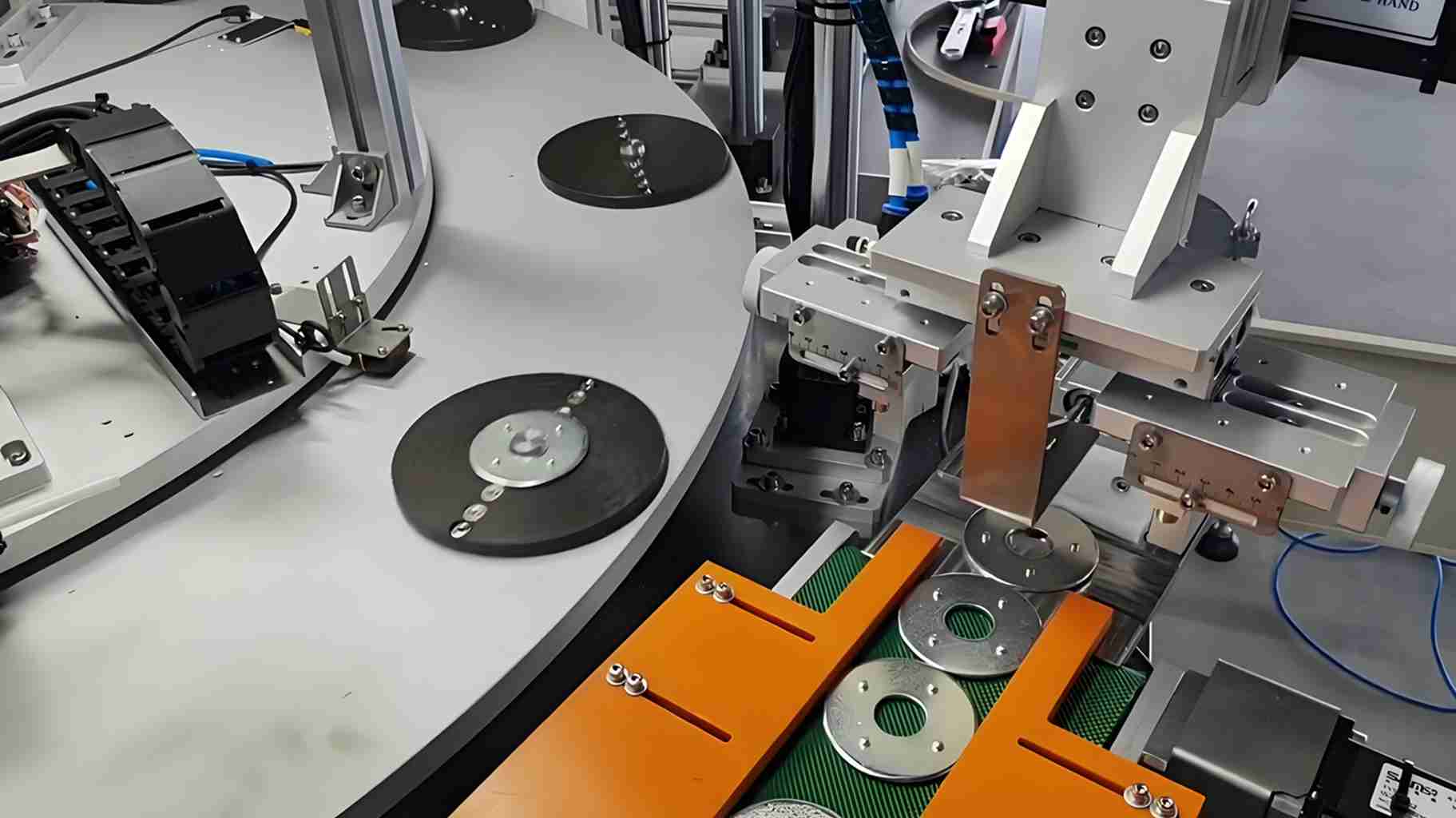
The equipment takes the whole process automation as the core competitiveness and builds the closed-loop pre-processing system. The feeding link adopts high-precision vibrating plate feeding mechanism, with CCD visual positioning system, which can realize automatic sorting, directional conveying and precise alignment of washer, with positioning accuracy of ±0.03mm, completely replacing the cumbersome operation of manual feeding, and avoiding the contamination and deviation brought by manual contact. Dispensing module equipped with quantitative dispensing system, through the servo motor precise control of the amount of glue and dispensing position, the amount of glue error control within ± 0.01g, not only to eliminate the waste of glue, but also to ensure the uniformity of the glue layer, to lay the foundation for the subsequent riveting firmness. The riveting link adopts imported servo drive technology, which can accurately adjust the riveting pressure and stroke according to the needs of different specifications of the speaker, and the pressure control accuracy reaches 0.1N, which effectively avoids the deformation and loosening of the washer caused by uneven riveting strength by hand. After completing riveting, the equipment automatically completes the discharging and sorting of finished products, realizing the whole process of unmanned operation from raw materials to semi-finished products.
The equipment has formed multi-dimensional advantages in safety, operability, versatility and manageability. In terms of operational safety, the machine body adopts a fully enclosed protective structure, equipped with infrared sensor safety device, when the human body near the work area, the equipment automatically stops, while setting the emergency stop button and overload protection system, to eliminate safety accidents from the source. Convenience of operation, equipped with a 7-inch color touch screen, built-in visualization of the operating interface, the staff can complete the parameter settings, mode switching and other operations after a simple training, the equipment also supports the memory function of the commonly used process parameters, the change of the direct call preset parameters, significantly shorten the debugging time. Strong versatility is another highlight of the equipment, through the rapid mold change mechanism and parametric adjustment design, can be adapted to the diameter of 10mm-200mm of various types of speaker washer assembly needs, mold change time of only 5-10 minutes, to meet the multi-species, small batch production scenarios. Visualization management, equipment integrated production data monitoring system, real-time display of production capacity, qualification rate, equipment operating status and other key data, support for the automatic generation and export of production reports, to help enterprises achieve transparent management of the production process.
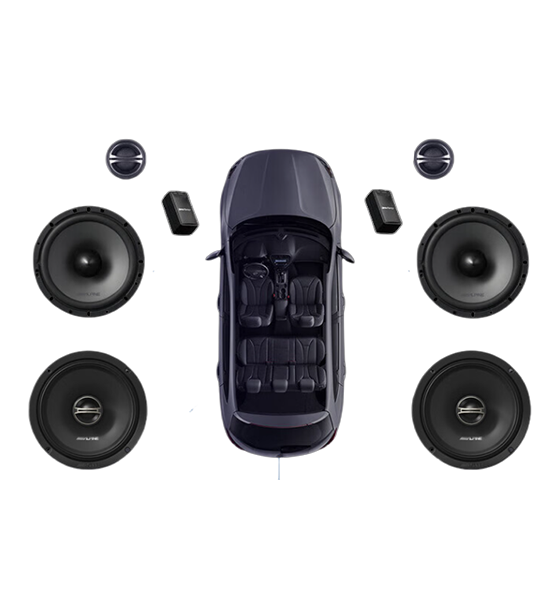
From the point of view of application scenarios, the equipment can be widely adapted to the assembly and manufacture of various types of speakers such as car audio, home audio, professional stage audio, headphones, etc. Whether it is a small precision headphone speaker or a large-scale professional audio speaker, it can realize stable and efficient processing. After being put into use, it can increase the production efficiency of single station by more than 5 times, and increase the product qualification rate from 92% of manual operation to more than 99.5%, and at the same time, reduce the labor input of 80%, which can significantly reduce the production cost of the enterprise. As the core equipment for automation of the pre-processing section of the speaker driver, this equipment provides strong support for the enterprise to realize flexible production, improve quality and efficiency, and promote the transformation of the speaker driver manufacturing industry to intelligence and automation.
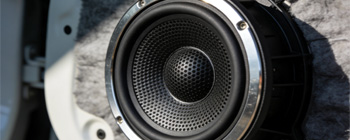
Footage of the automotive woofer automatic assembly line: magnetic circuit assembly, voice coil positioning and diaphragm bonding are automated across all key stations, locking assembly errors within the tolerance band.Contact Jiuju Automation for…
Live footage of the automatic assembly of the soft-parts section of square multimedia internal-magnet loudspeakers, showing precision assembly of flexible acoustic components such as voice coils, spiders and cones, ensuring coaxial positioning and…
Automotive external-magnet loudspeaker automatic assembly line: it integrates feeding, assembly and inspection in one process, fully automatic from component transport to finished-product offloading, eliminating human error.Contact Jiuju Automatio…
Fully automatic tunnel baking line for automotive loudspeakers: independent temperature control in multiple zones and PID closed-loop regulation ensure every loudspeaker cures under the same thermal history.Contact Jiuju Automation for more quotes…
loading...
It's already to the last piece of content!
Frequently Asked QuestionsClick a question to expand
01Which operations does the riveting press perform?▼
Seven in continuous sequence: automatic washer feeding, rivet point punching, dispensing, frame loading, riveting, dust removal and unloading. In other words, frame-to-washer riveting, adhesive fixing and dust removal are linked into one action with no manual transfer in between. This process chain applies to outer-magnet, inner-magnet, audio and stage speakers; changing product mainly means changing tooling and adjusting riveting pressure.
02What are the output and headcount?▼
≥1000 PCS/H with 1 operator. The operator handles loading, patrol checks and sampling; riveting and dispensing are done by the machine. At 8 hours per shift and 85% availability, effective daily output is about 6,800 pieces. The ceiling is set by the riveting station; dispensing and dust removal are auxiliary and not bottlenecks. Actual values are confirmed by acceptance testing.
03Which speakers does it suit?▼
Frame-to-washer riveting for outer-magnet, inner-magnet, audio and stage speakers; different sizes mainly require different tooling and riveting pressure settings. The boundary must be stated: professional speaker units above 18 inches need a larger table and higher riveting force, which the standard FB-120 does not cover; such cases must be evaluated separately. Non-circular frames (square or irregular) need dedicated locating tooling and cannot be quoted as standard parts.
04How is riveting quality assured?▼
Through force and displacement monitoring. The riveting process records the force-displacement curve in real time; anything outside the set window is judged abnormal and the machine stops, preventing under-riveting and over-riveting. This is more reliable than post-process sampling: a weak rivet is often invisible at final inspection and only shows up when the unit is assembled, where rework costs tens of times more than at the riveting station. Station sensors also stop the machine on a missing part, preventing dry riveting that damages tooling.
05What about size and floor space?▼
The machine measures 2200 × 2400 × 1800 mm, that is 2.2 m long, 2.4 m wide and 1.8 m high, about 5.3 square metres. It is a single-station machine, suitable for the middle of a line or a standalone station. Allow 1 m around it for operation and maintenance, and leave headroom above for tooling handling. The machine is heavy, so floor load capacity and vibration isolation must be checked in advance, especially on an upper floor.
06How does it compare with manual riveting?▼
In consistency and traceability. Manual riveting depends on the operator feel and experience, so force varies within a batch and weak rivets often only appear at assembly. Automatic riveting records a force-displacement curve for every piece, stops on abnormality, and keeps the data. Per our technical specification, manual lines can run a 3 to 5% defect rate in magnetic circuit and riveting operations; automation turns consistency into a quantifiable yield gain. But it must be admitted: for small batches and many specifications, manual changeover is more flexible.
07Can it connect to an automatic line?▼
Yes. It supports IO communication and MES integration, and can be integrated as one station in a complete line or run standalone. When integrating, confirm the locating datum and transfer direction of upstream and downstream parts, and whether orientation detection is needed before riveting to prevent a reversed part from damaging the die. For standalone use, no modification of the existing line is needed: connect power and air and start production.
08What are the changeover and acceptance criteria?▼
Changeover is confirmed by the number of tooling sets; it mainly involves changing the frame locating tooling and adjusting riveting pressure parameters. For acceptance we recommend four items: cycle rate, riveting strength (pull-out force or crush value), pass rate of the force-displacement curve, and defect rate. Riveting strength standards must be agreed against the customer product drawing or industry practice. Writing only pass guarantees a dispute at acceptance; the test method must be specified.
 Speaker automation jiujuauto









 简体中文
 English
 Tiếng Việt
 日本語
 한국어
 ไทย
 हिन्दी
 বাংলা
 Français
 Español de Perú
 Русский