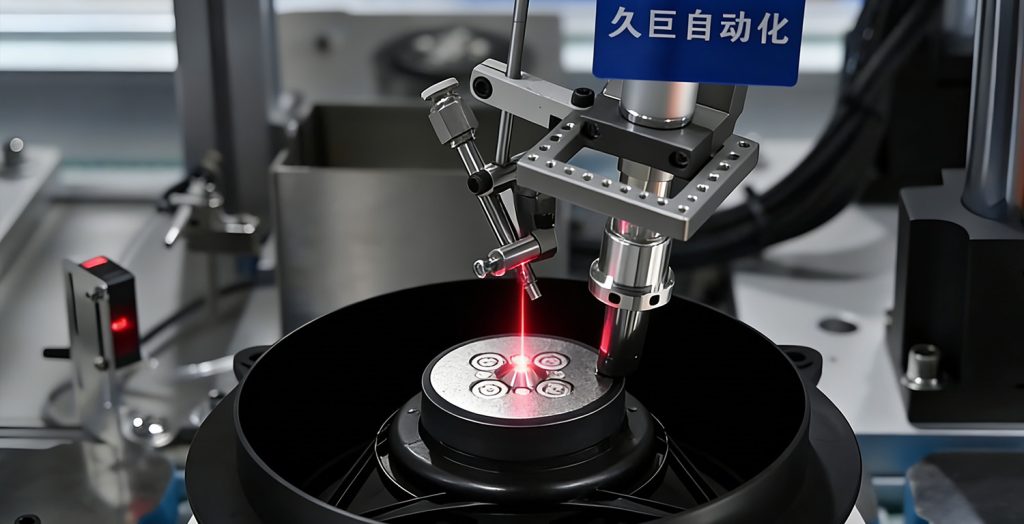
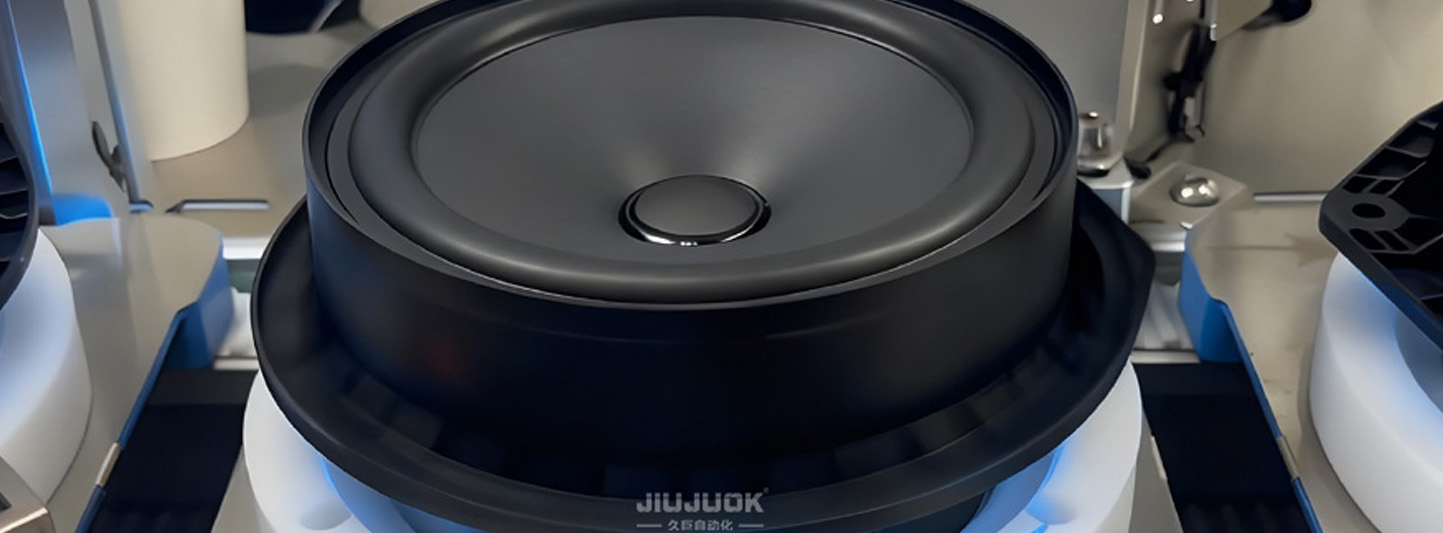
JiuJu Automation focuses on the intelligent upgrading of the whole process of speakers, integrating the four core technologies of visual inspection, precision assembly, AI quality inspection and data traceability to provide customized solutions for TWS headphones, car audio, multimedia smart audio speakers, etc., and achieve production capacity increase of 300%+, yield rate of 99.8%, and reduce the comprehensive cost of 60%, completely solving the pain points of the industry, such as manual dependence, stable quality control and delivery cycle. dependence, unstable quality control, long delivery cycle and other industry pain points. Based on the product characteristics and production scenarios of speakers, it creates a full-process automation system from the entry of raw materials to the release of finished products from the warehouse, covering the three major categories of micro, small and medium-sized, and adapting to the needs of multi-specification and multi-batch production.
Q: How to improve production efficiency through speaker automation equipment? What key technologies and methods are there?
A: Improving production efficiency through speaker automation equipment requires the comprehensive use of multiple technologies and methods. Here are the key points:
Equipment Optimization: 1. Choose High-performance Equipment: Choose equipment with high positioning precision, high repeatability, and a high production takt. 2. Optimize Equipment Configuration: Reasonably configure the quantity and specifications of equipment according to production needs. 3. Equipment Maintenance: Regularly maintain equipment to ensure it is in optimal condition. 4. Equipment Upgrade & Renovation: Timely carry out technical upgrades and renovation of equipment to improve equipment performance.
Process Improvement: 1. Optimize Production Process: Simplify the production process and reduce unnecessary operational steps. 2. Standardized Operations: Develop standardized work processes to improve operational efficiency. 3. Parallel Operation: Use parallel operation to improve equipment utilization. 4. Quick Changeover: Use quick changeover technology to reduce changeover time.
Management Improvement: 1. Digital Management: Use the MES system to achieve digital management of the production process. 2. Data Analysis: Optimize production parameters and improve production efficiency through data analysis. 3. Personnel Training: Strengthen operator training to improve operational skills and efficiency. 4. Quality Control: Strengthen quality control, reduce rework and waste.
By comprehensively applying these technologies and methods, the production efficiency of speaker automation equipment can be significantly improved, production costs reduced, and enterprise competitiveness enhanced.
Core view:
Key point: Improving the production efficiency of speaker automation equipment requires starting from three aspects — equipment optimization, process improvement and management enhancement — and comprehensively applying multiple technologies and methods to achieve an overall improvement in production efficiency.
JiuJi Automation Advantage:
Frequently Asked Questions FAQ
Click a question to expand the answer
01What kinds of measure raise production efficiency?
Four: raising cycle rate (motion optimisation, parallel stations), raising uptime (less changeover and breakdown downtime), raising yield (less rework and scrap), and reducing work-in-process and handling.The first three add directly to effective output; the fourth removes hidden labour hours, and its effect is easily underestimated.
02How much can parallel stations add?
It cannot be generalised; it depends on whether the process can be split.Where a process can be broken into independent actions, cycle time approaches 1/N of the original; where steps depend on each other, the gain is limited. Claims of a multiple-fold efficiency improvement usually refer to a single section, not the whole line — clarify this when selecting equipment.
03Where does cycle-time optimisation start?
Start with motion analysis: measure pick-and-place, locating, processing and inspection time separately at each station.Typically you find waiting longer than processing, a high share of idle travel, and locating performed twice. These three offer the largest gains, and most do not require new equipment.
04Does reducing handling improve efficiency?
Yes, and it is often overlooked.On a manual line, handling and re-locating do not appear as processing time but do consume labour hours, and they cause knocks and scratches. Folding these motions into the machine or linking stations with conveyors improves overall cycle time, not just one operation.
05How much does fast changeover affect efficiency?
It depends on changeover frequency.With a single variant in high volume it barely matters; in high-mix low-volume work it can be the main source of loss. Calculate changeover loss as a share of available hours: above 20%, consider dedicated tooling for secondary models or moving some models to another line.
06What are the keys to raising uptime?
Three: changeover design (quick-change capability, one-touch recipe switching), spares and maintenance (replace consumables on schedule rather than after failure), and incoming stability (no material shortages, no stops caused by incoming defects).All three sit on the management side; buying equipment alone will not raise them.
07Does yield improvement count as efficiency improvement?
It does, and it is often the largest hidden gain.Raising yield from 95% to 99% means 4 more points of good output from the same input, plus the labour hours saved on rework and scrap. Rework usually occupies the same equipment and people as new production without adding output.
08Which actions can automation replace?
Three: repetitive locating and pick-and-place, actions requiring precise force or displacement control (pressing, riveting), and inspection that must be recorded.What it cannot replace is judgement work — fault recognition, sorting incoming parts, machine repair. Counting these as labour savings distorts the calculation.
09How is the manning ratio decided?
From station requirements plus inspection cover, not from a rule-of-thumb figure of machines per operator.On an automated line, people mainly replenish material, patrol, sample-inspect and clear alarms; how often these tasks arise depends on tray capacity, alarm rate and incoming stability. Two identical machines may need different manning simply because of tray size.
10Does raising efficiency sacrifice quality?
It does if efficiency comes from compressing cycle time, cutting inspection or relaxing tooling precision.It does not if it comes from eliminating waiting, reducing handling and merging idle travel. The difference is that the first changes the process window while the second only changes time utilisation. Keep the two apart when reviewing a proposal.
11How is the real effect of an efficiency measure assessed?
By effective output and output per person, not by single-station speed.Effective output = cycle rate × uptime × yield; output per person = effective output ÷ actual headcount on shift (including patrol and maintenance). Figures that report only a station-level speed gain without uptime and headcount changes rarely hold up.
12Where is the ceiling on efficiency gains?
At the physical limit of the bottleneck process.Machine cycle time is bounded by motion time, curing time and magnetizing charge time; beyond a point there is no further room, and only additional parallel stations or a different process will help. To judge whether the ceiling has been reached, check whether effective processing time at the bottleneck station already exceeds 80%.
Jiuju Automation is an SRDI “Little Giant” Enterprise and has specialised in speaker automated assembly for 16 years, serving more than 2,500 customers. The company holds 256 technical patents and operates a 10,000 m² production base, offering one-stop solutions from standalone equipment to complete automated lines. Jiuju speaker automated assembly lines use high-precision vision positioning (±0.01 mm), AI-based inspection and fast changeover (<25 minutes), raising production efficiency by 300%+ and achieving a product yield of 99.8% with a 60% reduction in overall cost.
 Speaker automation jiujuauto











 简体中文
 English
 Tiếng Việt
 日本語
 한국어
 ไทย
 हिन्दी
 বাংলা
 Français
 Español de Perú
 Русский