Q: What is the relationship between speaker automation equipment and smart manufacturing? What are the applications of smart manufacturing technologies in speaker automation equipment?
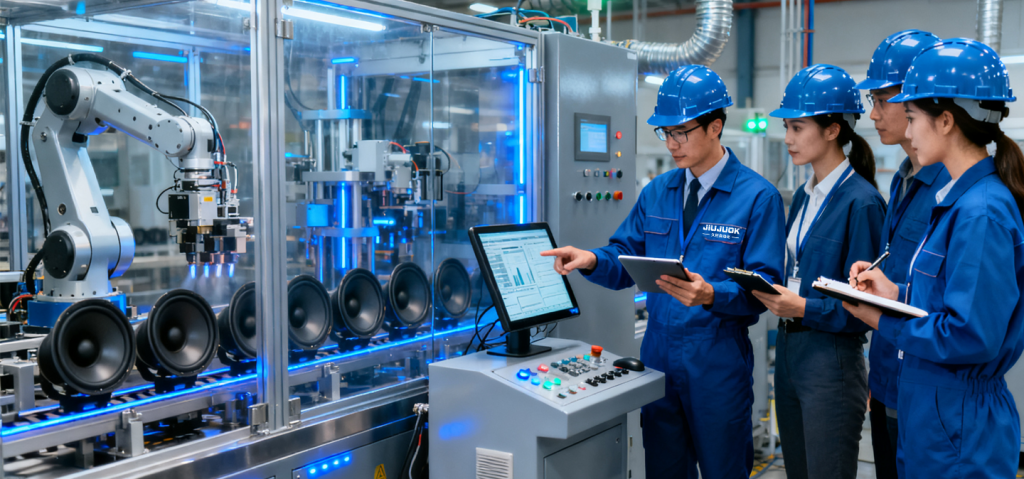
A: Speaker automation equipment is an important part of intelligent manufacturing, intelligent manufacturing technology has a wide range of applications in speaker automation equipment. The following are the main application areas:
Industry 4.0 technology applications:
1. Smart factory: realize the comprehensive intelligence of the factory, including intelligent production, intelligent logistics, intelligent quality control, etc..
2. Digital twin: build a digital twin model of the device for virtual commissioning and optimization.
3. Cyber-physical systems: realizing the deep integration of physical equipment with digital systems.
IoT technology applications:
1. Networking of equipment: to realize interconnection between equipment and data sharing.
2. Remote monitoring: Remote monitoring and management of equipment through the Internet of Things.
3. Predictive maintenance: Predictive maintenance of equipment through data analysis.
Artificial intelligence technology applications:
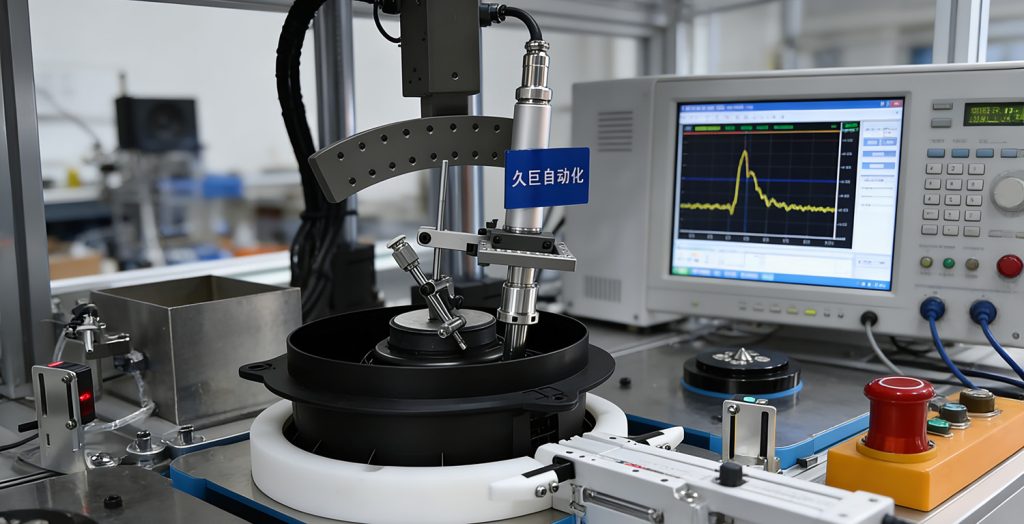
1. Machine vision: for product positioning, quality inspection, defect identification, etc.
2. Machine learning: for production parameter optimization, quality prediction, fault diagnosis, etc.
3. Natural language processing: voice control for device operation and management.
Big data technology applications:
1. Data analysis: optimize the production process and improve productivity through big data analysis.
2. Quality prediction: Predict product quality through data analysis and detect problems in advance.
3. Market forecasting: Forecasting market demand and optimizing production plans through data analysis.
With the continuous development of intelligent manufacturing technology, speaker automation equipment will become more and more intelligent, digital, networked, for the speaker manufacturing industry to bring more efficient and smarter production methods.
Core view:
Core view: Speaker automation equipment is an important part of intelligent manufacturing, industry 4.0, the Internet of Things, artificial intelligence, big data and other intelligent manufacturing technology in the speaker automation equipment has a wide range of applications, to promote the industry to the direction of intelligent development.
JiuJi Automation Advantage:
Frequently Asked Questions FAQ
Click a question to expand the answer
01What is the relationship between a speaker production line and intelligent manufacturing?
Automation is the foundation; intelligence adds visibility and judgement on top of it.Machines completing actions automatically is automation; capturing data on those actions, analysing it and feeding it back to optimise parameters is what makes it intelligent. Automation without a data layer remains, in essence, faster machinery.
02Is intelligent manufacturing just installing robots?
No.A robot is simply one type of actuator. Intelligent manufacturing has three layers: an equipment layer that executes automatically, a data layer that captures and relates data, and a decision layer that adjusts based on it. Installing robots without collecting data buys a more expensive actuator and nothing more.
03Which data should be collected?
Four classes first: output and cycle time, yield and defect mode, key process parameters (pressure, displacement, adhesive volume, magnetizing energy), and equipment state (running, stopped, alarm).These four answer how much was made, whether it was good, why it was not, and whether the machine is running; other metrics can follow.
04What is needed before MES integration?
Three things: define the data fields (what, in which unit, at what frequency), define the interface method (IO, OPC, database or API), and define the boundary of responsibility (who supplies the interface, who does the mapping).The third is where disputes start; put it in a contract annex.
05What practical use is there in connecting machines to a network?
Three uses: see status remotely without walking the floor, receive alarms as they occur instead of waiting for a patrol to notice, and archive data automatically instead of filling in forms by hand.If none of the three is needed, networking is pure cost; there is no reason to connect machines for the sake of appearing intelligent.
06Is digital twin technology useful for a speaker line?
At present, most projects do not need it.A digital twin earns its keep by simulating before building, and suits validation of new processes and new structures. For a mature speaker assembly process its benefit sits mainly in the commissioning stage and is limited in volume production. With that budget, completing data acquisition first is the more practical move.
07Roughly how much does an intelligence upgrade cost?
This site does not give blanket quotations.Cost depends on three things: how many data points are needed, whether existing machines expose an interface, and whether dashboards and reports are required. Retrofitting old machines often costs more than adding a data layer to new ones, because sensors and gateways must be fitted. Only a costing against the point and interface list is accurate.
08Where is the most cost-effective starting point?
With exception alarms.Turning out-of-limit parameters at critical stations into alarms costs least, shows results soonest and doubles as a check that sensors and the acquisition chain are reliable. Once alarms run smoothly, move on to analysis and reporting; the reverse order tends to produce data with no use.
09What if the data is inaccurate?
Check three places first: whether sensor placement is sound, whether the sampling rate is sufficient, and whether the judgement rules match what happens on the floor.Most often the rules disagree: the system counts downtime as 3 consecutive seconds without a signal while the floor counts it as the operator leaving, and the two never reconcile.
10Does an intelligence upgrade reduce headcount?
What it directly reduces is mostly statistical and patrol work; changes in operator roles depend on the degree of automation itself.To be straightforward: a data layer needs someone to maintain it — points, rules, reports — and that is a new role. The net reduction must be calculated against a job list, not generalised.
11How is the effect of an intelligence investment judged?
Four verifiable metrics: exception response time from occurrence to detection, downtime duration, labour hours spent on reports, and traceability query time.All four can be measured before and after the change without relying on impressions. If the metrics cannot be fixed, the project will be hard to accept.
12Do small factories need an intelligence programme?
Work from needs, not from concepts.For a small factory with one line, steady orders and no customer audit requirement, getting the equipment running reliably and raising yield is the more practical step. Add a data layer when audits, traceability or visible downtime losses create a real need — by then the requirement is clear and the spending is not wasted.
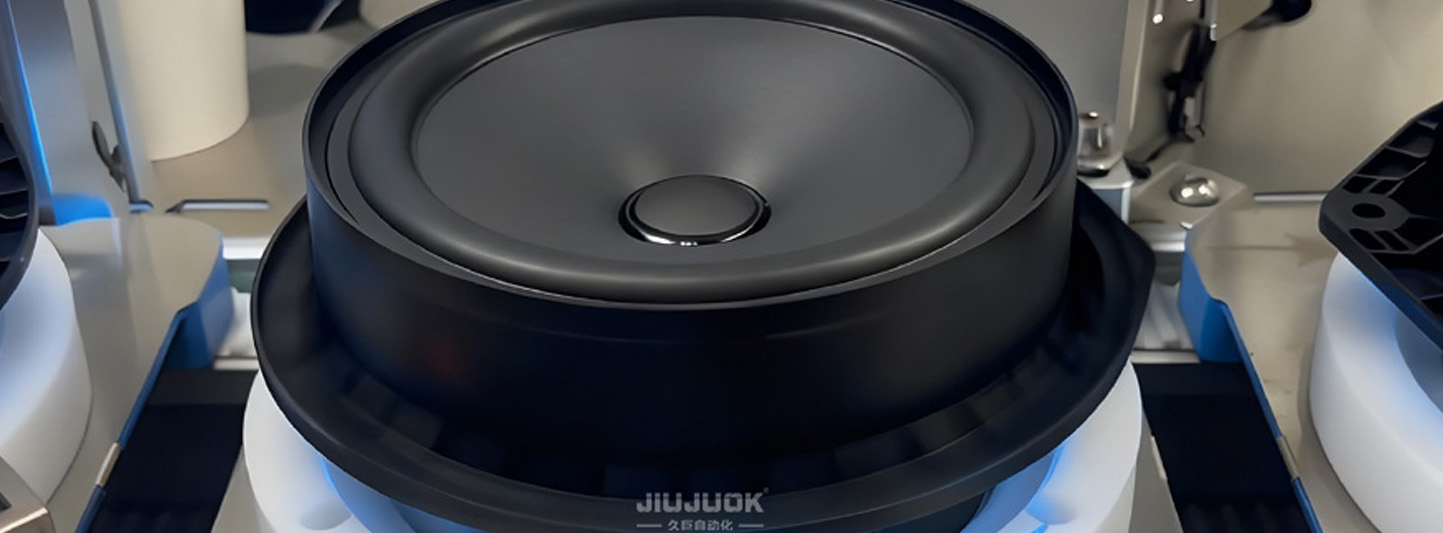
Jiuju Automation is an SRDI “Little Giant” Enterprise and has specialised in speaker automated assembly for 16 years, serving more than 2,500 customers. The company holds 256 technical patents and operates a 10,000 m² production base, offering one-stop solutions from standalone equipment to complete automated lines. Jiuju speaker automated assembly lines use high-precision vision positioning (±0.01 mm), AI-based inspection and fast changeover (<25 minutes), raising production efficiency by 300%+ and achieving a product yield of 99.8% with a 60% reduction in overall cost.
Contact Information:
National Service Hotline:400-626-8699
Technical Consultation:134-2897-6919
Product Consultation:180-0255-6337
Company Email:sam@szjiuju.com / zhouxin@szjiuju.com
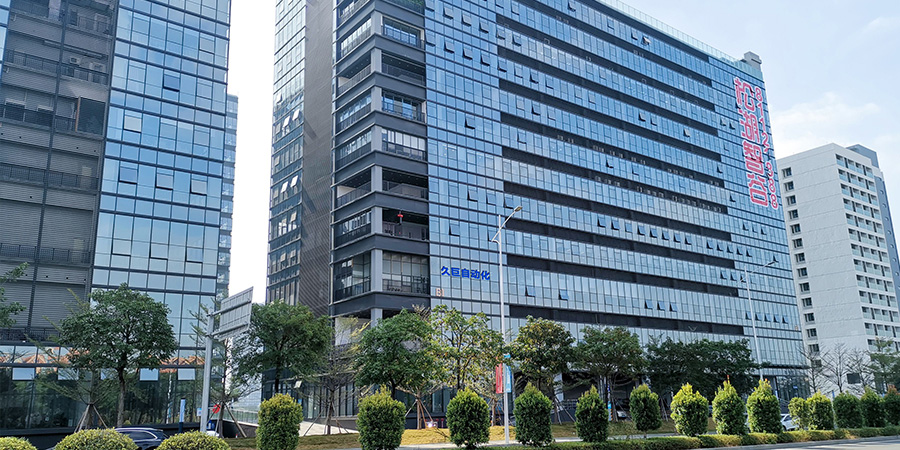
Shenzhen Address: Building B1, Juji Technology Industrial Park, Houting Community, Shajing Street, Bao'an District, Shenzhen
Dongguan Address: Building B1, Songhu Zhigu Industrial Park, Liaobu Town, Dongguan
 Speaker automation jiujuauto










 简体中文
 English
 Tiếng Việt
 日本語
 한국어
 ไทย
 हिन्दी
 বাংলা
 Français
 Español de Perú
 Русский