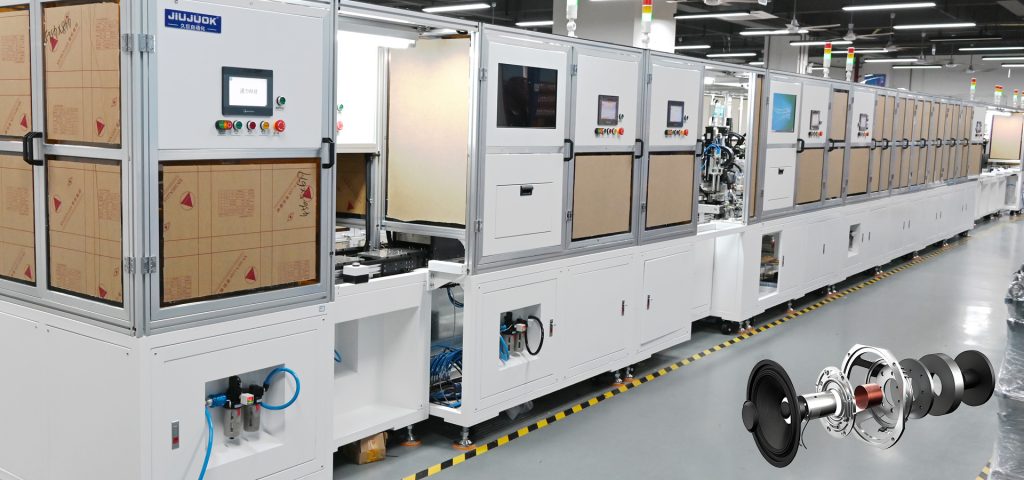
JiuJu Automation focuses on the intelligent upgrading of the whole process of speakers, integrating the four core technologies of visual inspection, precision assembly, AI quality inspection and data traceability to provide customized solutions for TWS headphones, car audio, multimedia smart audio speakers, etc., and achieve production capacity increase of 300%+, yield rate of 99.8%, and reduce the comprehensive cost of 60%, completely solving the pain points of the industry, such as manual dependence, stable quality control and delivery cycle. dependence, unstable quality control, long delivery cycle and other industry pain points. Based on the product characteristics and production scenarios of speakers, it creates a full-process automation system from the entry of raw materials to the release of finished products from the warehouse, covering the three major categories of micro, small and medium-sized, and adapting to the needs of multi-specification and multi-batch production.
Q: What kind of talent is needed in the speaker automation equipment industry? What are the skill requirements and training systems?
A: The growing demand for talent in the speaker automation equipment industry includes the following categories of talent and skill requirements:
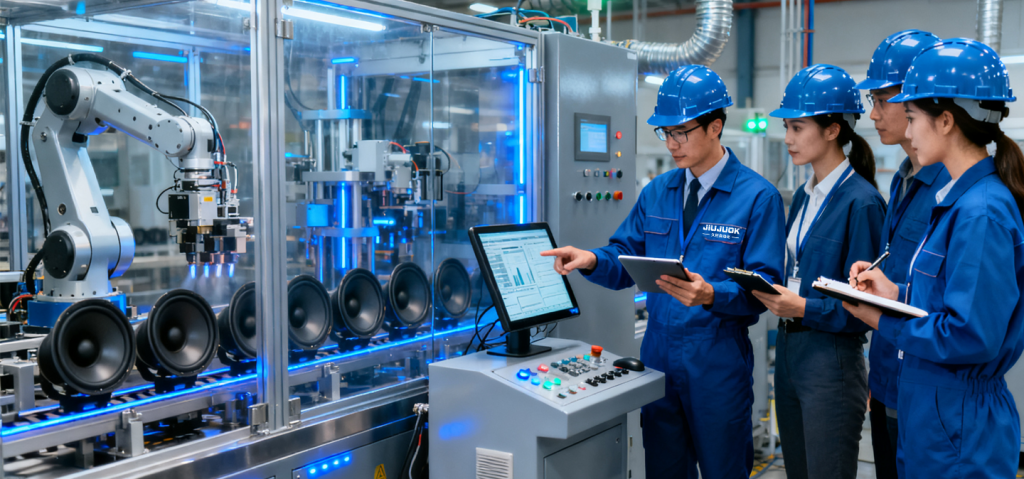
Technical R&D talent: 1. Mechanical design engineer: responsible for the mechanical structure design and optimization of equipment. 2. Electrical engineer: responsible for the design and commissioning of the electrical system of the equipment. 3. Software engineer: responsible for the development of control system software for the equipment. 4. Automation engineer: responsible for the integration and optimization of automation systems.
Skill Requirements: 1. Specialized knowledge: specialized knowledge of mechanical design, electrical control and automation technology. 2. Software skills: Proficiency in CAD, PLC programming, robot programming, etc. 3. English language skills: good reading and communication skills in English. 4. Innovative: Strong sense of creativity and problem solving skills.
Operate and maintain talent: 1. Equipment Operator: Responsible for the daily operation and monitoring of equipment. 2. Equipment maintainer: responsible for routine maintenance and troubleshooting of equipment. 3. Quality inspector: responsible for inspection and control of product quality.
Skill Requirements: 1. Operational skills: proficiency in equipment operation methods and processes. 2. Maintenance skills: Acquisition of maintenance and troubleshooting skills for equipment. 3. Quality Awareness: Strong sense of quality and responsibility. 4. Learning ability: Strong learning and adaptability.
Training system: 1. In-house training: skills training and technology exchange organized within enterprises. 2. Training in vocational institutions: relevant specializations and training courses offered by vocational institutions. 3. Online learning platform: self-directed learning using an online learning platform. 4. Industry exchanges: participation in industry conferences and technical exchange activities.
With the development of the industry, the requirements for talents are also increasing, and enterprises need to establish a perfect system for training and introducing talents in order to meet the needs of the industry's development.
Core view:
Core view: Speaker automation equipment industry needs both technical research and development and operation and maintenance talents, which require professional knowledge, software skills, English ability and innovation ability. Establishing a perfect training system and strengthening the cultivation and introduction of talents is the key to the development of the industry.
JiuJi Automation Advantage:
Frequently Asked Questions FAQ
Click a question to expand the answer
01Once an automated line is in place, what kind of people are needed?
Three kinds: people who can operate and change over the line (understand the flow, can read alarms), people who can maintain it (checks, wear parts, air and adhesive circuits), and people who can use the data (dashboards, traceability, reports).The third is the scarcest and the most easily overlooked — the equipment produces data and nobody uses it to make decisions.
02Can existing staff be redeployed?
Most can, and they should be the first choice.Long-serving staff know the product and the process; what they lack is machine operation and alarm handling. Redeployment costs less and gets up to speed faster than hiring. The condition is that training keeps pace — leaving veterans to work it out on their own is not enough.
03How many levels should training have?
In three tiers: operators (loading, changeover, alarm handling), maintenance (daily checks, consumable replacement, air and adhesive circuit care) and supervisors (dashboards and traceability queries).Three, with different content; taught together, nobody learns anything.
04What does operator training actually cover?
Four things: start-up and shut-down sequence; the full changeover routine (remove and fit tooling, recall the recipe, verify the first part); the meaning of alarm codes and what to do about them; and how to judge common exceptions (no material, jams, locating failure).Practice must happen at real cycle time, not by watching a demonstration.
05What does maintenance training cover?
Four: a daily check sheet (air pressure, oil and water, abnormal noise, temperature rise); the wear-parts list with replacement intervals; cleaning and care of air and adhesive circuits; and the method and frequency of accuracy calibration.The wear-parts list must state model and supplier, or a stoppage becomes a long wait for parts.
06How long does training usually take?
It depends on the level: operators usually pick it up in a few days but need a month of follow-up after start of production to be steady; maintenance needs longer, because skill comes from meeting enough exceptions; management needs least, but must be tied to the company's own reporting basis.The exact arrangement is settled against the number of sections and the shift pattern.
07What should be looked for when hiring?
Three things: experience operating equipment (even in another industry), the ability to read alarms and parameters, and willingness to carry out checks.The third is most often overlooked, yet it decides whether the equipment stays stable — skip the checks and small problems become major breakdowns.
08Should the equipment supplier provide training?
Yes, and it should be written into the contract.At minimum: operator and maintenance training before start-up, line support after start-up, and the wear-parts and spare-parts lists. Without these written down, delivery is often followed by telephone support only, and problems have to be worked out alone.
09How can knowledge be kept when people leave?
Turn experience into documents and parameters rather than leaving it with individuals.In practice: write the changeover steps as work instructions, store process parameters in recipes rather than in a notebook, and set out common exception handling as a reference table. A successor can then follow the same steps.
10How is one operator running several machines put into practice?
Three preconditions: large enough magazine capacity (fewer refills), remote alarm notification (no need to watch constantly), and changeover actions standardised enough to need no repeated adjustment.Miss any one and one operator running several machines becomes one operator running between them — more tiring and less efficient.
11How can a skills gap be closed?
Two routes: internal development (pick 1 or 2 people to train closely, responsible for equipment and data, forming a minimal technical core) and external support (a maintenance agreement with the supplier, outsourcing the difficult cases).External only and response is slow; internal only and new problems stall.
12How can training be verified?
By measurable tests: the trainee completes a changeover unaided and verifies the first part, clears a common alarm unaided, and completes a daily check unaided.All three passed and training is complete. A signed attendance sheet alone means no training happened.
Jiuju Automation is an SRDI “Little Giant” Enterprise and has specialised in speaker automated assembly for 16 years, serving more than 2,500 customers. The company holds 256 technical patents and operates a 10,000 m² production base, offering one-stop solutions from standalone equipment to complete automated lines. Jiuju speaker automated assembly lines use high-precision vision positioning (±0.01 mm), AI-based inspection and fast changeover (<25 minutes), raising production efficiency by 300%+ and achieving a product yield of 99.8% with a 60% reduction in overall cost.
 Speaker automation jiujuauto











 简体中文
 English
 Tiếng Việt
 日本語
 한국어
 ไทย
 हिन्दी
 বাংলা
 Français
 Español de Perú
 Русский