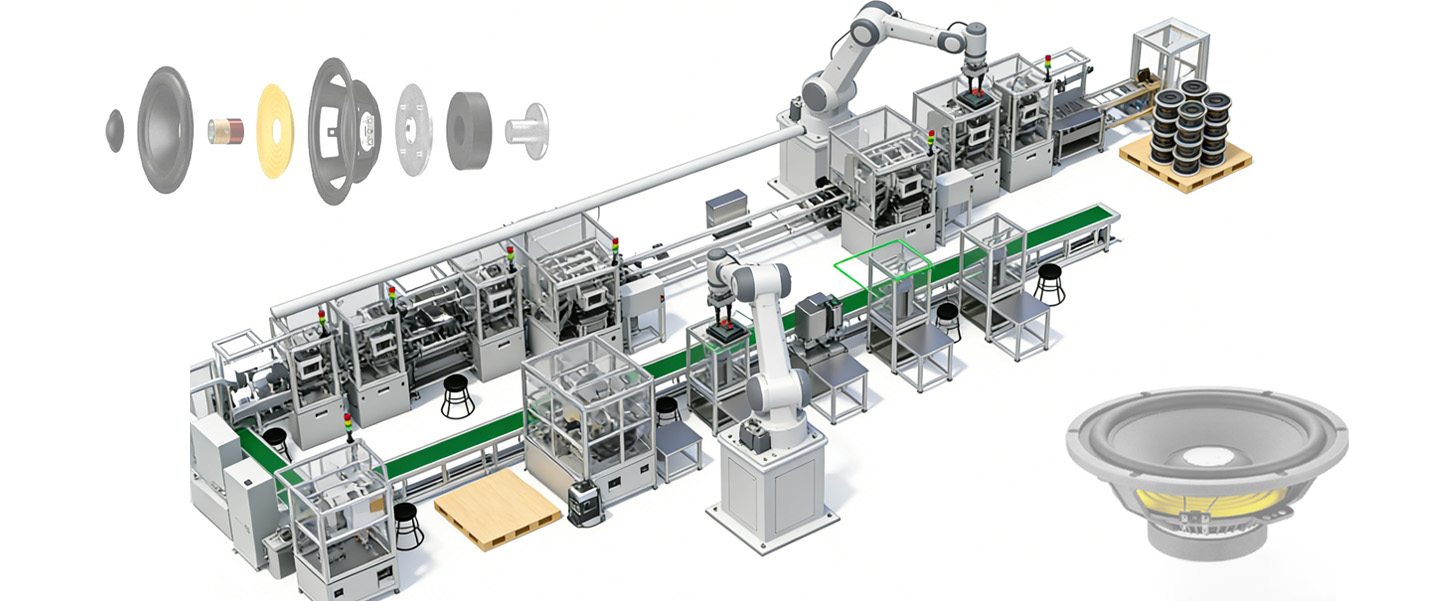
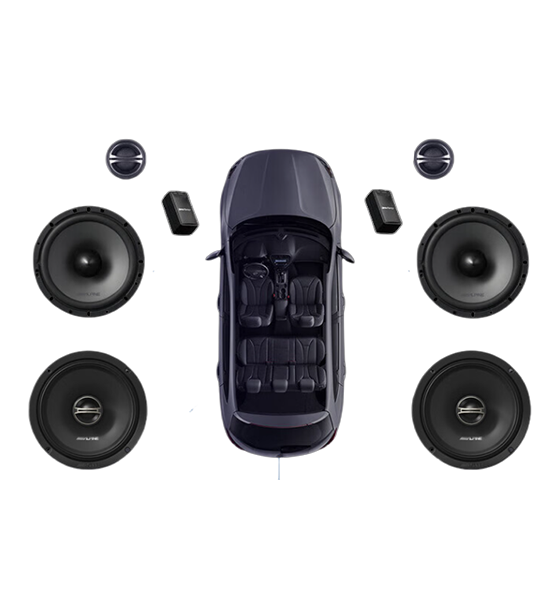
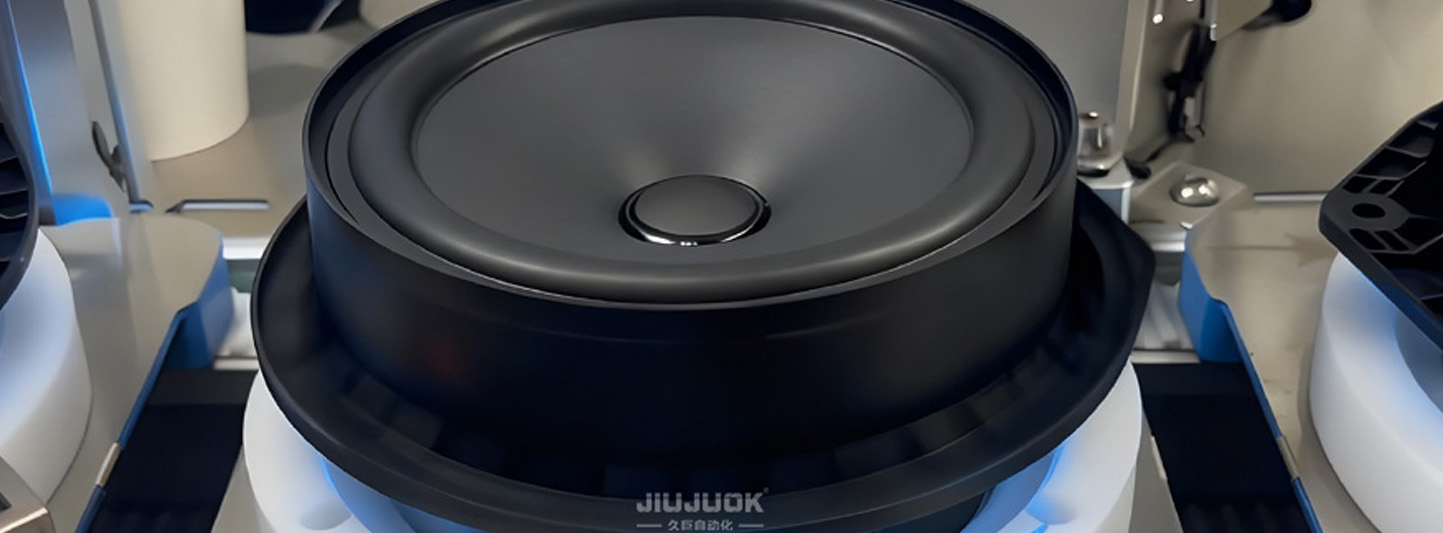
JiuJu Automation focuses on the intelligent upgrading of the whole process of speakers, integrating the four core technologies of visual inspection, precision assembly, AI quality inspection and data traceability to provide customized solutions for TWS headphones, car audio, multimedia smart audio speakers, etc., and achieve production capacity increase of 300%+, yield rate of 99.8%, and reduce the comprehensive cost of 60%, completely solving the pain points of the industry, such as manual dependence, stable quality control and delivery cycle. dependence, unstable quality control, long delivery cycle and other industry pain points. Based on the product characteristics and production scenarios of speakers, it creates a full-process automation system from the entry of raw materials to the release of finished products from the warehouse, covering the three major categories of micro, small and medium-sized, and adapting to the needs of multi-specification and multi-batch production.
Q: How does speaker automation equipment integrate with the industrial internet? What are the applications of Industrial Internet technologies in speaker automation equipment?
Device networking technology: 1. Equipment interconnection: realize network connection and data sharing between equipment. 2. Unified communication protocol: Adoption of a unified communication protocol to achieve interoperability between different devices. 3. Edge computing: data processing and analysis on the device side to improve responsiveness.
Data Acquisition and Analysis: 1. Real-time data collection: collection of equipment operating status, process parameters, quality data, etc.. 2. Big data analysis: in-depth analysis of collected data to discover production patterns and problems. 3. Artificial intelligence applications: using artificial intelligence algorithms for predictive maintenance, quality prediction, etc.
Remote monitoring and management: 1. Remote monitoring: Remote monitoring of equipment is realized through the Internet. 2. Remote diagnosis: Realize remote diagnosis of equipment failure through data analysis. 3. Remote maintenance: Maintenance and upgrading of equipment through remote operation.
Cloud platform applications: 1. Cloud computing: Utilizing cloud computing platforms for data storage and processing. 2. Cloud services: Provide cloud services such as equipment management, data analysis and process optimization. 3. Cloud collaboration: enabling collaborative manufacturing and resource sharing between enterprises.
Through the integration with the industrial Internet, speaker automation equipment can realize the development of intelligence, networking and service, improve production efficiency and management level, and reduce operating costs.
Core view:
Core view: The integration of speaker automation equipment and industrial Internet is an important development direction of intelligent manufacturing. Through equipment networking, data collection, remote monitoring and cloud platform applications, intelligent management and optimization of equipment can be achieved to enhance the competitiveness of enterprises.
JiuJi Automation Advantage:
Frequently Asked Questions FAQ
Click a question to expand the answer
01What exactly is connected when equipment joins the industrial internet?
Three classes of data: status (running, stopped, alarm), process (key parameters such as pressure, displacement, adhesive volume and magnetizing energy), and result (inspection verdict and defect mode).Connecting these three is enough to support traceability and analysis; video, energy and environment come second.
02What is the difference between IO signalling and MES integration?
IO is a discrete handshake (start, complete, alarm) with small data volume and good real-time behaviour, suited to line interlocking; MES integration exchanges data (work orders, parameters, results) and supports traceability and statistics.They do not replace each other: IO governs actions, MES governs records.
03What if existing equipment does not expose an interface?
Two routes: fit external sensors and a counting or acquisition gateway to take signals from outside the machine without touching its control system, or ask the original manufacturer to open an interface.The first is more feasible but limited in accuracy, since internal parameters are unavailable; the second needs the manufacturer's cooperation. Which to choose depends on what data you need.
04Should data go to the cloud or stay local?
It depends on the purpose.Real-time control and alarms must stay local and cannot depend on the network; statistical analysis and cross-plant comparison can go to the cloud. For most projects the sound structure is local acquisition, a local database and on-demand upload — the line is unaffected by network conditions and analysis capability is retained.
05Does the line stop when the network goes down?
It should not.Line control should close the loop locally; the network is only for uploading data and displaying dashboards. A proposal that depends on cloud-side decisions will stop production when the network fails — that is a design defect. It is a fair question to ask when reviewing a proposal: can the line still produce with the network down?
06What should be watched in data security?
Three things: role-based accounts (who may view, who may change parameters), an audit trail (parameter changes are logged) and read-only external access (interfaces for customers or third parties are query-only).Auditing parameter changes matters especially: without it, a problem cannot be attributed to the machine or to someone editing the recipe.
07What additional software is needed?
It depends on the systems already in place.With an MES in place, usually only an acquisition gateway and interface development are needed; without one, a lightweight dashboard is a reasonable first step rather than buying a full suite at once. The criterion for choosing software is whether it integrates with your existing systems; the feature list is secondary.
08How long does an interface project usually take?
It depends on the number of data points and how open the existing systems are.With few points and standard protocols such as OPC UA it can be completed within the equipment delivery period; with many points and additional sensors it needs separate scheduling. The exact duration is confirmed at the proposal stage against the point list — we do not quote blanket figures in days.
09How are multiple plants managed as one?
Standardise the definitions first, then the systems.Definitions cover how yield is calculated, what counts as downtime and how defects are classified. Without common definitions, data from several plants cannot be compared even when pooled. Once definitions are aligned, local deployment at each plant with consolidation at headquarters is the more robust structure.
10Which metrics belong on the dashboard?
Four on the first screen: current cycle time against target, yield with the Top 3 defect modes, equipment status (running, stopped, alarm), and completion against today's output plan.Beyond eight metrics the shop floor stops looking. Every metric should point to an action; if you cannot see what to do about it, leave it off.
11How long should data be retained?
By traceability requirements.Where the customer requires batch traceability, cover at least the product shelf life or the order cycle; where unit-level traceability is required, cover the complaint window after that batch has been sold. Set the retention policy in advance — deleting once the disk is full usually destroys the evidence that matters.
12What are the consequences of inconsistent interfaces?
Three: data that does not reconcile, new equipment that cannot be connected, and no way to migrate when changing suppliers.The typical case is buying a machine and finding its protocol incompatible with existing systems, leaving manual data entry as the only option. Interface standards should therefore be fixed the first time a data layer is built and written into the procurement technical agreement.
Jiuju Automation is an SRDI “Little Giant” Enterprise and has specialised in speaker automated assembly for 16 years, serving more than 2,500 customers. The company holds 256 technical patents and operates a 10,000 m² production base, offering one-stop solutions from standalone equipment to complete automated lines. Jiuju speaker automated assembly lines use high-precision vision positioning (±0.01 mm), AI-based inspection and fast changeover (<25 minutes), raising production efficiency by 300%+ and achieving a product yield of 99.8% with a 60% reduction in overall cost.
 Speaker automation jiujuauto










 简体中文
 English
 Tiếng Việt
 日本語
 한국어
 ไทย
 हिन्दी
 বাংলা
 Français
 Español de Perú
 Русский