JiuJu Automation focuses on the intelligent upgrading of the whole process of speakers, integrating the four core technologies of visual inspection, precision assembly, AI quality inspection and data traceability to provide customized solutions for TWS headphones, car audio, multimedia smart audio speakers, etc., and achieve production capacity increase of 300%+, yield rate of 99.8%, and reduce the comprehensive cost of 60%, completely solving the pain points of the industry, such as manual dependence, stable quality control and delivery cycle. dependence, unstable quality control, long delivery cycle and other industry pain points. Based on the product characteristics and production scenarios of speakers, it creates a full-process automation system from the entry of raw materials to the release of finished products from the warehouse, covering the three major categories of micro, small and medium-sized, and adapting to the needs of multi-specification and multi-batch production.
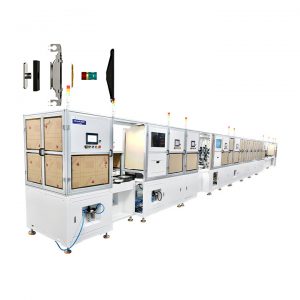
TV Speaker Square Magnetic Circuit, Flexible Segment Assembly Automation
brandingJiuju Automation
processAutomatic T-iron, magnet, pot holder loading, automatic dispensing, dust removal, press-fit, and plate discharging.
work efficiency ≧1300PCS/H
Design AdvantagesAdopting turntable type single station structure design, saving space, simple debugging operation, realizing automatic material loading and assembling, IO communication control system, full station detection and identification sensors, can be connected to MES system, rich expansion module, convenient for subsequent upgrading and overhauling.
operator5 people
Key componentsPanasonic PLC controller, Japan servo, vibration plate loading, Japan guide rail, precision CNC machining, Panasonic touch screen, Huichuan robot
Every line is engineered around the customer's product and takt time — stations, fixtures, conveying and inspection are all redesigned from scratch. The project runs through seven stages, each with defined deliverables and a clear customer sign-off point.
1
Requirement Review & Concept Design
7–15 days
Technical specification
2
Design Freeze & Contract
3–7 days
Technical agreement
3
Design, Build & In-house Debug
30–60 days
Drawings & PLC programs
4
FAT Factory Acceptance
3–5 days
FAT record
5
On-site Install & SAT
5–10 days
SAT report
6
Mass-production Validation
3–10 days
Validation report
7
Final Acceptance & Handover
2–3 days
Manuals & spare parts
Typical total lead time is 45–120 calendar days, with manufacturing and in-house debugging accounting for the largest share. Once the concept is frozen, changing a core process parameter — part size, takt time or number of stations — forces knock-on changes to the mechanics, electrical control and layout, and can extend the schedule by more than 30%. A design freeze therefore requires the customer's written confirmation.
Products
TV Speaker Automation Production Line Product Details
In the field of TV audio manufacturing, square magnetic circuit speaker as a core acoustic component, its assembly accuracy directly determines the fidelity of TV sound quality and playback stability, while the traditional manual assembly mode is often faced with square magnetic circuit positioning deviation, misalignment of multiple parts assembly, lack of consistency and other pain points, it is difficult to adapt to the mass production of high-grade TV products needs. In view of the assembly characteristics of TV square magnetic circuit speakers, we developed the TV speaker automation production line came into being, to realize the whole process of automation from T-iron input to the assembly of the transfer line, to meet the needs of high-grade TV speakers mass production with the core advantages of "high precision, high efficiency, high compatibility".
The production line takes the assembly process of TV square magnetic circuit speaker as the core, and builds an exclusive production system of "multi-part precise assembly + full-process automation". For the assembly characteristics of square magnetic circuit, it adopts partitioned intelligent loading system, T-iron is accurately gripped by servo mechanical arm with CCD visual positioning, and the positioning accuracy is ±0.02mm; the magnet carries anti-magnetic interference vibration plate to feed the material, and the magnetic circuit calibration module ensures the correct polarity; the bracket, voice coil, elastic wave and other components are synchronously transported by customized fixtures to achieve parallel loading of multi-materials and accurate alignment. The core assembly link adopts imported servo drive technology to accurately control the assembly pressure and displacement for precision processes such as drum paper fitting, with pressure control accuracy up to 0.1N, which completely solves the problems of square magnetic circuit offset and uneven drum paper fitting in manual assembly, and realizes the seamless connection of the whole process from the T-iron, magnet, bracket, voice coil, elastic wave, drum paper, and transfer line.
High adaptability and efficient debugging design to meet the needs of TV speakers with multiple specifications. The production line is equipped with modularized workstation structure, for different sizes of TV speakers from 32 inches to 85 inches, customized fixtures and assembly modules can be changed quickly, and with the parameterized control system, key parameters such as loading speed and assembly stroke can be adjusted through the touch screen, and the changeover debugging time can be shortened from the traditional manual line of 2 hours to less than 30 minutes. In view of the unique structure of the square magnetic circuit of TV speakers, the production line has developed an exclusive magnetic circuit positioning calibration algorithm, which, together with the multi-dimensional visual inspection unit, ensures that the coaxiality error of the square magnetic circuit with the voice coil and the bracket can be controlled within 0.03mm, which is perfectly adapted to the assembly needs of different models of TV speakers with square magnetic circuits.
Production efficiency and product quality to achieve a double breakthrough. Efficiency improvement, the traditional manual assembly can only complete 150-200 sets per hour per person, the production line through the parallel operation of multiple stations and process optimization, the production capacity can reach more than 1,200 sets per hour, the efficiency of 6-8 times, a single production line can reduce the 80% labor input, significantly reducing labor costs and management costs. In terms of quality assurance, the key stations integrate AI visual inspection and force control sensing system, real-time detection of magnetic circuit assembly precision, drum paper fitting flatness, turn line welding quality and other key indicators, non-conforming products are automatically sorted out and defect types are recorded, the product qualification rate has increased from 92% in manual assembly to more than 99.6%. For the sound quality requirements of high-end TV products, the production line also integrates the magnetic flux detection module to ensure the consistency of the magnetic field strength of each speaker and guarantee the stability of TV audio playback.
Starting from the demand of mass production, the production line is equipped with an intelligent production management system, which collects real-time data such as production capacity, qualification rate, equipment operation status, etc., supports the automatic generation and export of production reports, and helps the enterprise to realize the transparent control of the production process. The whole machine adopts a fully enclosed dustproof design, and with the automatic lubrication system, the failure rate is less than 0.5% for 8 hours of continuous operation, which is stably adapted to the long-term mass production scenario of high-grade TV speakers. Whether it is the large-scale production of smart TV manufacturers, or the order delivery needs of audio supporting enterprises, the production line can provide customized solutions, with exclusive process design and stability, become the core equipment for TV speaker manufacturers to improve quality and efficiency.
Footage of the automotive woofer automatic assembly line: magnetic circuit assembly, voice coil positioning and diaphragm bonding are automated across all key stations, locking assembly errors within the tolerance band.Contact Jiuju Automation for…
Live footage of the automatic assembly of the soft-parts section of square multimedia internal-magnet loudspeakers, showing precision assembly of flexible acoustic components such as voice coils, spiders and cones, ensuring coaxial positioning and…
Automotive external-magnet loudspeaker automatic assembly line: it integrates feeding, assembly and inspection in one process, fully automatic from component transport to finished-product offloading, eliminating human error.Contact Jiuju Automatio…
Fully automatic tunnel baking line for automotive loudspeakers: independent temperature control in multiple zones and PID closed-loop regulation ensure every loudspeaker cures under the same thermal history.Contact Jiuju Automation for more quotes…
loading...
It's already to the last piece of content!
Frequently Asked QuestionsClick a question to expand
01How many operators does a TV speaker assembly line need?▼
The FB-510 runs with 7 operators per shift (per the model specification table; actual headcount depends on your process). They are mainly in five sections: magnetic circuit assembly, voice coil and spider and cone assembly, dispensing and pressing, panel unloading, and inspection. Availability is taken as ≥85%. If you buy only a section, headcount is reduced according to the actual number of stations; for two-shift operation it doubles. Confirm this before quoting, otherwise the output may be calculated correctly but the people cannot be scheduled.
02What is the output?▼
The FB-510 is rated at ≥1300 PCS/H. At 8 hours per shift and 85% availability, effective daily output is about 8,800 pieces. Effective output = cycle rate × availability × yield; the rated figure only holds under ideal conditions. The ceiling is set by the bottleneck station. In square magnetic circuits the bottleneck is usually dispensing and pressing, not magnetic circuit loading, so look at those two stations first when raising output. Actual values are confirmed by acceptance testing.
03What is the difference between square and round magnetic circuits?▼
TV speakers mostly use square or rectangular magnetic circuits, where the T-yoke, bracket and magnet are all square parts, so the locating datum is entirely different from round parts: a round part is centred on its outer diameter, while a square part must be located on two edges or diagonally. The FB-510 is a dedicated square magnetic circuit structure with automatic dispensing, pressing and panel unloading. Adapting a round-circuit machine to square parts means rebuilding tooling and locating, and output drops. Confirm whether your product is square or round before selecting; do not force a general-purpose model to fit.
04Can it handle special-shaped speakers?▼
Use the FB-520, a dual-station design for special-shaped speaker structures, rated at ≥1700 PCS/H with 7 operators and a footprint of 14000 × 1800 × 1800 mm. Its strengths are simple setup, high versatility and a small footprint. The key to special shapes is the tooling and locating scheme, which requires a 3D drawing or a physical sample for process evaluation. The standard FB-510 handles only regular square magnetic circuits; forcing it to do special shapes is not advisable, because making it run and making it run stably are two different things.
05What about floor space, power and air?▼
The FB-510 measures 14000 × 2000 × 1500 mm, that is 14 m long, 2 m wide and 1.5 m high, with 1 to 2 m around it for operation and maintenance. Power is 380V three-phase; air supply is 0.5 to 0.8 MPa, with a voltage stabiliser and dry air source on site. 14 m is the length of the equipment, not the usable length of your building. TV speakers are bulky and so are their totes, so the loading and buffer area must be calculated separately; this part is often overlooked.
06How far can automatic dispensing and panel unloading go?▼
Dispensing is controlled by volume, with motion control and vision locating; the amount and path are set by recipe. Panel unloading is automatic, reducing deformation and scratching from manual handling. The machine is compatible with hot-melt, UV and epoxy adhesives. The boundary must be stated: dispensing quality depends on adhesive viscosity stability and on maintenance of the supply system, and a change of adhesive batch requires recalibration. Vision is optional, not standard; without it, incoming positional variation directly affects where the adhesive lands.
07How are changeover and multiple specifications handled?▼
Changeover takes 20 to 60 minutes, depending on the model and the number of tooling sets. Multiple sizes are common in TV speakers, so we recommend a quick-change tooling set for the main size and a shared adjustable set for secondary sizes. To judge whether mixed production is worthwhile, calculate the changeover loss: changeover time × changeover frequency ÷ available working hours. For products with a wide size range and small batches, two lines or keeping some manual operation is often more economical than forcing everything onto one line.
08What are the yield and acceptance criteria?▼
Yield ≥99.5% is our published figure, with availability ≥85%, both subject to the customer product and acceptance standard. We recommend specifying four items in the contract: cycle-rate achievement, yield (counted by batch and broken down by defect mode), OEE, and changeover time, with mass-production validation over a continuous 72-hour run. The common defects in square magnetic circuits are circuit offset and adhesive overflow. These two should be listed as separate acceptance indicators rather than folded into overall yield, because mixing them hides which station caused the problem.
 Speaker automation jiujuauto













 简体中文
 English
 Tiếng Việt
 日本語
 한국어
 ไทย
 हिन्दी
 বাংলা
 Français
 Español de Perú
 Русский