JiuJu Automation focuses on the intelligent upgrading of the whole process of speakers, integrating the four core technologies of visual inspection, precision assembly, AI quality inspection and data traceability to provide customized solutions for TWS headphones, car audio, multimedia smart audio speakers, etc., and achieve production capacity increase of 300%+, yield rate of 99.8%, and reduce the comprehensive cost of 60%, completely solving the pain points of the industry, such as manual dependence, stable quality control and delivery cycle. dependence, unstable quality control, long delivery cycle and other industry pain points. Based on the product characteristics and production scenarios of speakers, it creates a full-process automation system from the entry of raw materials to the release of finished products from the warehouse, covering the three major categories of micro, small and medium-sized, and adapting to the needs of multi-specification and multi-batch production.
If you're struggling with recruitment challenges, inconsistent quality, and production bottlenecks in your speaker manufacturing operations, learning about automated speaker assembly lines is the first step toward making a critical decision.
What is an automatic speaker assembly line?
JiuJu Automation-Speaker Automation Line
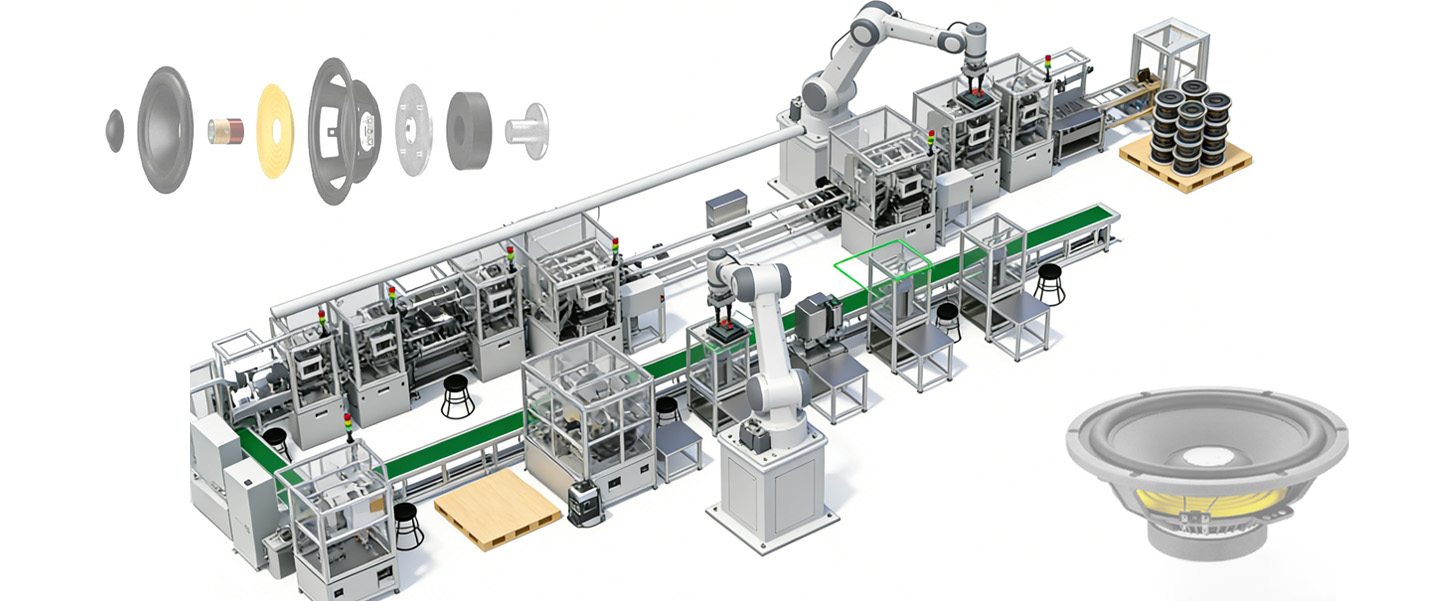
Automated Speaker Assembly LineIt is an intelligent production system that integrates multidisciplinary technologies such as mechanical, electrical, vision, and acoustic inspection, capable of automatically completing the entire assembly process from raw material feeding to the final speaker product coming off the line. Unlike the traditional ”manual labor plus assembly line” model, it utilizes precision robotic arms, servo control systems, vision positioning systems, and intelligent inspection systems to transform dozens of processes that previously relied on manual labor into high-precision, high-speed, and traceable automated workflows.
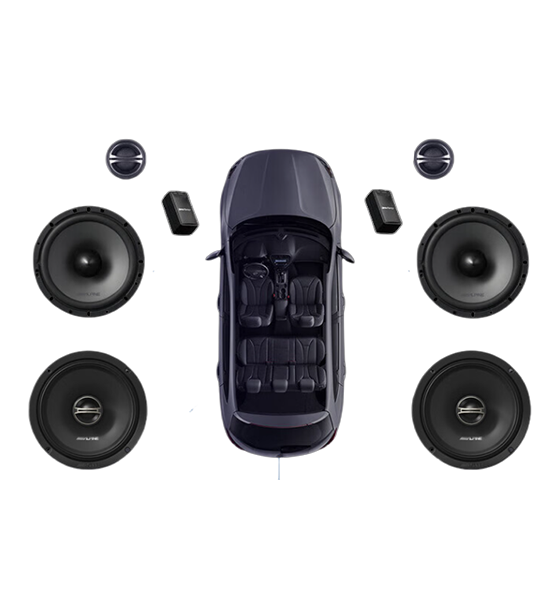
As a national ”Little Giant” enterprise, Jiuju has been dedicated to the field of speaker automation for 16 years. With over 256 core technology patents and a R&D team of more than 100 people, our 10,000-square-meter production facility ensures that every piece of equipment leaving our factory undergoes rigorous testing. Our[Automated Speaker Assembly Line]We have served over 2,000 customers, covering the full range of speaker categories, from micro (TWS/wearables) and small (headphones/smart speakers/TVs) to medium-sized (in-car/stage/home audio) speakers.
Automation vs. Manual: Fundamental Differences Across 4 Key Dimensions
**1. Efficiency: Production capacity increased to 3,001 TP3T+, with a cycle time as fast as 0.8 seconds per unit**
JiuJu Automation-Automatic production line for car audio speakers-Automatic press fit
Manual assembly lines are limited by workers’ operating speed, fatigue, and coordination; as a result, the daily production capacity for miniature speakers is typically only 30,000 to 50,000 units, and it is difficult to maintain continuous 24-hour operation. In contrast, Jiuju’s automated production line employs a multi-station parallel design, achieving a production cycle of 0.8 seconds per unit for miniature speakers, with a daily output of up to 120,000 units and support for 24-hour uninterrupted production. Calculated on a two-shift basis, the output of a single automated production line is equivalent to the combined output of 3–4 manual lines.
**2. Quality: Yield rate improved from 95.1% to 99.81%, with consistency reaching ±0.01 mm**
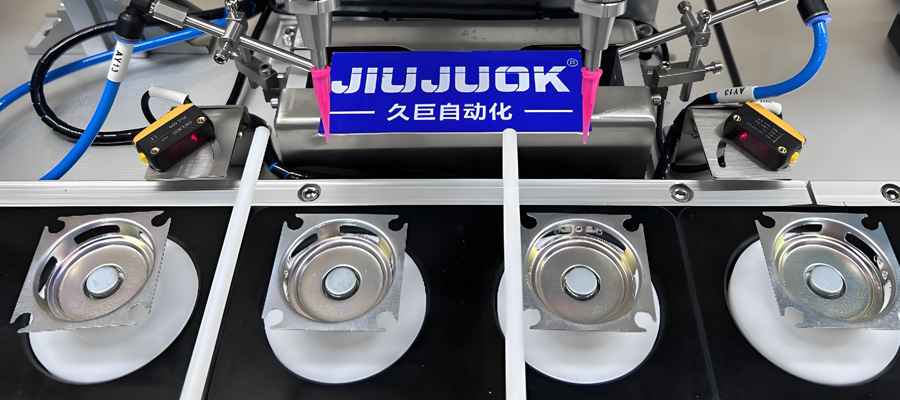
JiuJu Automation-Speaker Magnetic Road Machine-Automatic Dispensing for Audio Speakers
Speakers assembled manually can have sound quality consistency errors of up to ±2.8 dB and voice coil offset rates as high as 2.51 TP3T, with each product exhibiting differences in acoustic performance that are imperceptible to the naked eye. Automated production lines utilize technologies such as a vision positioning system (positioning accuracy of ±0.01 mm), closed-loop dispensing control (dispensing volume error ≤ ±0.01 g), AI acoustic testing (millisecond-level full inspection), maintain a stable yield rate of 99.81%, reduce sound quality consistency errors to ±0.5 dB, and lower the voice coil offset rate to 0.31%. This means that for every 1,000 speakers produced, the manual line would yield 50 defective units, while the automated line produces only 2.
**3. Cost Perspective: Total cost reduction of 60%; payback period of 10–12 months**
What exactly is an automated speaker assembly line, and how does it differ fundamentally from a traditional manual line? — Jiuju speaker automated assembly line
At first glance, an automated production line requires an investment of 2 to 5 million yuan, while a manual line only needs to hire 20 to 30 workers, with monthly payroll expenses of approximately 100,000 to 150,000 yuan. However, when factoring in hidden expenses such as recruitment costs, training costs, management costs, rework costs, material wastage, and the risk of workplace injuries, the annual total cost of a manual production line often reaches as high as 1.5 to 2 million yuan. Although automated production lines require a significant upfront investment, they can save 420,000–1 million yuan in labor costs annually. Combined with reduced rework losses due to improved yield rates, lower material waste, and compressed management costs, the total cost can be reduced by 60–100%, typically allowing for a return on investment within 10–12 months.
**4. Consistency: Every speaker has its own ”ID,” ensuring full traceability throughout the process**
What exactly is an automatic loudspeaker assembly production line, and what is the essential difference from a conventional manual assembly line? — Consistency of Jiuju's loudspeaker automated assembly line production
The biggest challenge with manual assembly is a lack of traceability—when a customer complains about inconsistent sound quality in a batch of speakers, you cannot pinpoint exactly which production step, worker, or piece of equipment caused the issue. Automated production lines generate a unique QR code for each speaker, recording end-to-end data including production equipment serial numbers, operators, process parameters, and inspection results, enabling bidirectional traceability ”from raw materials to finished products.” This not only complies with automotive industry standards such as IATF 16949 but also provides robust data support for addressing customer complaints and quality audits.
– **Automatic Feeding System**: Various feeding methods, including vibratory feeders, tape feeders, and trays, to accommodate components of different shapes
– **Precision Assembly Unit**: Automated execution of key processes such as voice coil insertion, magnetic circuit assembly, diaphragm bonding, and surround welding
– **Visual Positioning System**: CCD vision-guided positioning ensures assembly accuracy of ±0.01 mm
– **Dispensing and Curing System**: Closed-loop control of dispensing volume, with online detection of excess or insufficient dispensing and automatic compensation
– **Magnetization Detection System**: Customized automatic magnetizing machine, with a magnetizing intensity error of ≤±21 TP3T for multi-pole magnets
– **Acoustic Monitoring System**: AI-driven comprehensive testing of frequency response, sensitivity, and distortion
– **MES Data System**: Real-time monitoring of production data and automatic alerts for quality anomalies
Modular configuration lowers the barrier to entry
Many customers worry that ”the upfront investment for a complete production line is too high.” In fact, Jiuju’s automation equipment supports modular configurations—you can start with standalone machines (such as the magnetization section, film coating section, or automatic oven), and after verifying the results, gradually expand to cell lines and full production lines. This ”incremental” strategy allows small and medium-sized enterprises to complete their automation upgrades step by step with minimal financial pressure.
**Related Recommendations:**
—
*Still worried about hiring difficulties and unstable quality? Jiuju has focused on speaker automation for 16 years and is the choice of more than 2,000 customers. Call now: 134-2897-6919 Book a free solution consultation, or[Schedule a factory tour in Shenzhen/Dongguan], and witness the real efficiency of an automated production line with your own eyes!*
Frequently Asked Questions FAQ
Click a question to expand the answer
01Which processes does an automated speaker assembly line actually contain?
It covers the main assembly processes from parts to finished product,usually magnetic-circuit assembly (T-yoke, magnet, washer), soft-part assembly (voice coil, spider, cone), dispensing and press fitting, soldering, magnetisation, acoustic testing and packing. Coverage differs by model; the model specification table is authoritative.
02How many sections does a complete speaker line have, and can one section be bought alone?
By process it divides into a magnetic-circuit section and a soft-part section; inspection and packing can be counted separately.One section can be bought alone: start with the magnetic-circuit or soft-part section to clear the bottleneck, verify the result, then expand. Jiuju supports modular configuration, so a whole line need not be bought at once.
03What is the most fundamental difference between an automated and a manual line?
Not speed, but what guarantees consistency.A manual line relies on the operator's feel and experience, so pressure, adhesive volume and placement vary from person to person; an automated line gives these actions to the machine, so pressure and displacement curves, adhesive volume and magnetising energy are all recorded and can be reviewed.
04Is an automated line always higher in output than a manual line?
No.Output equals cycle time times uptime times yield. The advantage of an automated line is stable cycle time that does not drift with operator condition; but with frequent changeovers and poor uptime, actual output may not exceed a manual line staffed by experienced workers. Calculate changeover loss first: changeover duration × changeover frequency ÷ available hours.
05After automating, how many people does a line still need?
It depends whether a whole line or a single section is bought.Taking the FB-610 automotive speaker line as an example, the whole line has 15 operators; the FB-550 audio line has 7 and the FB-510 TV line 7; stand-alone machines such as the FB-430 magnetic-circuit machine and the FB-120 riveting press need 1 each. Staff are concentrated in the soft-part assembly and inspection/packing sections; the magnetic-circuit section can run unmanned.
06For the same product, how much does yield differ between an automated and a manual line?
This site does not give a uniform improvement figure,because the defect rate of a manual line depends on the product, the process and shift management. Only the company's published figures can be stated: yield of 99.5% or above and uptime of 85% or above, both subject to the customer's product and acceptance standard; the preconditions are written at the proposal stage and the signed acceptance report governs in practice.
07Is it true that changeover is slower on an automated line?
In most cases, yes.An automated line has more adjustable stations and more parameters to re-confirm, so changeover takes 20–60 minutes depending on the model and the number of tooling sets. A manual line changes over by changing people and technique, which can be faster. For high-mix low-volume work, calculate changeover loss before judging whether it pays.
08With high mix and low volume, is an automated line still worth it?
It depends on how much of the available hours changeover loss takes.The advantage is clearest with a single product in large volume; with high mix and low volume, start with a stand-alone machine at the bottleneck, or give the main models quick-change tooling and let secondary models share adjustable tooling, rather than forcing a whole line.
09How long from contract to volume production?
A complete line usually takes 45–120 calendar days,in seven stages: requirements review and proposal design, technical freeze, design and manufacture with in-house commissioning, in-house acceptance, dismantling and shipment, on-site installation and commissioning, and volume-production validation. Manufacturing and in-house commissioning take the largest share. A stand-alone machine follows the sample trial route, with a trial period of 3–10 working days.
10Can an old line be upgraded, or must it be rebuilt from scratch?
It need not be rebuilt.The usual approach is to keep the usable infeed and outfeed equipment and replace only the bottleneck stations; alternatively, connect a stand-alone machine to the existing line first and link it up later. Whether an upgrade is possible depends on the locating datum and whether the existing interfaces are open, which must be confirmed on site at the proposal stage.
11Can the automated line's data connect to our existing MES?
Yes — IO communication and MES connection are supported,outputting output, cycle time, defects and equipment status. The precondition is that the existing line provides a standard IO interface or an agreed protocol and that the data fields are defined; if the old equipment has a closed system with no open interface, only a physical connection is possible and the data layer cannot be joined.
12For a first automation project, start with a whole line or a single machine?
Most customers go from a single machine to a full line:use one machine on the most painful bottleneck, run it for a while to verify cycle time and yield, then decide on expansion. A full line is a large investment and demands more of incoming consistency and staffing; the risk of going straight to a full line sits mainly in material matching, not in the equipment itself.
 Speaker automation jiujuauto







 简体中文
 English
 Tiếng Việt
 日本語
 한국어
 ไทย
 हिन्दी
 বাংলা
 Français
 Español de Perú
 Русский