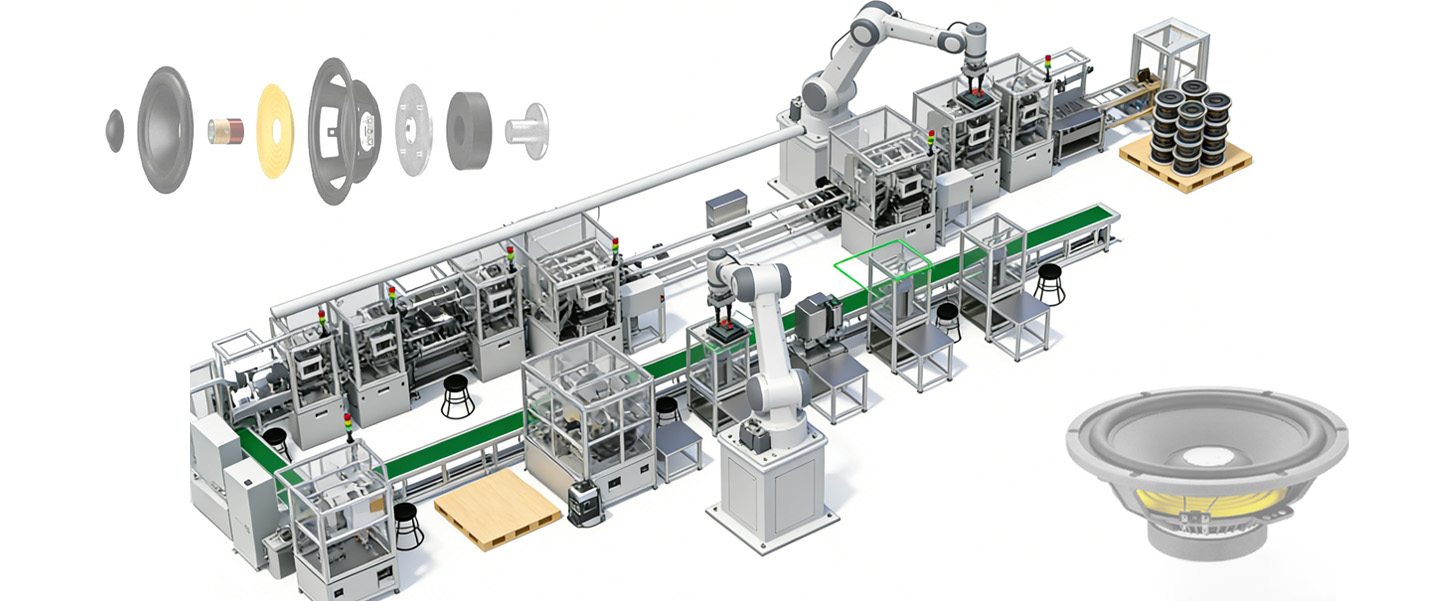
JiuJu Automation focuses on the intelligent upgrading of the whole process of speakers, integrating the four core technologies of visual inspection, precision assembly, AI quality inspection and data traceability to provide customized solutions for TWS headphones, car audio, multimedia smart audio speakers, etc., and achieve production capacity increase of 300%+, yield rate of 99.8%, and reduce the comprehensive cost of 60%, completely solving the pain points of the industry, such as manual dependence, stable quality control and delivery cycle. dependence, unstable quality control, long delivery cycle and other industry pain points. Based on the product characteristics and production scenarios of speakers, it creates a full-process automation system from the entry of raw materials to the release of finished products from the warehouse, covering the three major categories of micro, small and medium-sized, and adapting to the needs of multi-specification and multi-batch production.
OurSpeaker Unit Assembly Production LineAdopts modular and flexible design, covering multiple audio product categories, suitable for batch manufacturing and small-batch multi-variety production of consumer audio, car audio and customized acoustic products. In the consumer audio field,Production LineCan Be Used for Manufacturing Tweeter (high-frequency unit), Midrange Speaker (mid-frequency unit), Woofer (woofer unit), Full-range Driver (full-range unit), and Subwoofer system. This type of product focuses on diaphragm positioning precision, voice coil concentricity control, andAutomatic Dispensingconsistency with the curing process to ensure sound quality stability and production efficiency.
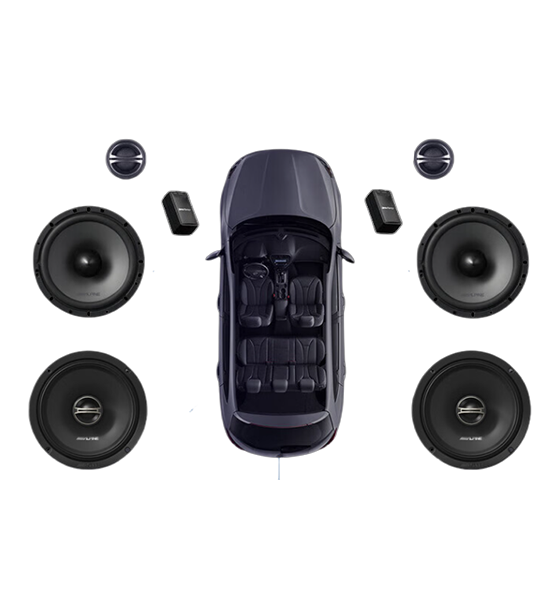
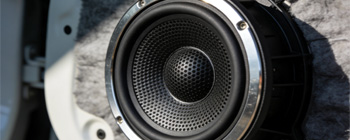
In the automotive audio field,Production LineCompatible with various automotive speaker unit structures, includingDoor speaker units, dashboard speaker units, rear quarter speaker units, center speaker units and multi-way system unitsetc. Automotive audio has higher requirements for reliability and environmental adaptability, so the system can integrate magnetic circuitAutomatic Assembly, impedance testing, frequency response testing and end-product acoustic performance testing to meet automotive-grade quality standards.
In terms of customized and industrial acoustic products,Production LineIt can support production needs such as non-standard-size loudspeakers, special-structure driver units, high-power audio equipment, and closed acoustic modules, suitable for OEM/ODM customization projects and low-batch high-complexity production models. The overall system adopts a scalable architecture; key process modules include frame assembly, voice-coil winding (if applicable), magnetic-circuit assembly, damping-material bonding, dispensing curing, and performance testing, which can be automatically combined and configured according to product requirements, and can integrate vision inspection systems andMES Data Traceability System, achieving full-process quality control.
Jiuju Automation - Speaker Automatic Assembly Line
Frequently Asked Questions FAQ
Click a question to expand the answer
01By magnetic circuit structure, what types of speaker can one line produce?
By magnetic circuit there are two broad types: internal-magnet and external-magnet.In an internal-magnet design the magnet sits inside the U-yoke and a washer pressed onto it forms the gap; this is common in micro speakers for earphones, laptops and phones. In an external-magnet design the magnet sits around the T-yoke and is typical of mid- and large-size speakers for automotive, audio and stage use. The two have completely different locating datums, so a line should be specified around the product family you make most of.
02By size, what range is covered?
The company's stated coverage is internal and external magnet, round and square, 3 to 8 inch plus micro speakers, covering tweeter, mid-range and woofer units.That is the capability of the full series, not of a single machine. Each model must be checked individually; series figures cannot stand in for single-machine figures.
03Can you handle micro speakers such as TWS and earphone drivers?
Yes. Micro internal-magnet speakers run on the FB-430 (three-piece magnetic circuit: U-yoke, magnet, washer) or the FB-440 for internal-magnet tweeters, with a nominal output of ≥3000 PCS/H and one operator per machine.These parts are highly sensitive to incoming consistency: chipped edges and coating defects on NdFeB magnets translate directly into locating offset and poor adhesive bonds, so incoming inspection has to control them.
04Can you handle automotive audio speakers?
Yes. A complete automotive speaker line runs on the FB-610, covering the full chain from T-yoke, magnet, frame, spider, voice coil, cone, dispensing, pressing and welding through to inspection and packing, and it handles both internal-magnet tweeters and external-magnet mid-woofers.For aftermarket car audio and mid-woofers, the FB-620 is also available.
05Can you handle professional stage speakers?
Partly, and it depends on size.The FB-120 covers frame-and-washer riveting for external-magnet, internal-magnet, audio and stage speakers. Units above 18 inches, however, need a larger table and higher riveting force, which the standard FB-120 does not cover; those cases are assessed individually.
06Can you handle both square and round magnetic circuits?
Yes, but they are specified separately.Square magnetic circuits run on the FB-510, which includes automatic dispensing, pressing and tray unloading; non-standard shapes run on the FB-520. Round-circuit machines are not interchangeable with square ones: square parts locate on two edges or a diagonal, round parts centre on the outer diameter, so tooling cannot be shared and forcing it costs efficiency.
07Where exactly does the difference between internal and external magnet show up?
In how the gap is formed and in the locating datum.With internal magnet the magnet goes into the U-yoke and the washer is pressed on to form the gap, so locating accuracy directly determines gap uniformity. With external magnet the magnet goes around the T-yoke and the frame is fitted on top. The former is more sensitive to locating and adhesive volume; the latter to riveting force and concentricity.
08How many speaker types can one line run?
It depends on the changeover design.The equipment supports modular configuration and quick-change tooling: change the fixture, call up the recipe, and several variants can run on one line. But changeover loss has to be calculated — changeover time × changeover frequency ÷ available hours. The more variants and the smaller the batch, the larger that loss becomes.
09Can you handle non-standard speaker shapes?
Yes, on the FB-520, a dual-station design for non-standard speaker structures, with output of ≥1700 PCS/H and 7 operators.For non-standard parts the tooling and locating concept are the critical points, so a 3D model or physical sample is needed for process evaluation. Getting a part to run and getting it to run stably are two different things, and that should be clear from the evaluation stage.
10How long does changeover between product types take?
Changeover time for a complete line depends on the model and the number of fixtures; the company's stated figure is 20 to 60 minutes. Single machines are usually faster.Changeover involves three things: swapping the tooling, calling up the matching recipe and verifying the first part with a sample. For any specific line these must be checked model by model during the proposal stage.
11Which product types require dedicated machines?
Three cases are clear: square-circuit TV speakers use the dedicated FB-510 structure, non-standard shapes use the FB-520, and complete internal-magnet assembly for smart speakers uses the FB-720.Forcing these three onto general-purpose machines means rebuilding tooling and losing efficiency, which works out worse than choosing the dedicated machine.
12How do we confirm whether our product can be run?
The most direct way is to send a sample for a trial run.Trial runs are supported: free for standard machines with regular workpieces, taking 3 to 10 working days; non-standard tooling is charged as usual and credited against the order once it is placed. A trial produces a test record, which tells you more about fit than any specification sheet. Before selecting a model, please provide product drawings, magnetic circuit structure, dimensions and target cycle time.
 Speaker automation jiujuauto






 简体中文
 English
 Tiếng Việt
 日本語
 한국어
 ไทย
 हिन्दी
 বাংলা
 Français
 Español de Perú
 Русский