JiuJu Automation focuses on the intelligent upgrading of the whole process of speakers, integrating the four core technologies of visual inspection, precision assembly, AI quality inspection and data traceability to provide customized solutions for TWS headphones, car audio, multimedia smart audio speakers, etc., and achieve production capacity increase of 300%+, yield rate of 99.8%, and reduce the comprehensive cost of 60%, completely solving the pain points of the industry, such as manual dependence, stable quality control and delivery cycle. dependence, unstable quality control, long delivery cycle and other industry pain points. Based on the product characteristics and production scenarios of speakers, it creates a full-process automation system from the entry of raw materials to the release of finished products from the warehouse, covering the three major categories of micro, small and medium-sized, and adapting to the needs of multi-specification and multi-batch production.
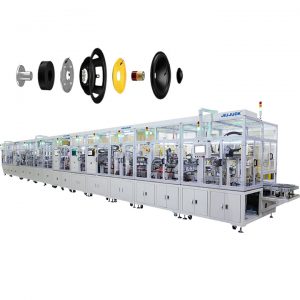
Realization of audio speakers from t-iron to finished product assembly
brandingJiuju Automation
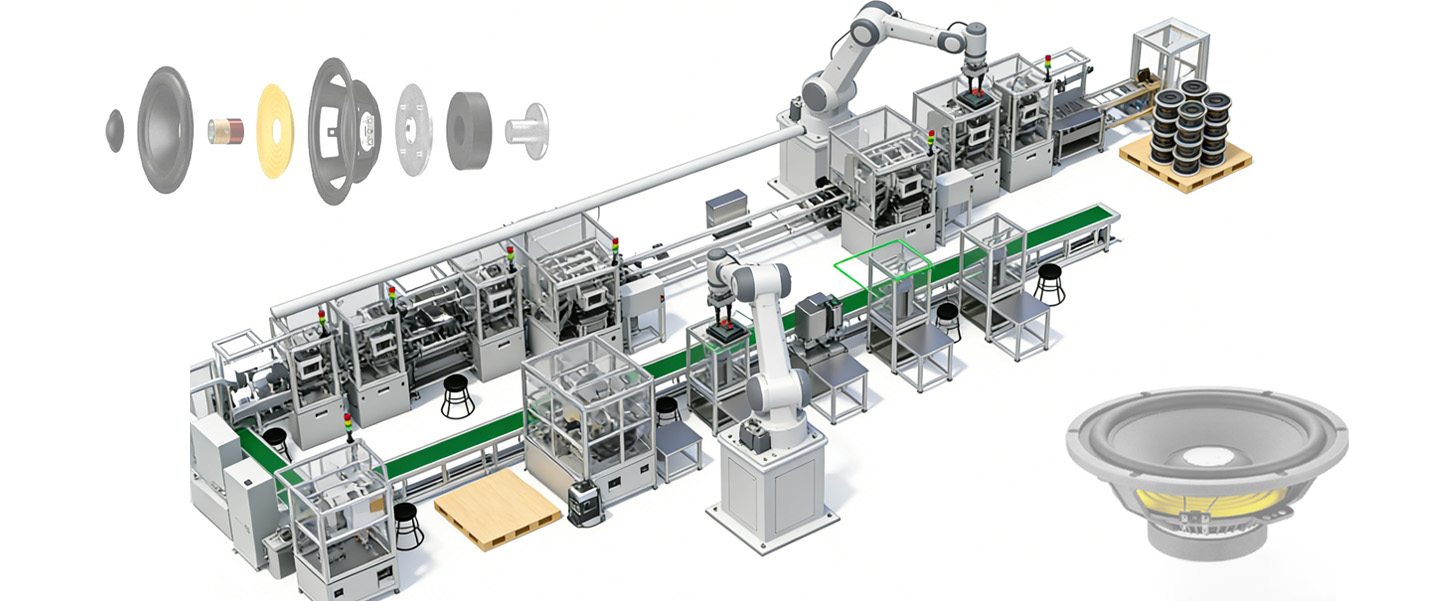
processRealization from automatic T-iron, magnet loading, automatic gluing, inserting gauge, spinning, drying, dust removal, automatic discharging, etc.
work efficiency≥2800PCS/H
Key componentsPanasonic PLC controller, Japan servo, vibration plate loading, Japan guide rail, precision CNC machining, Panasonic touch screen, Huichuan robot
operator5 people
Design AdvantagesAdopting turntable type single station structure design, space saving, simple debugging operation, realizing automatic material loading and assembling, IO communication control system, full station detecting and identifying sensors, connecting with MES system, rich expansion module, convenient for subsequent upgrading and overhauling.
Every line is engineered around the customer's product and takt time — stations, fixtures, conveying and inspection are all redesigned from scratch. The project runs through seven stages, each with defined deliverables and a clear customer sign-off point.
1
Requirement Review & Concept Design
7–15 days
Technical specification
2
Design Freeze & Contract
3–7 days
Technical agreement
3
Design, Build & In-house Debug
30–60 days
Drawings & PLC programs
4
FAT Factory Acceptance
3–5 days
FAT record
5
On-site Install & SAT
5–10 days
SAT report
6
Mass-production Validation
3–10 days
Validation report
7
Final Acceptance & Handover
2–3 days
Manuals & spare parts
Typical total lead time is 45–120 calendar days, with manufacturing and in-house debugging accounting for the largest share. Once the concept is frozen, changing a core process parameter — part size, takt time or number of stations — forces knock-on changes to the mechanics, electrical control and layout, and can extend the schedule by more than 30%. A design freeze therefore requires the customer's written confirmation.
Products
Audio Speaker Automation Production Line Product Details
In the audio speaker manufacturing industry, lean production and space utilization rate is the core demand of the enterprise to reduce costs and increase efficiency, the traditional linear production line not only takes up a lot of space, and cumbersome debugging and changing, it is difficult to adapt to the front and rear assembly needs of multiple varieties of speakers. To address this industry pain point, we developed the audio speaker automated production line innovatively adopts the disc type line design, realizing the whole process of automation of the front and rear assembly of audio speakers, and adapting to the lean assembly manufacturing process of all kinds of speakers with the core advantages of "space-saving, high compatibility, easy to operate, and strong quality".
The disk type line design is the core innovation point of the production line, cracking the space occupation problem from the root. Compared with the traditional linear production line, the design through the center of the circle radial layout of the workstations, the front and rear assembly processes are highly integrated in the diameter of 3-5 meters within the scope of the disc, reducing the amount of space occupied by more than 60%, without large-scale transformation of the workshop can be quickly deployed, especially for small and medium-sized manufacturing enterprises with workshop layout requirements. The disk drive is driven by an imported splitter, with a positioning accuracy of ±0.01mm, and all the work stations are synchronized around the disk, realizing the seamless connection between the front and rear processes from magnetic circuit assembly, voice coil bonding, diaphragm assembly to lead wire welding, performance testing, and semi-finished product output, and completely replacing the cumbersome process of manual segmentation operation.
High compatibility and convenient debugging characteristics greatly enhance production flexibility. The production line is equipped with modularized station design, which can quickly increase, decrease or replace the loading mechanism, assembly module and testing unit according to the assembly requirements of different specifications of audio speakers (20mm-200mm in diameter). With the parameterized control system, the adjustment of key parameters such as feeding speed, assembly pressure, etc. can be completed through the touch screen, and the time for changeover and debugging can be shortened from the traditional production line's 2-3 hours to 20-30 minutes. The time of changeover debugging is shortened from 2-3 hours to 20-30 minutes. For different categories of products such as headphone speakers, home audio speakers, professional stage audio speakers, etc., the production line can realize "one machine, multi-functional" production, which is perfectly suited to the production of multi-species, small-lot and large-lot cross-production scenarios.
Operation efficiency and product quality have realized a double leap. At the operation level, the production line is equipped with a visual human-machine interactive interface, integrating fault warning, parameter memory, one-key start/stop and other functions, which can be operated independently by new employees after one hour of training, significantly reducing the cost of manpower training. In terms of efficiency improvement, the disc layout maximizes the efficiency of the parallel operation of each station, and the hourly production capacity can reach 1200-1500 sets, which is 5-6 times higher than that of the traditional manual production line, and the single production line can reduce the labor input of 80%, which significantly reduces the labor cost. In terms of quality assurance, the key station integrates CCD visual inspection and pressure sensing system, real-time detection of assembly precision, bonding strength and welding quality, and automatic sorting and alarm triggering for substandard products, the product qualification rate is increased from 93% for manual assembly to more than 99.5%, which can satisfy the stringent requirements of high-end audio for sound quality and stability.
From the perspective of lean production, the production line is also equipped with a production data statistics module, which records real-time data such as production capacity, qualification rate, equipment operation status, etc. It supports the automatic export of production reports, which provides data support for enterprises to optimize their production processes. Whether it is the capacity upgrading of small and medium-sized enterprises, or the flexible production layout of large manufacturers, the production line can provide customized solutions, with innovative design and stable performance, to become the core equipment for the intelligent transformation of audio speaker manufacturing enterprises.
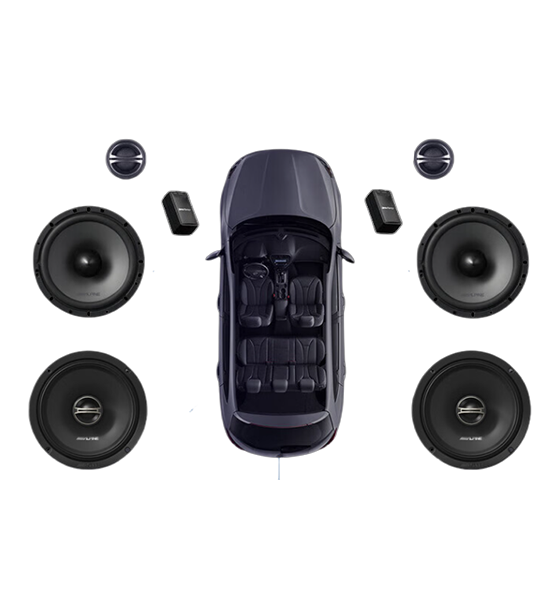
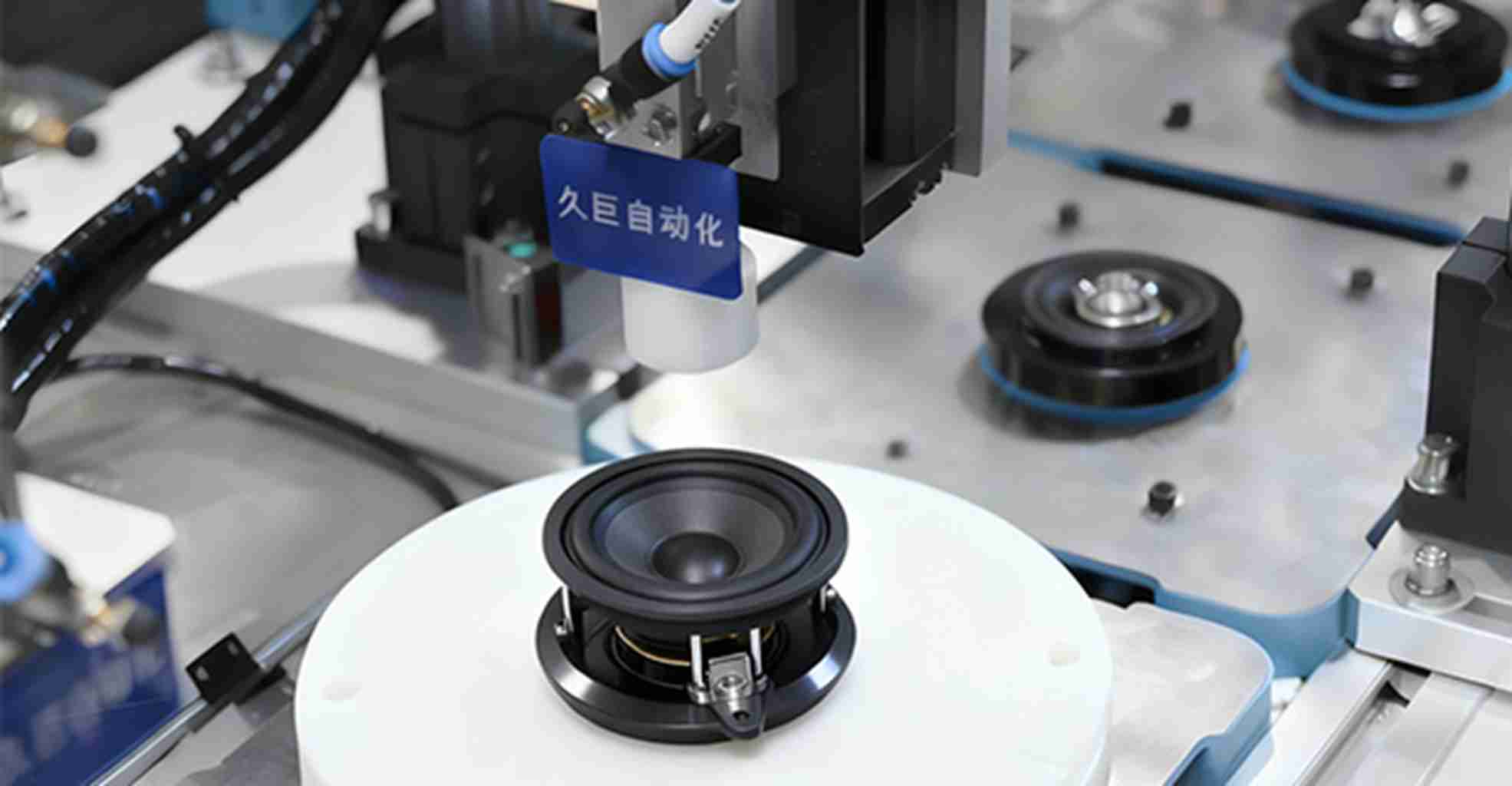
Footage of the automotive woofer automatic assembly line: magnetic circuit assembly, voice coil positioning and diaphragm bonding are automated across all key stations, locking assembly errors within the tolerance band.Contact Jiuju Automation for…
Live footage of the automatic assembly of the soft-parts section of square multimedia internal-magnet loudspeakers, showing precision assembly of flexible acoustic components such as voice coils, spiders and cones, ensuring coaxial positioning and…
Automotive external-magnet loudspeaker automatic assembly line: it integrates feeding, assembly and inspection in one process, fully automatic from component transport to finished-product offloading, eliminating human error.Contact Jiuju Automatio…
Fully automatic tunnel baking line for automotive loudspeakers: independent temperature control in multiple zones and PID closed-loop regulation ensure every loudspeaker cures under the same thermal history.Contact Jiuju Automation for more quotes…
loading...
It's already to the last piece of content!
Frequently Asked QuestionsClick a question to expand
01How many operators does an audio speaker assembly line need?▼
The FB-550 runs with 7 operators per shift (per the model specification table; actual headcount depends on your process). They are distributed across five sections: magnetic circuit loading, magnetic circuit assembly, soft-part assembly, dispensing and pressing, and inspection and packing. Note that the FB-550 is itself an integrated magnetic-circuit and soft-part line: if you already have magnetic circuit equipment and buy only the soft-part section, headcount will be below 7. Availability is taken as ≥85%; for two-shift operation the headcount doubles accordingly. This is the item most often left out when planning shifts.
02What output can the line achieve?▼
The FB-550 is rated at ≥900 PCS/H, meaning more than 900 pieces per hour. At 8 hours per shift and 85% availability, effective daily output is about 6,100 pieces. Effective output = cycle rate × availability × yield; the rated figure only holds under ideal conditions. The ceiling is set by the bottleneck station cycle time, not by the line average. Actual values are confirmed by the acceptance report signed by both parties.
03What is the soft-part section, and how does it differ from a complete line?▼
The soft-part section covers voice coil, spider, cone, dispensing and pressing; the magnetic circuit section handles T-yoke, magnet and washer assembly. The FB-550 joins the two, but does not include acoustic testing or packing of the finished unit. So draw the boundary before you buy: which operations go on the line, which stay manual, and how testing and packing connect. Buying only the soft-part section with magnetic circuits sourced elsewhere, or adding just a magnetic circuit section, are both common configurations. There is no need to invest in a complete line at once.
04What is the difference between the fifth-generation FB-550 and the fourth-generation FB-540?▼
Mainly the magnetic circuit locating structure. The FB-550 uses a dual-locating magnetic circuit and soft-part section for outer-magnet speakers, giving better concentricity and consistency, which suits mid-woofers with tight magnetic gap uniformity requirements. The FB-540 is the fourth-generation structure, suited to established products with a relatively fixed specification. Both generations run at ≥900 PCS/H with 7 operators. If your model range is narrow and precision requirements are moderate, the FB-540 is sufficient; for multiple specifications and tighter precision, choose the FB-550.
05How much floor space, power and air does it need?▼
The FB-550 measures 20000 × 4500 × 1800 mm, that is 20 m long, 4.5 m wide and 1.8 m high. Allow 1 to 2 m around the equipment for operation and maintenance. Power is 380V three-phase, with a voltage stabiliser and a dedicated circuit breaker; air supply is 0.5 to 0.8 MPa, and a dry air source must be available on site. 20 m is the length of the equipment itself, not the usable length of your building. Confirm the layout against column spacing, material flow, loading area and maintenance access. Do not measure your workshop against the equipment length.
06How long does changeover take, and can several models share the line?▼
Changeover takes 20 to 60 minutes, depending on the model and the number of tooling sets. It is achieved through modular design, quick-change tooling and recipe switching, so mixed production across several models does not require structural changes to the line. One unfavourable fact must be stated: changeover on an automated line is usually longer than on a manual line, because there are more adjustable stations and more parameters to re-confirm. To judge whether mixed production pays off, calculate the changeover loss: changeover time × changeover frequency ÷ available working hours. For a single model in high volume the advantage is clearest.
07How are yield and acceptance criteria defined?▼
Yield ≥99.5% is our published figure, with availability ≥85%. Both are subject to the customer product and acceptance standard, and the preconditions must be written into the proposal. We recommend specifying four acceptance items in the contract: cycle-rate achievement, yield (good units divided by input units, counted by batch and broken down by defect mode), OEE, and changeover time. Mass-production validation follows a continuous 72-hour run. Definitions vary enough to double or halve the same number, so all four items belong in the contract.
08Can it connect to our existing line and MES?▼
Yes. The control system is Panasonic PLC plus Japanese servo plus Inovance robots; the data layer supports IO communication, MES integration and data-driven process analysis, and can output production volume, yield and equipment status. The prerequisite is that the existing line provides a standard IO interface or an agreed communication protocol, with data fields defined. If the existing equipment uses a closed control system without an open interface, only physical linking is possible and the data layer cannot be connected. This must be confirmed at the proposal stage, not raised just before acceptance.
processAutomatic T-iron, magnet, pot holder, gauge, wave, voice coil, drum paper loading, automatic dispensing, pressing, welding, testing, packaging and so on.
 Speaker automation jiujuauto








 简体中文
 English
 Tiếng Việt
 日本語
 한국어
 ไทย
 हिन्दी
 বাংলা
 Français
 Español de Perú
 Русский