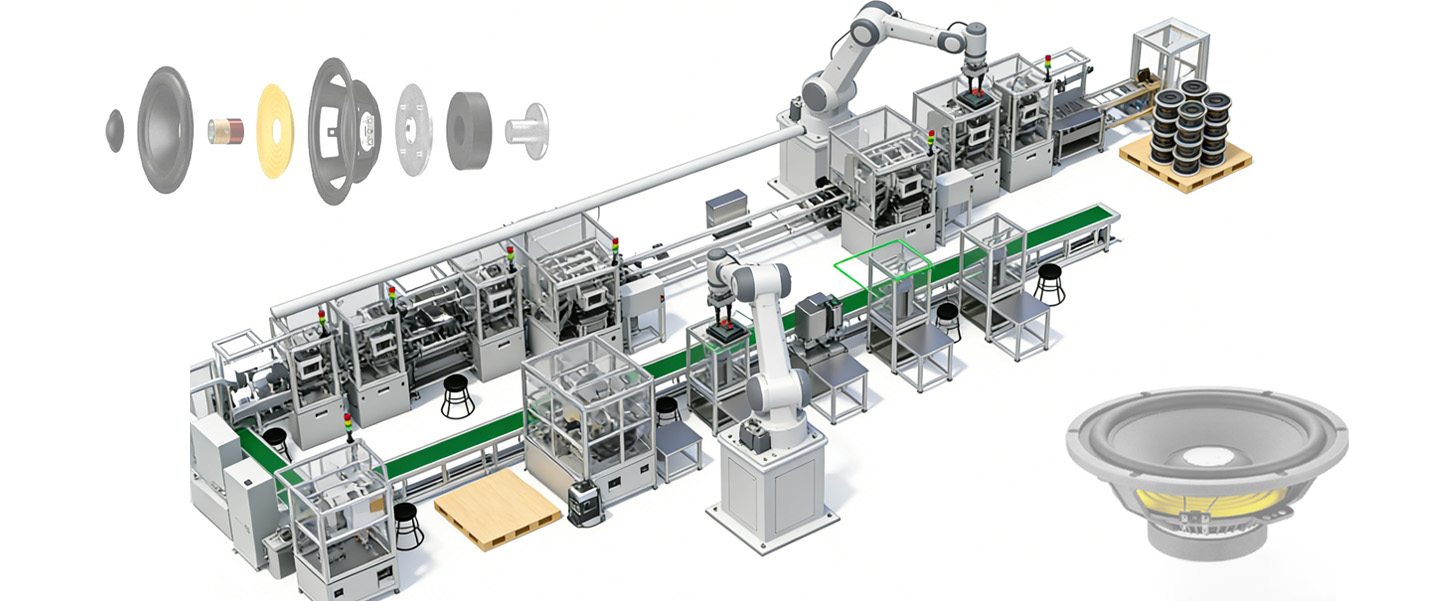
JiuJu Automation focuses on the intelligent upgrading of the whole process of speakers, integrating the four core technologies of visual inspection, precision assembly, AI quality inspection and data traceability to provide customized solutions for TWS headphones, car audio, multimedia smart audio speakers, etc., and achieve production capacity increase of 300%+, yield rate of 99.8%, and reduce the comprehensive cost of 60%, completely solving the pain points of the industry, such as manual dependence, stable quality control and delivery cycle. dependence, unstable quality control, long delivery cycle and other industry pain points. Based on the product characteristics and production scenarios of speakers, it creates a full-process automation system from the entry of raw materials to the release of finished products from the warehouse, covering the three major categories of micro, small and medium-sized, and adapting to the needs of multi-specification and multi-batch production.
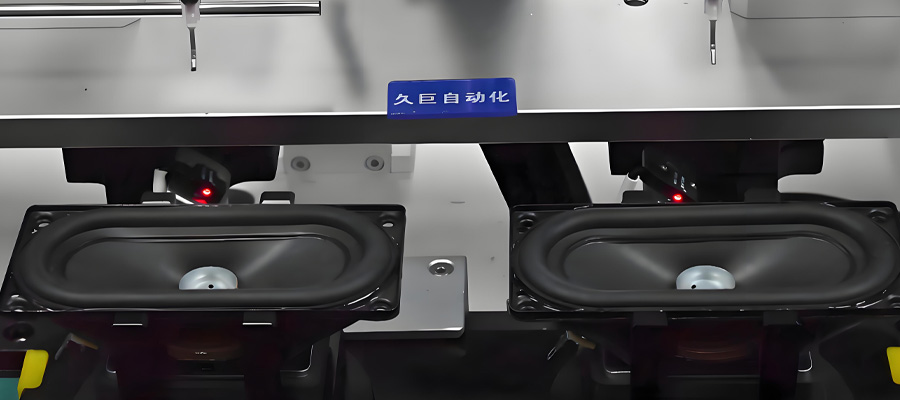
Realization of speaker T-iron to finished product automatic dispensing assembly
brandingJiuju Automation
Glue viscosity range1-100000cps
work efficiency≧2500PCS/H
Power supply specificationsAC 220V 50Hz
operator 1 person
Dispensing precision0.01mm
Gum volume error±1%
Customization Process Customization process
For standalone and special-purpose machines the tooling and parameters are already fixed, so the fastest and lowest-cost way to verify the process is to send us your real parts and have them run on our equipment. Seven steps, 3–10 working days.
1
Trial Request & Requirement Check
1 working day
Trial request form
2
Part Receipt & Registration
1–2 days
Part log sheet
3
Tooling Setup & Parameter Setting
2–3 days
Trial plan
4
Trial Run with Process Records
1–3 days
Photos & video
5
Testing & Data Logging
1–2 days
Data log
6
Trial Test Report Issued
2 days
Trial report
7
Case Filing & Sharing
1 day
Case card
How we charge: trials are free for standard models with standard parts. For non-standard machines that need new tooling or station-by-station debugging, we charge according to normal industry practice (about 7–10 days), and the fee is credited against the order once it is placed. For confidential parts we can run the trial at your site, or in our plant under a signed NDA.
Products
Speaker automation dispenser product details
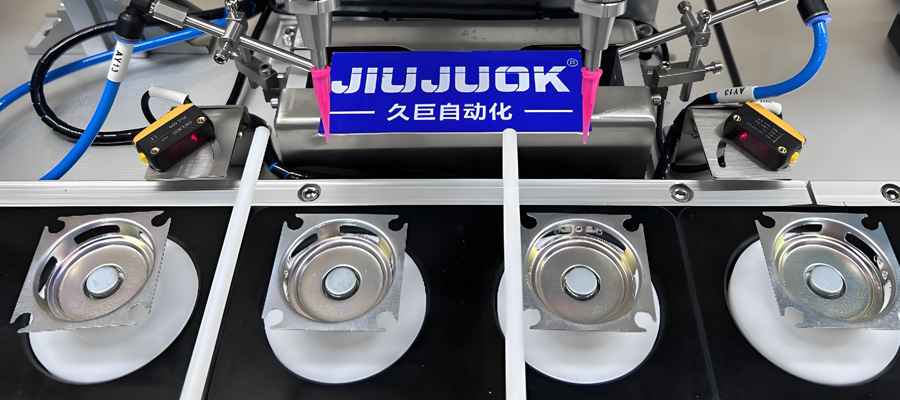
Speaker dispensing process on the amount of glue precision, dispensing position consistency requirements are extremely high, too much glue easily lead to voice coil stagnation, too little will affect the bonding strength of the components, directly related to the product qualification rate. Our automatic high-precision speaker dispenser for this core pain point, using multi-dimensional technological innovation, to achieve the standardization of the dispensing process and high efficiency.
1. Advantage of core technology, building the cornerstone of quality
Ultra-high precision glue control systemThe dispensing precision is up to ±0.01mm and the glue volume error is controlled within ±2% by imported servo motors and high precision dispensing valves, together with CCD visual positioning system. For the different parts of the speaker voice coil, magnetic circuit, diaphragm and other dispensing needs, can accurately match the epoxy glue, silicone, UV glue and other types of glue, to eliminate overflow, leakage, uneven amount of glue and other problems.
Fully automated and efficient productionIt adopts full-automatic loading and unloading mechanism, together with multi-station rotary table, to realize the automation of the whole process of loading, positioning, dispensing, curing (optional UV curing module) and unloading. A single device can handle 800-1200 speaker workpieces per hour, compared with the traditional manual dispensing efficiency increased by 5-8 times, while avoiding the individual differences caused by manual operation, so that the product qualification rate from 85% above to 99% above.
Intelligent adaptation of multi-size productsThe equipment supports the processing of speaker workpieces with a diameter of 5-200mm, and the dispensing parameters (such as the amount of glue, dispensing speed, positioning coordinates, etc.) of different products can be quickly accessed through the touch screen, with a built-in storage library of 1000+ product parameters, and the changeover time is only 3-5 minutes, which is perfectly adapted to the production needs of speakers in different scenarios, such as earphones, bluetooth speakers, automobile stereos, and stage stereos.
Stable and durable structural designThe body is made of high-strength aluminum alloy, with corrosion-resistant work surface, adapting to the complex production environment in the workshop; the equipment is equipped with glue quantity monitoring system and fault alarm device, which will immediately stop and prompt automatically when there is insufficient glue or problems such as positioning deviation and glue valve blockage, reducing the production loss.
2. Scenarios and Customer Value
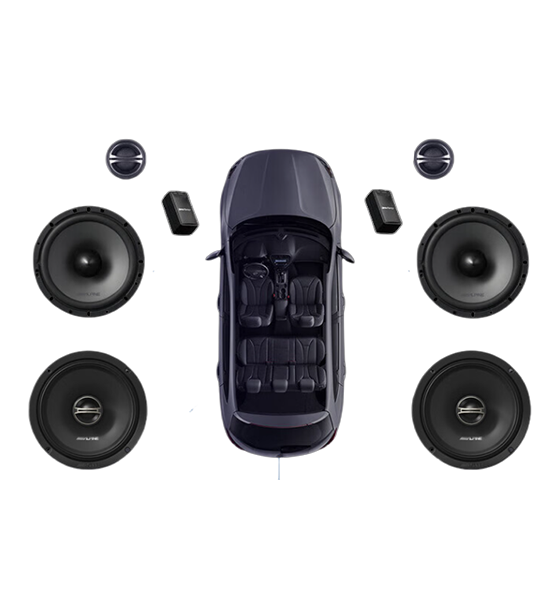
The equipment is widely used inMiniature headphone speakers, TWS headphone speakers, Bluetooth speaker speakers, car car speakers, stage professional audio speakersIt is especially suitable for the manufacture of high-end speaker drivers which require high precision. For customers, the equipment can not only greatly improve production efficiency and reduce labor costs, but also reduce defective product loss through stable dispensing quality, helping customers to create highly competitive speaker products and seize the high-end market.
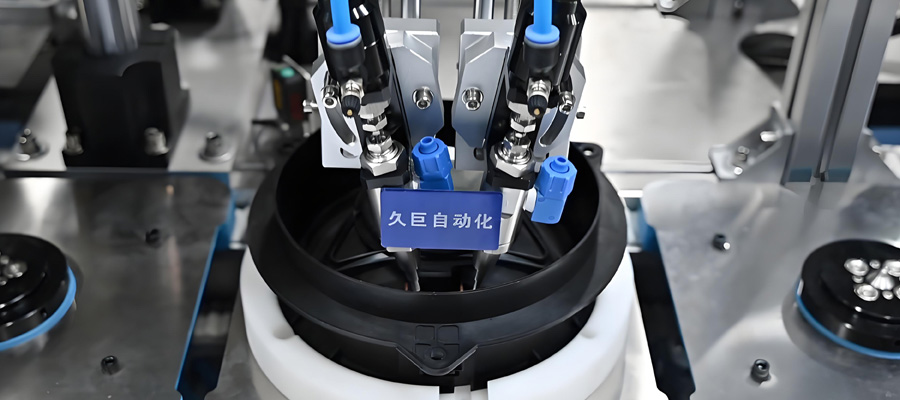
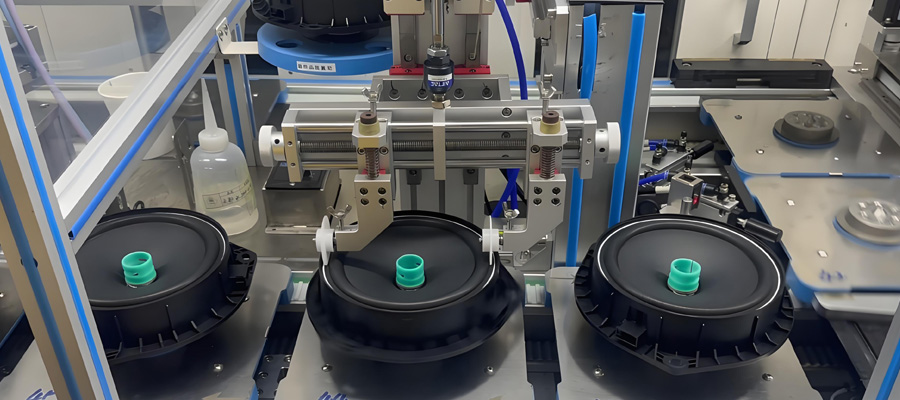
Footage of the automotive woofer automatic assembly line: magnetic circuit assembly, voice coil positioning and diaphragm bonding are automated across all key stations, locking assembly errors within the tolerance band.Contact Jiuju Automation for…
Live footage of the automatic assembly of the soft-parts section of square multimedia internal-magnet loudspeakers, showing precision assembly of flexible acoustic components such as voice coils, spiders and cones, ensuring coaxial positioning and…
Automotive external-magnet loudspeaker automatic assembly line: it integrates feeding, assembly and inspection in one process, fully automatic from component transport to finished-product offloading, eliminating human error.Contact Jiuju Automatio…
Fully automatic tunnel baking line for automotive loudspeakers: independent temperature control in multiple zones and PID closed-loop regulation ensure every loudspeaker cures under the same thermal history.Contact Jiuju Automation for more quotes…
loading...
It's already to the last piece of content!
Frequently Asked QuestionsClick a question to expand
01What does ±0.02 ml dispensing accuracy mean?▼
±0.02 ml is the control accuracy of a single dispensed volume, roughly a fraction of a typical adhesive drop. In speaker assembly it matters for adhesive line width and volume stability: too much adhesive in the magnetic circuit section overflows and contaminates the gap, too little leaves insufficient bond strength. Three preconditions must hold: stable adhesive viscosity, regular maintenance of the supply system, and an unclogged needle. If any one fails, the rated accuracy is void. This is also where batch accidents most often originate in dispensing.
02What is the output?▼
≥1500 PCS/H, about 2.4 seconds per piece. This cycle corresponds to single-point or few-point volumetric dispensing. If the product needs multiple points or multiple adhesive types (for example structural adhesive followed by sealant), the cycle must be recalculated from the actual number of points. The ceiling is set by travel path length and adhesive curing wait time, not just by head speed. Provide the number of points and the adhesive type when asking for an evaluation, otherwise only a range can be given.
03Which adhesives can it dispense?▼
It is compatible with hot-melt, UV and epoxy adhesives. Hot-melt needs heating, temperature holding and fast curing; UV needs a UV curing source; epoxy involves two-component ratio and pot life. Different adhesive types need different supply systems and needles. One machine can switch adhesive type, but the supply module must be changed and parameters recalibrated. Define the main adhesive type at selection; do not expect one machine to do everything well. Doing everything usually means nothing is stable enough.
04What does vision locating do?▼
Vision finds the datum: after the part is in position it photographs and identifies the actual location, then offsets the dispensing path to the true coordinates, compensating for incoming tolerance and fixture error. Volumetric dispensing without vision can only follow fixed coordinates, so any positional variation lands the adhesive at the edge. Vision can also inspect appearance after dispensing (line continuity, gaps), but that is optional, not standard, and must be confirmed as a separate configuration.
05Can it connect to an existing line and to MES?▼
Yes. It supports IO communication and MES integration; dispensing parameters and inspection results can be uploaded for batch traceability. The prerequisite is that upstream and downstream equipment provides a standard interface. If the existing line uses manual transfer, the machine can run standalone first and be connected later. Note that dispensing demands a high locating standard, so the locating method upstream and downstream must be unified when connecting; otherwise vision has to re-find the datum every time.
06What are the power and air requirements?▼
Power is 220V single-phase; air supply is 0.5 to 0.8 MPa, with a voltage stabiliser and dry air source. Hot-melt models also need heating power and insulated supply lines. Floor space depends on the model; a single machine is usually within 2 square metres, with room around it for operation and adhesive changes. Adhesive storage and tempering must be planned separately, away from direct sun or damp beside the machine: batch defects caused by degraded adhesive are hard to attribute.
07How is adhesive volume controlled and traced?▼
Three layers: a volumetric supply system controls the single dispensed volume; vision or a flow sensor monitors what is actually dispensed; MES records the dispensing parameters and inspection result for each unit. Traceability granularity depends on whether a unique code is written. Batch records only reach the batch. Tracing to an individual unit requires code reading stations before and after dispensing. The three layers are cumulative; missing one breaks the chain, and machine parameters alone are not enough.
08How are changeover and trial runs arranged?▼
Changeover is confirmed by workpiece and adhesive type; it mainly involves changing fixtures and needles and calling up a new recipe. It is usually quicker than a line changeover. These machines support sample trial runs: free of charge for standard models with regular workpieces, taking 3 to 10 working days; non-standard tooling is charged at the usual rate and credited against the order; confidential workpieces can be trialled on site. The trial produces adhesive volume and pull-strength records, which is the most direct basis for judging feasibility.
 Speaker automation jiujuauto








 简体中文
 English
 Tiếng Việt
 日本語
 한국어
 ไทย
 हिन्दी
 বাংলা
 Français
 Español de Perú
 Русский