Speaker Automation Solutions

Speaker Automation Solutions

Speaker automation solution

JiuJu Automation - Speaker Automation Total Solution
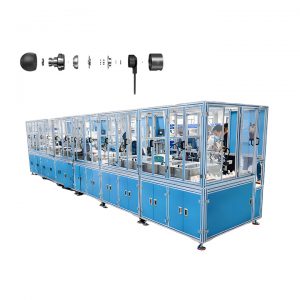
Miniature Speaker Automation Line
Miniature Speaker Automation LineAiming at TWS/wearing device special miniature speakers, it integrates high-precision visual positioning (±0.01mm), piezoelectric dispensing, laser welding and other core processes to realize full automation of magnetic circuit assembly, sound film lamination, solder joint inspection and electrical performance testing. The single production line has a beat of 0.8s/piece and a daily capacity of 120,000 pieces, which saves 85% manpower compared with the manual production line, and the yield rate has increased from 95% to 99.8%, and it is suitable for the production of mainstream TWS earphone speakers such as AirPods, Huawei FreeBuds, and so on.
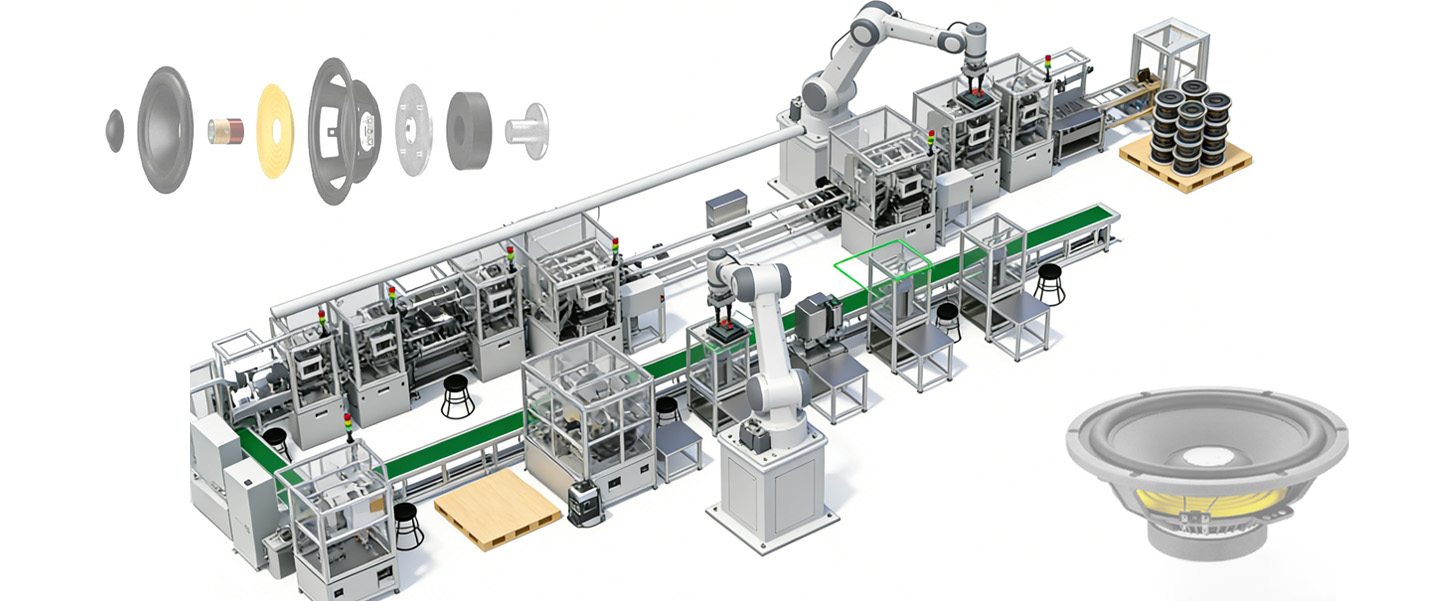
Small speaker automated production line
Small speaker automated production lineSuitable for headphones/smart speakers/tv speakers special small speakers, equipped with AI visual defect detection system (can identify 0.02mm tiny defects), fully automatic air tightness testing (pressure accuracy ± 0.01KPa), automatic winding and other modules, support multi-specification flexible production, changeover time <25 minutes. The production line adopts modularized design, which can be flexibly expanded according to customer's capacity demand.
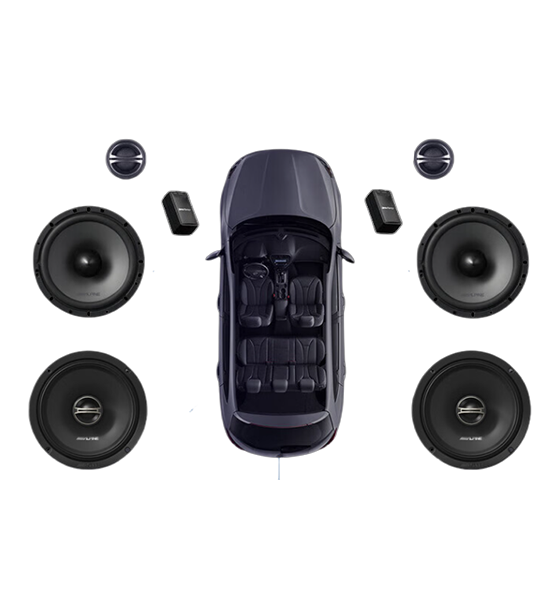
Medium-sized speaker automation production line
Medium-sized speaker automation production lineFor car/home audio special medium-sized speakers, integrating six-axis collaborative robots, high-precision force-controlled assembly (±0.05N), full-frequency acoustic testing and other technologies, supporting eight specifications of speakers co-production, to meet the demand for small-lot, multi-variety production of car audio and smart home speakers. The production line is equipped with MES system, realizing real-time monitoring of production data and automatic warning of quality abnormality.

Headphone Speaker Automation Production Line

Automated production line for headphone speakersAutomated production line for headphone speakersExample products: SECY parts/brake pads/heat sinks/refrigeration equipment

Headphone Speaker Automation Production Line

Realization of automated total assembly of headphone speakers
  • brandingJiuju Automation
  • production capacities≧1300PCS/H
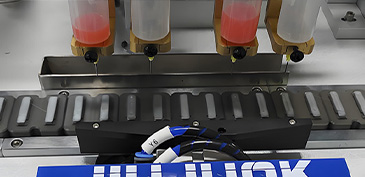
  • processAutomatic loading, gluing, spot welding, AOI inspection, UV curing, wire cutting and unplugging, lead-through measurement, height measurement.

Customization Process Customization process

Every line is engineered around the customer's product and takt time — stations, fixtures, conveying and inspection are all redesigned from scratch. The project runs through seven stages, each with defined deliverables and a clear customer sign-off point.

1
Requirement Review
& Concept Design
7–15 days
Technical specification
2
Design Freeze
& Contract
3–7 days
Technical agreement
3
Design, Build
& In-house Debug
30–60 days
Drawings & PLC programs
4
FAT
Factory Acceptance
3–5 days
FAT record
5
On-site Install
& SAT
5–10 days
SAT report
6
Mass-production
Validation
3–10 days
Validation report
7
Final Acceptance
& Handover
2–3 days
Manuals & spare parts
Typical total lead time is 45–120 calendar days, with manufacturing and in-house debugging accounting for the largest share. Once the concept is frozen, changing a core process parameter — part size, takt time or number of stations — forces knock-on changes to the mechanics, electrical control and layout, and can extend the schedule by more than 30%. A design freeze therefore requires the customer's written confirmation.
Products

Headphone Speaker Automation Production Line Product Details

In the field of consumer electronics, cell phone speaker monoblocks and soldered Bluetooth headset cores as the core acoustic components, the assembly accuracy directly determines the sound quality resolution and product reliability, while the assembly of such micro-components are often faced with space constraints, cumbersome processes, consistency is difficult to control and other pain points, the traditional manual operation can not be adapted to meet the demand for large-scale production of high-end headphones. For this segmentation scenario, we developed the headset speaker automation production line came into being, specially designed for cell phone speaker monobloc and soldered bluetooth headset core customized design, with high standard configuration and precision technology, to build micro-acoustic components of the automated manufacturing solutions.

Miniature Speaker Automation Line

The production line is designed to meet the needs of micro-component assembly and accurately covers the core production process. In view of the thin structure of the cell phone speaker unit and the precision welding requirements of the internal welding Bluetooth headset core, the production line adopts the structure of "segmented precision assembly + core process enhancement" to complete the whole process of magnetic circuit assembly, voice coil winding, diaphragm lamination, lead welding, performance testing and other operations in sequence. Magnetic circuit assembly is equipped with customized miniature vibration plate feeding, with high-definition CCD visual positioning system, to achieve T-iron, miniature magnets and other small-sized parts of the accurate grabbing and positioning, positioning accuracy of ± 0.01mm, to completely solve the problem of manual operation of the miniature parts are prone to drift. The internal welding process is exclusively equipped with a micro laser welding module, with a welding precision of 0.02mm, effectively avoiding the problems of false welding and leakage that are easily caused by manual welding, and guaranteeing the stability of the electrical connection of the earphone core.

High-standard hardware configuration is the core guarantee of precision and stability. The production line fully adopts the core parts of the first-tier brands at home and abroad, and the drive system adopts Panasonic servo motors from Japan to ensure the precise and controllable operation of each station; the detection unit is equipped with Keens vision sensors from Germany to realize the precise identification of tiny defects; the transmission structure adopts Swiss precision ball screws, and with the customized precision fixtures, the mechanical error during the assembly process can be controlled to be less than 0.005mm. For the assembly characteristics of micro components, the jigs are made of aviation-grade aluminum alloy through five-axis machining centers, and the surface is anodized to ensure rigidity and wear-resistant characteristics, and the service life of a single set of jigs can reach more than 100,000 hours, which provides a solid support for the consistency of the products.

Intelligent control and flexible production design enhance core competitiveness. The operation level is equipped with Chinese visual human-machine interaction system, with 10-inch touch screen, real-time display of the operating status of each station, production capacity data and fault warning, support for one-key storage and invocation of process parameters, and can be independently operated by new employees after 2 hours of training. For the production of different types of cell phone speakers and Bluetooth headset cores, the production line supports modular quick changeover, through the replacement of special fixtures and call the preset parameters, the changeover time can be controlled within 15-20 minutes, to adapt to the production of 10mm miniature cell phone speakers to 15mm Bluetooth headset cores of multi-specification needs. In terms of production efficiency, the hourly production capacity can reach 1800-2200 sets, 8-10 times higher than the traditional manual production line, a single production line can reduce 90% labor input, significantly reducing labor costs and management costs.

The quality control system guarantees high-end demand in all aspects. The production line sets up multiple inspection nodes in key stations such as magnetic circuit assembly, diaphragm lamination, welding, etc. Through multi-dimensional inspections such as visual inspection, pressure sensing, acoustic testing, etc., real-time screening of dimensional deviation, misalignment of assembly, abnormal sound quality and other defective products, with an accuracy of 99.8%. The whole machine adopts a fully enclosed dust-proof and anti-static design, and is equipped with a constant-temperature and constant-humidity control system, which provides a clean and stable production environment for assembly of miniature parts, increasing the product qualification rate from 91% to more than 99.7%. Stable production environment for the assembly of micro-components, product qualification rate increased from 91% in manual assembly to more than 99.7%. Meanwhile, it is equipped with a production data traceability system, which realizes full traceability of the production process of each set of products, perfectly adapting to the quality control requirements of high-end headset brands, and becoming the core equipment for cell phone and bluetooth headset manufacturers to realize large-scale, high-quality production.

Related Cases

Recommendations

loading...

It's already to the last piece of content!

Frequently Asked QuestionsClick a question to expand

01How many operators does a headphone speaker line need?▼
The FB-430 needs just 1 operator. The machine handles automatic feeding, gluing, assembly and unloading of the U-yoke, magnet and washer set; the operator only replenishes material and performs patrol and sampling checks.
This is the typical configuration for a dedicated inner-magnet three-piece machine. Note that one-operator operation assumes incoming parts arrive on trays or in bulk. If packaging is mixed and manual sorting is needed, the actual requirement is 1.5 to 2 operators. So the figure of 1 is bound to a material condition, not an unconditional commitment.
02What does the 3000 PCS/H figure mean?▼
≥3000 PCS/H is the cycle capability of three-piece magnetic circuit assembly, about 1.2 seconds per piece. It is not the output of a complete headphone speaker line.
Actual output is affected by incoming consistency, adhesive curing time and replenishment frequency. If voice coil, diaphragm and inspection stations are added downstream, the line cycle rate must be recalculated from the bottleneck station; the figure of 3000 cannot simply be carried over.
This is the most common misreading at selection: taking a single machine cycle rate as the line output.
03What are the three pieces?▼
The U-yoke, the magnet and the washer, the three core parts of an inner-magnet speaker magnetic circuit. The FB-430 performs automatic magnet feeding, spacer feeding, U-yoke feeding and adhesive assembly.
Inner-magnet construction differs from outer-magnet: the magnet sits inside the U-yoke and the washer sits against the magnet to form the gap, so locating accuracy directly determines gap uniformity. The core of such a machine is therefore not speed but consistency of locating and adhesive volume. Fast but uneven gaps mean rework downstream.
04How small a speaker can it handle, and is the accuracy sufficient?▼
It covers inner-magnet micro speakers for headphones, notebooks, phones and multimedia. Our published figures for the micro speaker line are ±0.01 mm locating accuracy, ≥99% coverage and ≥2000 UPH output.
The working range of the FB-430 is confirmed by part size; very small or irregular parts need dedicated tooling. To judge feasibility, look at three things: magnet size, U-yoke inner diameter and adhesive line width. If any is out of tolerance the tooling must change; the speaker outer diameter alone tells you nothing.
05What are the requirements for NdFeB magnets?▼
NdFeB is the mainstream magnet material for inner-magnet micro speakers: strong and compact, but sensitive to incoming consistency. It requires stable dimensional tolerance, no chipping and intact plating.
Chipping causes jams and locating offset; poor plating leads to insufficient bond strength. Neither can be corrected at the machine; both depend on incoming material control. We recommend agreeing sampling standards in the contract and providing samples for a trial run rather than discovering the variation during mass production.
06What are the floor space and power requirements?▼
The FB-430 measures 3300 × 1600 × 1500 mm, that is 3.3 m long, 1.6 m wide and 1.5 m high, about 5.3 square metres, with 1 m around it for operation.
Power depends on configuration (some dedicated machines use 220V); air supply is 0.5 to 0.8 MPa. Small machines like this suit a distributed layout: placing several units beside a large line to supplement a process is more flexible than concentrating everything on one long line, and it does not tie up a whole bay.
07Can it handle tweeters?▼
Use the FB-440 for inner-magnet tweeter three-piece magnetic circuit assembly, rated at ≥3000 PCS/H with 1 operator and the same 3300 × 1600 × 1500 mm footprint. It performs dual-locating magnetic circuit assembly with automatic magnet, spacer, U-yoke and adhesive feeding.
Tweeters differ from mid-woofers in magnetic circuit size and washer structure. If you make both, we recommend two separate machines rather than frequent changeover on one, because the changeover loss will consume the labour you saved.
08What should be watched in changeover and acceptance?▼
Changeover time is confirmed by the number of tooling sets; a single machine is usually quicker than a complete line. For acceptance we recommend four items: cycle rate, magnetic gap consistency (concentricity), bond strength and defect rate.
The key defects in inner-magnet micro parts are magnet offset and adhesive overflow. Both standards should be set and samples retained at the trial stage. Yield ≥99.5% is our published figure, subject to the customer product and acceptance standard. A standard that says only pass is useless; it must state what is measured and how.

Recommended Products

Recommendations

loading...

It's already to the last piece of content!

Jiuju Automation · Factory: Dongguan, Guangdong, China · Company: Shenzhen, Guangdong, China · Tel: 400-626-8699