JiuJu Automation focuses on the intelligent upgrading of the whole process of speakers, integrating the four core technologies of visual inspection, precision assembly, AI quality inspection and data traceability to provide customized solutions for TWS headphones, car audio, multimedia smart audio speakers, etc., and achieve production capacity increase of 300%+, yield rate of 99.8%, and reduce the comprehensive cost of 60%, completely solving the pain points of the industry, such as manual dependence, stable quality control and delivery cycle. dependence, unstable quality control, long delivery cycle and other industry pain points. Based on the product characteristics and production scenarios of speakers, it creates a full-process automation system from the entry of raw materials to the release of finished products from the warehouse, covering the three major categories of micro, small and medium-sized, and adapting to the needs of multi-specification and multi-batch production.
Realization of speaker T-iron to finished product assembly as a whole
brandingJiuju Automation
processAutomatic T-iron, magnet, pot holder, gauge, wave, voice coil, drum paper loading, automatic dispensing, pressing, welding, testing, packaging and so on.
work efficiency≧2500PCS/H
Design AdvantagesAdopt linear double-station structure design, space saving, simple debugging operation, realize the automatic material loading and assembling, IO communication control system, full-station detection and identification sensors, can be connected to the MES system, rich expansion module, convenient for subsequent upgrading and overhaul.
operator 1 person
Key componentsPanasonic PLC controller, Japan servo, vibration plate loading, Japan guide rail, precision CNC machining, Panasonic touch screen, Huichuan robot
Customization Process Customization process
Every line is engineered around the customer's product and takt time — stations, fixtures, conveying and inspection are all redesigned from scratch. The project runs through seven stages, each with defined deliverables and a clear customer sign-off point.
1
Requirement Review & Concept Design
7–15 days
Technical specification
2
Design Freeze & Contract
3–7 days
Technical agreement
3
Design, Build & In-house Debug
30–60 days
Drawings & PLC programs
4
FAT Factory Acceptance
3–5 days
FAT record
5
On-site Install & SAT
5–10 days
SAT report
6
Mass-production Validation
3–10 days
Validation report
7
Final Acceptance & Handover
2–3 days
Manuals & spare parts
Typical total lead time is 45–120 calendar days, with manufacturing and in-house debugging accounting for the largest share. Once the concept is frozen, changing a core process parameter — part size, takt time or number of stations — forces knock-on changes to the mechanics, electrical control and layout, and can extend the schedule by more than 30%. A design freeze therefore requires the customer's written confirmation.
Products
Automated production line for automobile speaker Product Details
In the field of car audio manufacturing, car speaker as a key acoustic component, its assembly accuracy and consistency directly affects the acoustic experience of the car, while the traditional segmented production mode is often faced with process fragmentation, manual intervention, data traceability and other pain points, especially difficult to adapt to the long order cycle, mass production of quality and stability of the demand. In response to this core demand, we developed the automated production line for automotive speakers, realizing the whole process of automated assembly from the T-iron input to the finished product packaging, and becoming the core equipment for the manufacturing of long-cycle and high-volume automotive speakers with high-end design, intelligent control and stable performance.
The production line takes the whole process automation as its core competitiveness, and builds a closed-loop production system of "raw material input-precision assembly-testing and grading-finished product packaging". The starting end is equipped with T-iron automatic loading mechanism, through servo mechanical arm and CCD visual positioning system to achieve accurate gripping and positioning, positioning accuracy of ± 0.02mm, followed by the subsequent completion of the magnetic circuit assembly, voice coil winding, diaphragm lamination, terminal welding and other key processes in turn, the various workstations through the intelligent conveyor system seamlessly, the whole process without human intervention. For the precision requirements of automobile speaker assembly, the key stations are equipped with imported servo drive module, which can accurately control the assembly pressure and stroke, for example, the magnetic circuit riveting pressure control accuracy reaches 0.1N, which effectively avoids the assembly deviation caused by manual operation. The terminal finished product packaging link integrates automatic sorting, counting and encapsulation systems, realizing the unmanned operation of the whole process from raw materials to finished products.
High-end design and intelligent control form a multi-dimensional competitive advantage. The structural design adopts aviation-grade aluminum alloy frame and fully enclosed dustproof shell, together with precision machining process, which not only guarantees the rigidity of the whole machine but also improves the texture of the equipment, which meets the needs of high-end manufacturing workshop layout. The operation level is equipped with visualization industrial software, 10-inch touch screen, real-time display of the operating status of each station, production capacity data and fault warning, the staff can complete the parameter setting and process monitoring after simple training, support for the process parameters of the one-key storage, the replacement of the pre-set program directly call. Modular design makes the equipment maintenance more flexible, each functional unit can be disassembled independently for maintenance, which greatly shortens the downtime and increases the comprehensive utilization rate of the equipment to more than 95%.
Quality assurance and data management meet high-end production requirements. The production line is equipped with a multi-station AOI visual inspection system, which detects dimensional accuracy, assembly deviation and appearance defects in real time at key nodes such as magnetic circuit assembly, diaphragm lamination, welding, etc., with an accuracy of 99.8%, and automatically rejects non-conforming products and records the type of defects. The data-based process analysis system collects production data from each station in real time, generates reports on production capacity trend and fluctuation of qualified rate, supports data export and traceability, and helps enterprises optimize the production process. The whole machine has been tested by 1000 hours of continuous operation, and the failure rate is lower than 0.3%. It is stably adapted to the scenarios of long order cycle and mass production, which can improve the efficiency of a single production line by more than 6 times, and the qualified rate of the product is increased from 94% in manual assembly to 99.6%.
The production line is widely adapted to the manufacture of various types of automotive speakers, such as car subwoofers, tweeters, coaxial speakers, etc. It is especially suitable for the long cycle and large-volume order demand of the supporting suppliers of automotive OEMs. Through automation upgrading and intelligent control, it not only reduces 80% labor input, but also guarantees the quality stability, provides core support for the enterprise to build a highly efficient, accurate and traceable production system, and promotes the transformation of the automotive audio manufacturing industry to intelligence and scale.
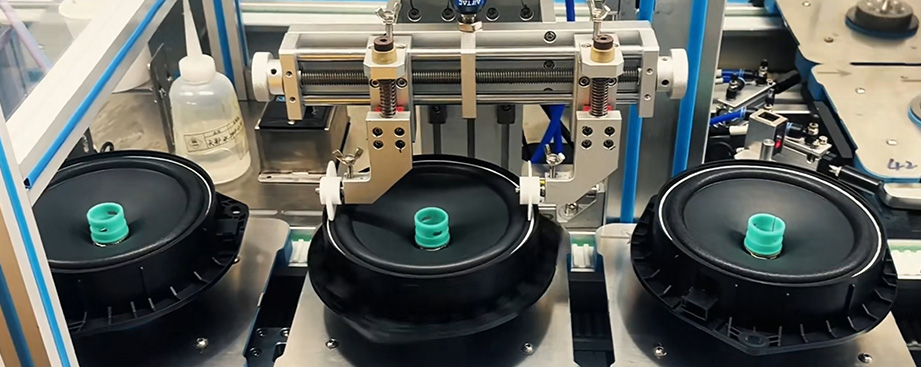
Footage of the automotive woofer automatic assembly line: magnetic circuit assembly, voice coil positioning and diaphragm bonding are automated across all key stations, locking assembly errors within the tolerance band.Contact Jiuju Automation for…
Live footage of the automatic assembly of the soft-parts section of square multimedia internal-magnet loudspeakers, showing precision assembly of flexible acoustic components such as voice coils, spiders and cones, ensuring coaxial positioning and…
Automotive external-magnet loudspeaker automatic assembly line: it integrates feeding, assembly and inspection in one process, fully automatic from component transport to finished-product offloading, eliminating human error.Contact Jiuju Automatio…
Fully automatic tunnel baking line for automotive loudspeakers: independent temperature control in multiple zones and PID closed-loop regulation ensure every loudspeaker cures under the same thermal history.Contact Jiuju Automation for more quotes…
loading...
It's already to the last piece of content!
Frequently Asked QuestionsClick a question to expand
01How many operators does an automotive speaker assembly line need?▼
The FB-610 runs with 15 operators per shift (per the model specification table; actual headcount depends on your process). The most misunderstood point is the claim that one person runs a whole line: that refers only to the magnetic circuit section, which operates unmanned across 9 stations from T-yoke loading to magnetic circuit dust removal (automatic T-yoke feeding, dust removal, glue dispensing, magnet feeding, gauge insert and extract, magnetic circuit pressing, washer and spacer feeding, magnetizing, dust removal output). Operators are concentrated in the soft-part assembly section (voice coil, spider, cone, dispensing, pressing) and in inspection and packing. So the answer depends on which section you ask about: for the magnetic circuit alone, close to unmanned; for the complete line including inspection and packing, 15 operators. We do not quote a blanket labour-saving percentage, because it depends on how many people your current line uses and how shifts are organised. A percentage divorced from your existing line means nothing.
02What output and uptime can the line achieve?▼
The FB-610 is rated at ≥1000 PCS/H (PCS/H is synonymous with UPH, pieces per hour); our published figure is a standard capacity of 900 to 1100 UPH with availability ≥85%. The key distinction is between rated and effective capacity: effective capacity = cycle rate × availability × yield. At 1000 PCS/H, 85% availability and 99.5% yield, effective output is about 846 PCS/H. The rated figure only holds under ideal conditions. The ceiling is set by the bottleneck station cycle time, not by the line average. Actual values are confirmed by the acceptance report signed by both parties.
03How long does changeover take, and how much capacity does it consume?▼
Changeover takes 20 to 60 minutes, depending on the model and the number of tooling sets. It is achieved through modular design, quick-change tooling and recipe switching, so mixed production across several models does not require structural changes to the line. One unfavourable fact must be stated: changeover on an automated line is usually longer than on a manual line, because there are more adjustable stations and more parameters to re-confirm. To judge whether automation pays off, calculate the changeover loss first: changeover time × changeover frequency ÷ available working hours. For a single model in high volume the advantage is clear; for many models in small batches, changeover loss can eat most of the efficiency gain. Before selecting a line, provide the model list (size range, inner or outer magnet, number of tooling sets). Changeover time must be checked model by model. Whether the line can handle all of your models depends on those three variables, not on a single word yes.
04What sizes and types of speakers does the line handle?▼
The FB-610 covers the full assembly chain for automotive audio speakers: T-yoke, magnet, frame, spider, voice coil, cone, dispensing, pressing, welding, inspection and packing. On the magnetic circuit it handles both inner-magnet tweeters and outer-magnet mid-woofers, which is the main difference from single-circuit models. Our published coverage across the range is inner and outer magnet, round and square, 3 to 8 inch and micro speakers, covering tweeter, mid-range and woofer units. That is the capability of the whole range, not of a single FB-610. Compatibility must be verified model by model. For reference, other models in the range cover different jobs: FB-620 for car-audio retrofit and mid-woofers; FB-430, FB-510, FB-520, FB-550 and FB-710 for section-by-section delivery; FB-720 for complete inner-magnet assembly of smart speakers.
05How much floor space and power does the line need?▼
The FB-610 measures 53000 × 3000 × 2000 mm, that is 53 m long, 3 m wide and 2 m high. Allow 1 to 2 m around the equipment for operation and maintenance, including changeover and tooling handling. Power is 380V three-phase (220V for some dedicated machines), with a voltage stabiliser and a dedicated circuit breaker. Air supply is 0.5 to 0.8 MPa, and a dry air source must be available on site. Total power is calculated from the actual line configuration and confirmed at the proposal stage. Configurations differ substantially depending on whether acoustic testing, leak testing and AOI stations are included, so we do not publish a blanket kilowatt figure. Floor space is a hard constraint: 53 m is the length of the equipment itself, not the usable length of your building. Confirm the layout against column spacing, material flow, loading area and maintenance access. Do not measure your workshop against the equipment length.
06How are yield and acceptance criteria defined?▼
Yield ≥99.5% is our published figure, with availability ≥85%. Both are subject to the customer product and acceptance standard, and the preconditions must be written into the proposal. We recommend specifying four acceptance items in the contract: (1) cycle-rate achievement, measured cycle time divided by agreed cycle time; (2) yield, good units divided by input units, counted by batch and broken down by defect mode; (3) OEE, availability × performance × quality; (4) changeover time, the complete process of switching from one model to another. Mass-production validation follows the common industry practice of a continuous 72-hour run, which tests continuous operation, changeover, exception handling and batch variation. A single batch passing trial production does not prove long-term stability. Definitions vary enough to double or halve the same number, so all four items belong in the contract.
07How far can quality traceability go?▼
Inspection data is bound to batch and individual unit and written to MES, so production parameters and inspection results can be queried. The data layer consists of IO communication, MES integration and a data dashboard, giving visibility and traceability of output, yield and equipment status. Which process steps are traceable depends on the inspection stations actually configured. Magnetic circuit pressing, magnetizing, dispensing, welding, and acoustic and leak testing are the five commonly installed. Tracing to an individual unit requires a unique code written between process steps, by inkjet or laser marking, so that scanning retrieves the full parameter record for that unit. The boundary must be clear: with final inspection only and no in-process records, a problem cannot be traced to a station or a batch. This is the point customers raise most often in factory audits, and it determines whether vision and sensing stations are worth adding.
08How long is the payback compared with a manual line?▼
Payback for the FB-610 is calculated project by project; we do not publish a single figure, because it depends on local labour cost, capacity utilisation, unit price and the defect rate of your current line. Change any one of them and the conclusion changes. What we can give you is the method: capacity gain = (new cycle rate − current cycle rate) × effective working hours × yield improvement. Defect cost saving = current defect rate × output × loss per unit − post-automation defect cost, including rework, scrap and warranty risk. One reference value you can use as an input: manual lines typically run a 3 to 5% defect rate in magnetic circuit and riveting operations, against ≥99.5% yield after automation. To run the calculation for you, we need four inputs: headcount and shift pattern of your current line, current actual cycle rate, target annual output, and unit price together with defect rate.
 Speaker automation jiujuauto














 简体中文
 English
 Tiếng Việt
 日本語
 한국어
 ไทย
 हिन्दी
 বাংলা
 Français
 Español de Perú
 Русский