JiuJu Automation focuses on the intelligent upgrading of the whole process of speakers, integrating the four core technologies of visual inspection, precision assembly, AI quality inspection and data traceability to provide customized solutions for TWS headphones, car audio, multimedia smart audio speakers, etc., and achieve production capacity increase of 300%+, yield rate of 99.8%, and reduce the comprehensive cost of 60%, completely solving the pain points of the industry, such as manual dependence, stable quality control and delivery cycle. dependence, unstable quality control, long delivery cycle and other industry pain points. Based on the product characteristics and production scenarios of speakers, it creates a full-process automation system from the entry of raw materials to the release of finished products from the warehouse, covering the three major categories of micro, small and medium-sized, and adapting to the needs of multi-specification and multi-batch production.
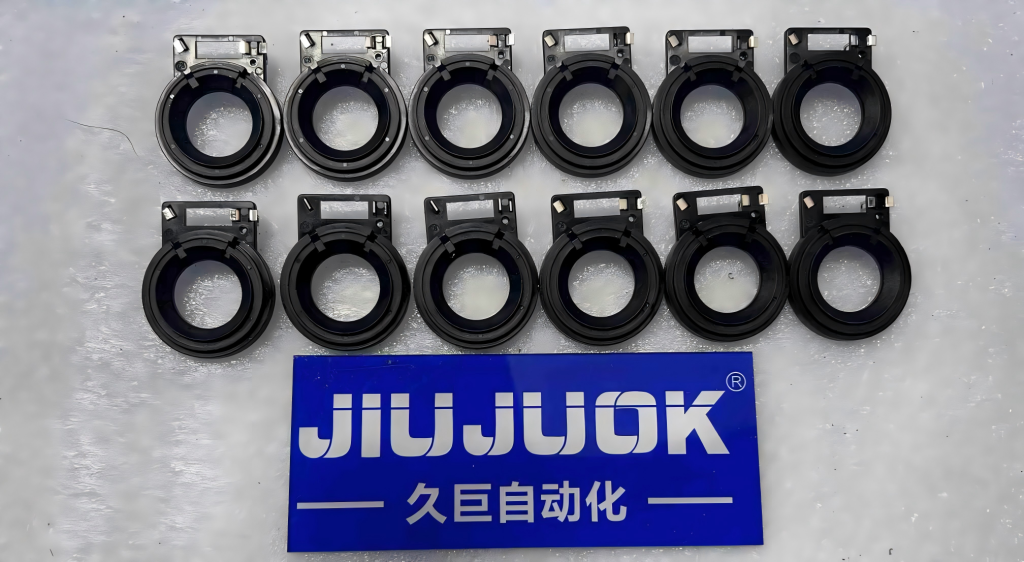
Automation of tweeter welding segment sub riveting
brandingJiuju Automation
processAutomatic loading and unloading of pads and brackets, riveting, and testing
Design AdvantagesAdopt single station modular structure design, integral assembly automatically, space saving, debugging operation is simple, realize the material on the material and assembly automatically, IO communication control system, full station detection and identification sensors, can be connected to the MES system, convenient for subsequent upgrading and overhaul.
work efficiency ≧1300PCS/H
operator1 person
Key componentsPanasonic PLC controller, Japan servo, vibration plate loading, Japan guide rail, precision CNC machining, Panasonic touch screen, Huichuan robot
For standalone and special-purpose machines the tooling and parameters are already fixed, so the fastest and lowest-cost way to verify the process is to send us your real parts and have them run on our equipment. Seven steps, 3–10 working days.
1
Trial Request & Requirement Check
1 working day
Trial request form
2
Part Receipt & Registration
1–2 days
Part log sheet
3
Tooling Setup & Parameter Setting
2–3 days
Trial plan
4
Trial Run with Process Records
1–3 days
Photos & video
5
Testing & Data Logging
1–2 days
Data log
6
Trial Test Report Issued
2 days
Trial report
7
Case Filing & Sharing
1 day
Case card
How we charge: trials are free for standard models with standard parts. For non-standard machines that need new tooling or station-by-station debugging, we charge according to normal industry practice (about 7–10 days), and the fee is credited against the order once it is placed. For confidential parts we can run the trial at your site, or in our plant under a signed NDA.
In the field of high-end audio manufacturing, the precision of tweeter terminal assembly directly determines the product's sound quality performance, while the traditional manual assembly mode has long faced pain points such as low efficiency, poor precision and lack of consistency. In response to this core demand, the tweeter terminal automatic assembly machine developed by us came into being, specially designed for the precise assembly scenario of plastic parts and positive and negative electrode lugs, reconfiguring the production process with automation technology to provide core support for the mass production of high-grade tweeters.
The core function of the equipment focuses on the full automation of the insertion process of positive and negative electrode pads for plastic parts, integrating the multi-station cooperative operation system to realize the unmanned operation of the whole process from material loading, accurate positioning, polarity identification to insertion molding. The equipment is equipped with high-precision vibration plate feeding mechanism, which can automatically sort and orient the positive and negative electrode pads, and cooperate with CCD visual recognition system to capture the positioning reference in real time to ensure that the alignment accuracy of the pads and the assembly holes of the plastic parts can be controlled within ±0.02mm, thus completely solving the problems of off-set and tilting that are easy to occur in manual insertion. For different types of tweeter terminals, the equipment supports rapid parameterized switching, through the touch screen operation can be completed feeding speed, insertion strength and other key parameters to adjust, suitable for a variety of specifications of product production needs.
The leap in productivity is one of the core advantages of the equipment. Traditional manual assembly per person per hour can only complete 300-500 sets of assembly, and need to be equipped with specialized personnel to carry out polarity verification and defect screening. This equipment through the design of multi-station parallel operation, the hourly production capacity of up to 2000 sets of more than 3-4 times the increase in production efficiency, a single production line can reduce 80% staffing, significantly reducing labor costs and management costs. At the same time, the equipment integrated online inspection module, after the completion of the insertion and assembly of real-time detection of the height of the solder pads, polarity and integrity of the plastic parts, substandard products are automatically rejected and the type of defects are recorded, effectively increasing the product qualification rate from 95% of manual assembly to 99.8% or more.
With the double guarantee of quality stability and batch production capacity, the equipment is perfectly adapted to the needs of high-grade product manufacturing. The equipment adopts imported servo drive system and precision ball screw transmission structure to ensure long-term mechanical stability, and the failure rate of the equipment in 24 hours of continuous operation is less than 0.5%. The machine body adopts fully enclosed dustproof design and is equipped with negative-pressure dust-removal system, which can effectively avoid the influence of dust on the contact performance of the terminals in the process of assembling, and can satisfy the reliability of high-grade application scenarios such as automobile audio, professional stage audio and so on. Requirements. In addition, the equipment is equipped with a production data traceability system, which can record in real time the assembly time, operator, inspection data and other information of each batch of products, realizing the traceability of product quality throughout the life cycle.
From the practical application value point of view, this equipment not only solves the efficiency and quality bottleneck of high-grade tweeter terminal assembly, but also helps enterprises realize flexible production layout through automation upgrade. Whether it is the capacity upgrading needs of small and medium-sized enterprises, or large-scale production planning for manufacturers, this equipment can provide customized solutions, and become the core equipment to promote the intelligent transformation of the audio manufacturing industry.
Footage of the automotive woofer automatic assembly line: magnetic circuit assembly, voice coil positioning and diaphragm bonding are automated across all key stations, locking assembly errors within the tolerance band.Contact Jiuju Automation for…
Live footage of the automatic assembly of the soft-parts section of square multimedia internal-magnet loudspeakers, showing precision assembly of flexible acoustic components such as voice coils, spiders and cones, ensuring coaxial positioning and…
Automotive external-magnet loudspeaker automatic assembly line: it integrates feeding, assembly and inspection in one process, fully automatic from component transport to finished-product offloading, eliminating human error.Contact Jiuju Automatio…
Fully automatic tunnel baking line for automotive loudspeakers: independent temperature control in multiple zones and PID closed-loop regulation ensure every loudspeaker cures under the same thermal history.Contact Jiuju Automation for more quotes…
loading...
It's already to the last piece of content!
Frequently Asked QuestionsClick a question to expand
01What does the terminal insertion machine do?▼
It inserts the positive and negative solder tabs into the plastic part of tweeter speakers: tabs and bracket are fed automatically, inserted into the plastic part, riveted and inspected. Done manually, the problem is that the two tabs are easily reversed or inserted too shallow, leading to weak solder joints later, and the fault is only found at final inspection. The machine fixes orientation with dedicated tooling and controls insertion depth by force monitoring, turning a feel-based operation into a parameter-based one.
02What are the output and headcount?▼
≥1000 PCS/H with 1 operator. The operator handles feeding and replenishment, patrol checks and sampling; insertion and riveting are done by the machine. At 8 hours per shift and 85% availability, effective daily output is about 6,800 pieces. The ceiling is set by the insertion station cycle; the inspection station is not a bottleneck. Actual values are confirmed by acceptance testing.
03How are tabs and brackets fed?▼
Both tabs and brackets are fed automatically, from tape or a vibratory bowl, into the station at cycle rate. The incoming packaging directly determines whether automatic feeding is possible: loose parts need additional orienting and sorting mechanisms, while tape-fed parts connect directly. This must be confirmed before selection, because modifying the feeding mechanism can cost more than the difference between machines, and it affects lead time and stability.
04How is inspection done after insertion?▼
Inspection follows riveting immediately, checking insertion depth, riveting strength and missing parts; rejects are ejected automatically with an alarm. Detection uses force and displacement monitoring plus station sensors, and is 100% in-line, not sampling. The boundary must be stated: electrical performance (continuity, insulation, contact resistance) is outside this machine scope and needs a separate test station. Completing this operation therefore does not mean the terminal is functionally good; downstream testing cannot be skipped.
05What about size and floor space?▼
The machine measures 2000 × 1500 × 1500 mm, that is 2 m long, 1.5 m wide and 1.5 m high, about 3 square metres, with 1 m around it for operation. The single-station modular design suits the end of a line or a standalone station, and is easy to move and re-layout. The machine is not heavy; an ordinary workshop floor is sufficient, with no special foundation.
06What does single-station modular mean?▼
It means the whole machine is an independent station module that can run alone or be integrated as one section of a larger line. The benefit is flexible expansion: buy one to relieve a bottleneck, add a second in parallel when volume rises, or integrate into an automatic line. The cost is that machines need manual or mechanical transfer between them, unlike a complete line with continuous flow. Plan for the next two years of output; do not configure for maximum on day one.
07Which speakers does it suit?▼
Mainly plastic-part positive and negative tab insertion for tweeter speakers. Mid-woofers use different terminal forms (mostly binding posts or spring contacts), so tooling and feeding must be redesigned; wire soldering and FPC connection are outside this machine scope and belong to a soldering station. Provide the actual terminal or a drawing before selection; the speaker model alone does not tell us whether it can be done.
08How are changeover and trial runs arranged?▼
Changeover is confirmed by tab specification and plastic part structure; it mainly involves changing tooling and feed tracks. These machines support sample trial runs: free of charge for standard models with regular workpieces, taking 3 to 10 working days; non-standard tooling is charged at the usual rate and credited against the order; confidential workpieces can be trialled on site. The trial produces insertion depth and riveting strength records, which judge fit better than a specification sheet.
processAutomatic T-iron, magnet, pot holder, gauge, wave, voice coil, drum paper loading, automatic dispensing, pressing, welding, testing, packaging and so on.
 Speaker automation jiujuauto














 简体中文
 English
 Tiếng Việt
 日本語
 한국어
 ไทย
 हिन्दी
 বাংলা
 Français
 Español de Perú
 Русский