JiuJu Automation focuses on the intelligent upgrading of the whole process of speakers, integrating the four core technologies of visual inspection, precision assembly, AI quality inspection and data traceability to provide customized solutions for TWS headphones, car audio, multimedia smart audio speakers, etc., and achieve production capacity increase of 300%+, yield rate of 99.8%, and reduce the comprehensive cost of 60%, completely solving the pain points of the industry, such as manual dependence, stable quality control and delivery cycle. dependence, unstable quality control, long delivery cycle and other industry pain points. Based on the product characteristics and production scenarios of speakers, it creates a full-process automation system from the entry of raw materials to the release of finished products from the warehouse, covering the three major categories of micro, small and medium-sized, and adapting to the needs of multi-specification and multi-batch production.
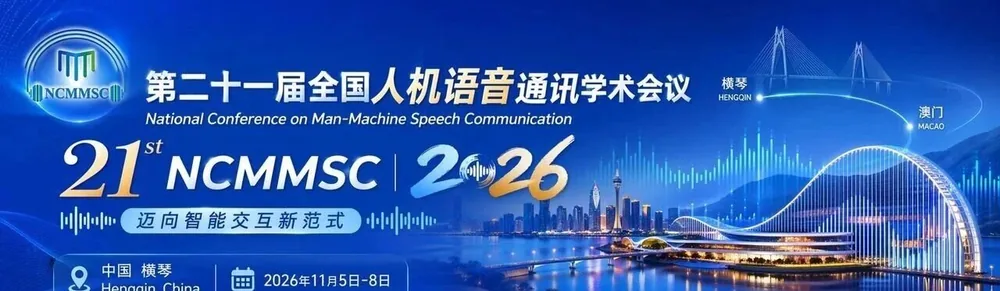
NCMMSC 2026 will be held at the Tianmu Qintai International Convention and Exhibition Center in Hengqin, Zhuhai, from November 5 to 8, 2026.
From November 5 to 8, NCMMSC 2026, a major national event for the speech technology industry, will take place at the Tianmu Qintai International Convention and Exhibition Center in Hengqin, Zhuhai. Under the theme "Speech × Language × Multimodality: Toward a New Paradigm of Intelligent Interaction," the conference will be held alongside NLPCC 2026 in Macao and AACL 2026 in Hengqin, bringing three academic communities together across the Greater Bay Area. According to the organizers, this is the first time NCMMSC has been held in the Greater Bay Area, and in 2026 the conference entered Category C of the CCF recommended conference list.
Most industry coverage stops at the surface level: distinguished speakers and open registration. For those of us manufacturing electroacoustic components, the more valuable signal lies beneath the agenda. Speech technology is moving into end devices, and both ends of those devices are acoustic components.
1. Signals from the agenda and the partner lineup
According to the organizers, the program includes five keynote speeches, six tutorials, twelve special topics, and twelve reports at the young researchers forum, plus an industry forum, a student forum, and a science outreach forum. Fifteen industry partners are participating, with a published list that includes Tencent, Xiaomi Group, iFlytek, OPPO, ModelBest, Speechocean, DataBaker, Huiting Technology, Shengyun Technology, Qingshu Zhihui, and Megatronix, among others.
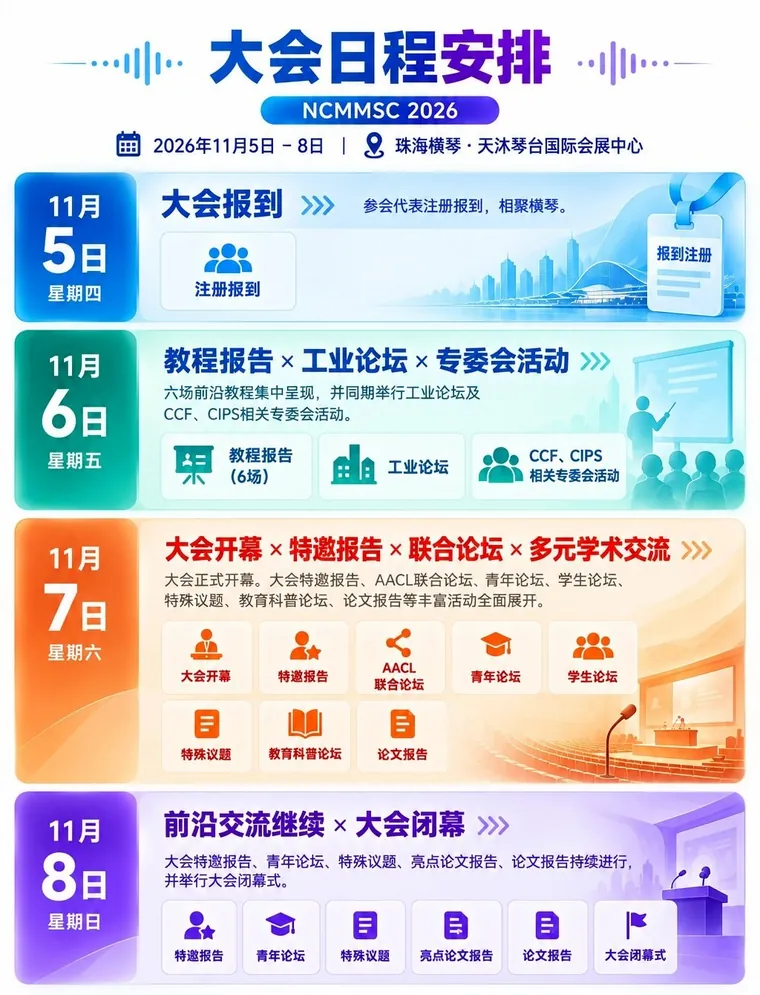
The four-day schedule: registration, tutorials and the industry forum, the opening with keynote speeches, and the closing session.
The direction this list points to is fairly clear. Speech technology has moved out of the lab and into smart cockpits, on-device systems, embodied intelligence, and developer ecosystems. The fact that the industry forum is given its own track also shows that the academic community is actively reaching toward industrial practice.
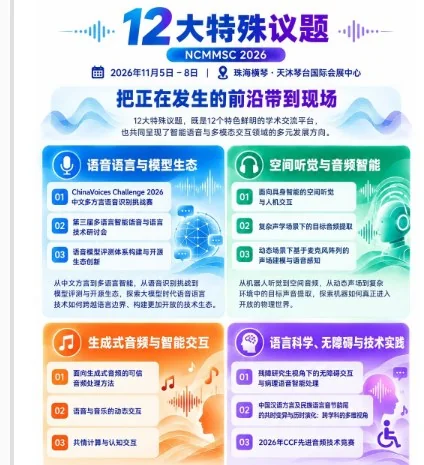
The 12 special topics span four directions: speech, audio, multimodality, and cross-disciplinary research.
2. Both ends of the voice chain are electroacoustic components
A complete voice interaction chain runs from sound capture through recognition and understanding to synthesis and playback. The conference focuses on the algorithmic middle of that chain, but both ends land on hardware: microphone arrays at the front, loudspeakers at the back. As algorithms keep raising the ceiling of voice quality, consistency on the hardware side becomes the practical bottleneck. However clean the training samples, if unit-to-unit variation in mass production is too large, the real-world experience will fall off a cliff.
This is especially visible in smart cockpits. A car cabin is a complex sound field with high noise, multiple speakers, and strong reflections, so the requirements on frequency response consistency, distortion control, and abnormal noise suppression are far stricter than for consumer products.
3. Three new questions for speaker automation assembly
First, consistency and traceability must reach down to the individual unit.When algorithm teams design on the assumption that every device can be recognized accurately, manufacturing has to answer a harder question: how much do the acoustic parameters differ between the first unit and the ten-thousandth unit of the same batch? And if something goes wrong, can it be traced back to a specific workstation and set of process parameters?
Second, high-mix low-volume production has become the norm.Smart cockpits, headphones, laptops, smart speakers, and in-car alert tones all use different speaker specifications, while order quantities keep shrinking. If a line cannot change over quickly, the resulting downtime eats directly into margin. Flexibility is no longer a bonus feature; it is an entry requirement.
Third, inspection is moving from sampling to full in-line testing.Parameters such as impedance, frequency response, and abnormal noise used to rely on manual spot listening. Once customers require per-unit data records, testing has to be automated in line and bound to each product serial number. The inspection station therefore shifts from a supporting step to a backbone of the production line.
4. Where Jiuju sits in this chain
Jiuju Automation focuses on automated speaker assembly, with lines covering automotive speakers, multimedia speakers, earphone speakers, and TV speakers, along with process modules for dispensing, magnetization, magnetic circuit assembly, terminal insertion, riveting, and in-line inspection. In response to the three requirements above, our approach is to connect process parameters with inspection data directly on the line: assembly stations record the critical parameters, the inspection station performs full acoustic testing, and once bound to each product the data becomes traceable.
If you are evaluating a speaker automation line, or need to improve changeover efficiency or inspection coverage on an existing line, contact Jiuju Automation for a proposal and quotation. Phone +86 134-2897-6919 / 180-0255-6337(WeChat same number), email sam@szjiuju.com / zhouxin@szjiuju.comThe
5. Conference information
Date: November 5-8, 2026 Venue: Tianmu Qintai International Convention and Exhibition Center, Hengqin, Zhuhai Theme: Speech × Language × Multimodality: Toward a New Paradigm of Intelligent Interaction General Chairs: Yu Kai (Shanghai Jiao Tong University), Jia Jia (Tsinghua University), and Wu Zhiyong (Tsinghua Shenzhen International Graduate School)
This article is an industry commentary prepared by Jiuju Automation based on publicly available conference information. It is not published by the conference organizers and does not represent their views. For the official agenda, speakers, and registration details, please refer to the organizers' announcements.
Source Source: Shenxue Lou (Acoustics Building). "Distinguished Speakers Gather as Three Conferences Convene: Shenxue Lou Invites You to NCMMSC 2026, the National Speech Industry Technology Event, in Hengqin, Zhuhai This November." WeChat public account, October 24, 2026.
 Speaker automation jiujuauto










 简体中文
 English
 Tiếng Việt
 日本語
 한국어
 ไทย
 हिन्दी
 বাংলা
 Français
 Español de Perú
 Русский