JiuJu Automation focuses on the intelligent upgrading of the whole process of speakers, integrating the four core technologies of visual inspection, precision assembly, AI quality inspection and data traceability to provide customized solutions for TWS headphones, car audio, multimedia smart audio speakers, etc., and achieve production capacity increase of 300%+, yield rate of 99.8%, and reduce the comprehensive cost of 60%, completely solving the pain points of the industry, such as manual dependence, stable quality control and delivery cycle. dependence, unstable quality control, long delivery cycle and other industry pain points. Based on the product characteristics and production scenarios of speakers, it creates a full-process automation system from the entry of raw materials to the release of finished products from the warehouse, covering the three major categories of micro, small and medium-sized, and adapting to the needs of multi-specification and multi-batch production.
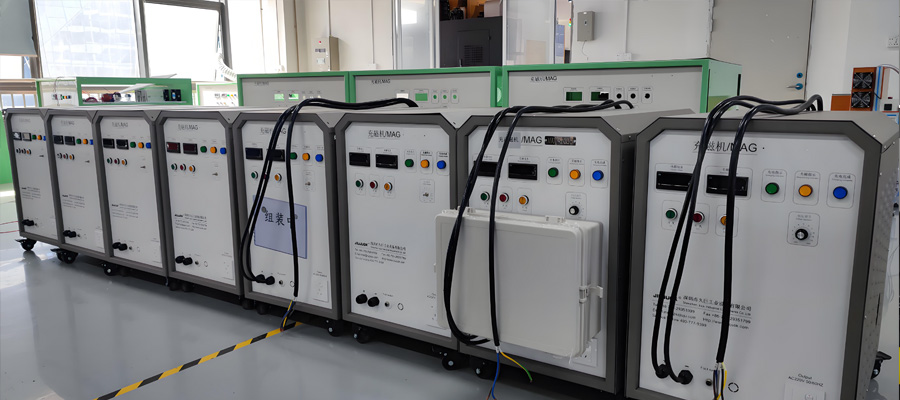
Efficient, uniform and stable magnetization of speaker magnets
Magnetic field strength0.1-7.0T (adjustable)
Single Magnetization Time0.001s
brandingJiuju Automation
Magnetization uniformity≥99%
Applicable magnet sizeΦ3-Φ400mm (customizable)
Power supply specificationsAC 220V/380V 50Hz 60HZ
production efficiency1500-2000pcs/h
Customization Process Customization process
For standalone and special-purpose machines the tooling and parameters are already fixed, so the fastest and lowest-cost way to verify the process is to send us your real parts and have them run on our equipment. Seven steps, 3–10 working days.
1
Trial Request & Requirement Check
1 working day
Trial request form
2
Part Receipt & Registration
1–2 days
Part log sheet
3
Tooling Setup & Parameter Setting
2–3 days
Trial plan
4
Trial Run with Process Records
1–3 days
Photos & video
5
Testing & Data Logging
1–2 days
Data log
6
Trial Test Report Issued
2 days
Trial report
7
Case Filing & Sharing
1 day
Case card
How we charge: trials are free for standard models with standard parts. For non-standard machines that need new tooling or station-by-station debugging, we charge according to normal industry practice (about 7–10 days), and the fee is credited against the order once it is placed. For confidential parts we can run the trial at your site, or in our plant under a signed NDA.
Products
Automatic Speaker Magnetizer Product Details
Magnetization is the key process to form a stable magnetic field in the magnetic circuit system of the speaker, and the uniformity and stability of the magnetic field strength directly determines the sensitivity, frequency response range and consistency of the sound quality of the speaker. Our speaker magnetizer adopts advanced multi-pole magnetizing technology, combined with intelligent control system, to provide efficient, uniform and stable magnetizing treatment for the speaker magnets, and safeguard the acoustic performance of the speaker from the source.
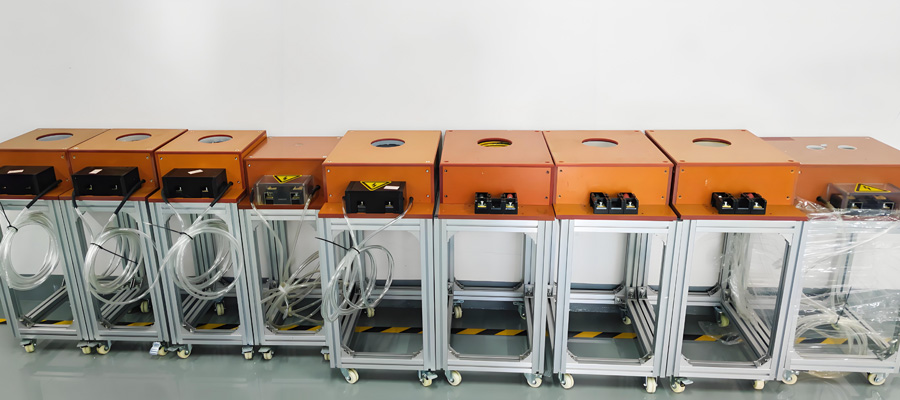
Multi-pole uniform magnetization technology: Adopting customized magnetizing head design, together with pulse magnetizing technology, it can realize accurate magnetizing of different materials of magnets such as NdFeB, ferrite, etc., and the uniformity of the magnetic field strength reaches more than 99%. For different polarity requirements of the speaker magnetic circuit (such as unipolar, bipolar, multi-polar), the magnetizing head can be quickly replaced to meet diversified production needs.
Highly efficient and fast magnetization capabilityThe equipment adopts high-frequency magnetizing power supply, the single magnetizing time is only 0.01-0.05 seconds, and the single equipment can handle 1500-2000 magnetic steel workpieces per hour. Compared with the traditional magnetizing machine, the efficiency is increased more than 3 times, and the magnetic field strength of the magnet steel after magnetization is stable, the demagnetization rate is lower than 0.5%/year, which guarantees the sound stability of the speaker for long-term use.
Intelligent Magnetic Intensity Detection SystemThe equipment integrates a high-precision magnetic field strength detector, which automatically detects the magnets after magnetization is completed, and automatically sorts unqualified products to avoid defective products from flowing into the next process. At the same time, the system can record the magnetization parameters and inspection data of each batch of products in real time, and support the data export, which is convenient for production quality traceability.
Safe and energy-saving designIt is equipped with perfect safety protection system, including high-voltage insulation protection, over-current protection, over-heating protection, etc., and infrared protection device is set up in the operation area to guarantee the safety of the operators; it adopts energy-saving magnetizing power supply, with the standby power consumption lower than 50W, which saves energy of more than 30% compared with the traditional equipment, and reduces the cost of energy consumption of the customer's production.
2,Scenarios and Customer Value
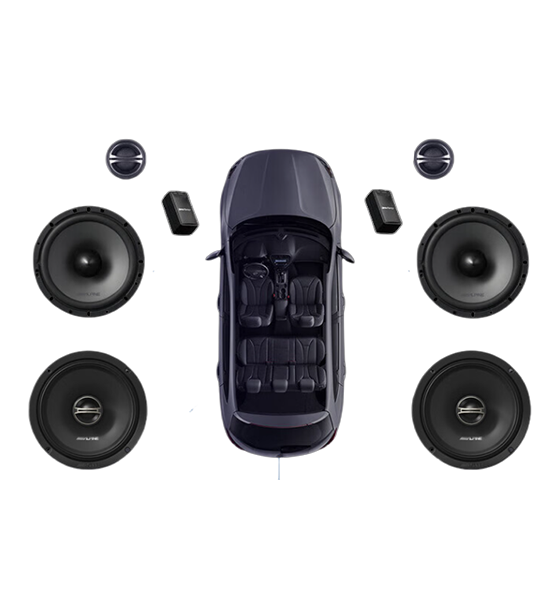
The device is adapted toVarious types of speaker magnets (NdFeB magnets, ferrite magnets, SmCo magnets)It is widely used in the production process of headphone speakers, audio speakers, car speakers, walkie-talkie speakers, medical equipment speakers and other products. Through the accurate magnetization treatment of this equipment, the magnetic field distribution of the speaker's magnetic circuit is even, which can effectively improve the sensitivity of the speaker (by 5-10dB), optimize the frequency response curve, and make the sound quality clearer and the bass sound fuller. At the same time, the efficient production capacity and intelligent inspection system can help customers reduce the rework rate, shorten the production cycle and improve the overall production efficiency.
3,Manufacturer strength and service guarantee
As a source manufacturer specializing in the research, development, manufacturing and sales of speaker production equipment, we have a 10,000 square meters production base, a 20-person core R&D team and a perfect after-sales service system. All equipments have passed ISO9001 quality system certification, providingFree door-to-door installation and commissioning, 7 days free operation training, 1 year machine warranty, lifelong technical maintenanceetc. For the customer's special production needs, we can provide customized equipment development services, from the program design to the delivery of equipment for the whole process of personal follow-up.
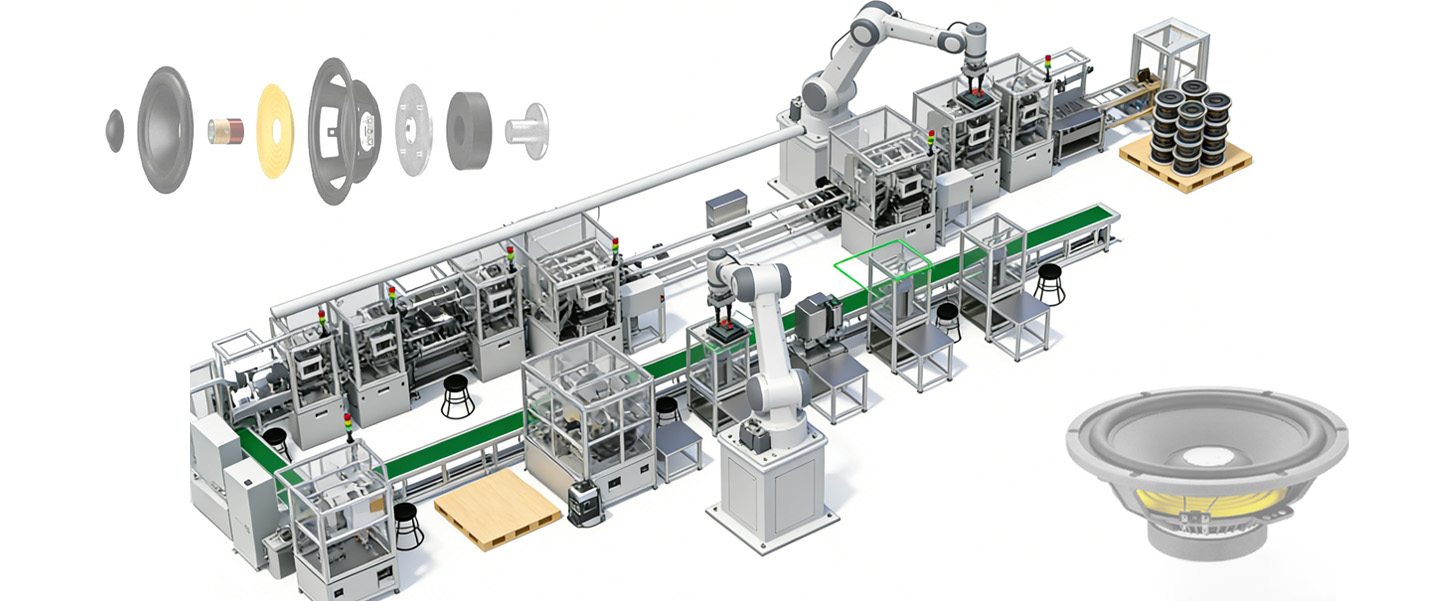
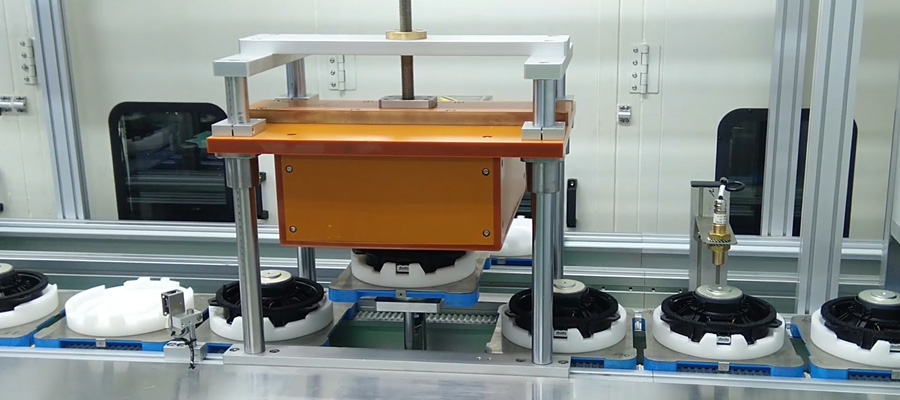
Footage of the automotive woofer automatic assembly line: magnetic circuit assembly, voice coil positioning and diaphragm bonding are automated across all key stations, locking assembly errors within the tolerance band.Contact Jiuju Automation for…
Live footage of the automatic assembly of the soft-parts section of square multimedia internal-magnet loudspeakers, showing precision assembly of flexible acoustic components such as voice coils, spiders and cones, ensuring coaxial positioning and…
Automotive external-magnet loudspeaker automatic assembly line: it integrates feeding, assembly and inspection in one process, fully automatic from component transport to finished-product offloading, eliminating human error.Contact Jiuju Automatio…
Fully automatic tunnel baking line for automotive loudspeakers: independent temperature control in multiple zones and PID closed-loop regulation ensure every loudspeaker cures under the same thermal history.Contact Jiuju Automation for more quotes…
loading...
It's already to the last piece of content!
Frequently Asked QuestionsClick a question to expand
01What is the output of the magnetizer?▼
≥1200 PCS/H, about 3 seconds per piece, including loading, magnetizing and unloading. The cycle is mainly limited by capacitor charging time: more energy means fuller saturation and longer charging. If the product needs multi-pole or repeated magnetizing, the cycle adds up accordingly. Actual output is confirmed by acceptance testing; the rated figure assumes standard workpieces and a single magnetizing pulse.
02Which magnetic circuits can it magnetize?▼
Inner-magnet main magnets and secondary magnets, plus in-line magnetizing in the magnetic circuit section. Different circuits need different magnetizing fixtures and directions: axial, radial, multi-pole, thickness direction and so on. The fixture determines the field distribution, so changing product mainly means changing the fixture and calling up new parameters. The boundary must be stated: fixtures are custom parts, and non-standard circuits need separate design and verification. A universal fixture cannot be made to fit; the resulting surface flux usually falls short of saturation.
03How is magnetizing saturation assured?▼
Through capacitor discharge: a high-voltage capacitor stores energy and discharges instantly, producing a field stronger than the intrinsic coercivity (Hcj) of the material so that the magnet reaches saturation. The key parameters are stored energy, discharge voltage and fixture matching. Saturation cannot be judged from the machine display; measure surface flux or magnetic flux and compare with the material datasheet. The typical symptom of under-saturation is low surface flux with large batch variation. When that appears, check the fixture and energy first, not the magnet material.
04Can it be integrated into an assembly line?▼
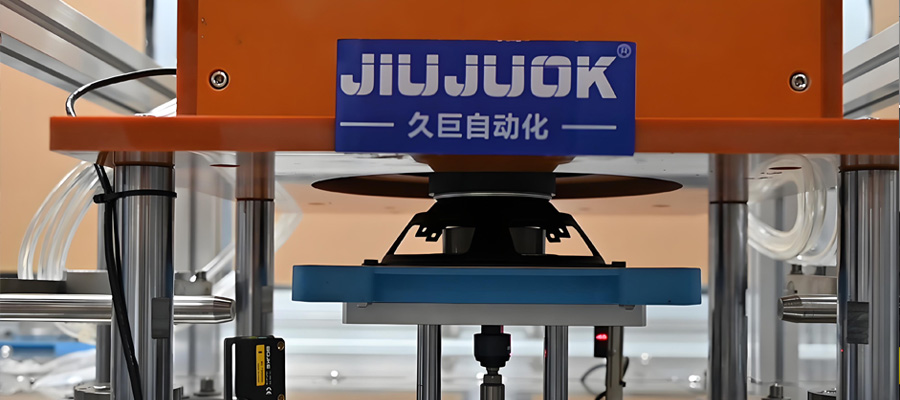
Yes. It supports in-line integration as one station of the magnetic circuit section, and MES integration to record magnetizing parameters for every unit. Two points need attention when integrating: the strong field at the instant of magnetizing interferes with nearby sensors and electronics, so magnetic shielding and station isolation are needed; and magnetized magnets attract each other, so the transfer mechanism needs an anti-attraction design. Both should be settled at the proposal stage; changing them later costs more.
05What are the power and air requirements?▼
Power is 380V three-phase; air supply is 0.5 to 0.8 MPa, with a voltage stabiliser and dry air source on site. The control system is Panasonic PLC plus Japanese servo. A magnetizer is a pulsed high-current load and stresses the grid. We recommend a dedicated circuit with a circuit breaker of adequate capacity, not shared with precision test equipment. Installed power is given at the proposal stage according to the model configuration; we do not publish a blanket figure on the page.
06How is magnetizing consistency controlled?▼
Three layers: the machine fixes stored energy and discharge voltage and logs them per unit; the process side samples periodically with a gaussmeter or fluxmeter; the data side binds magnetizing parameters and inspection results to the batch or the individual unit. The usual causes of poor consistency are fixture wear, capacitor ageing and magnet batch variation. Capacitors are wear parts and their capacitance decay must be checked periodically; once decayed enough, the parameters are unchanged but the actual magnetizing energy is no longer sufficient.
07How long does changeover take between magnetic circuits?▼
Mainly the fixture change, usually quicker than a line changeover. Changeover involves three things: change the magnetizing fixture, call up the corresponding parameter recipe, and verify surface flux on a sample. Changeover time is confirmed by fixture structure and quantity. For customers with many varieties we recommend one fixture set per main circuit, to avoid frequent disassembly affecting locating accuracy and fixture life. One fixture set costs far less than the downtime it prevents.
08Should I buy an in-line unit or a standalone machine?▼
It depends on output and process linkage. Below 5,000 pieces a day with many circuit specifications, a standalone magnetizer is more flexible and the manual transfer cost is acceptable. Above 10,000 a day with a single circuit, in-line integration pays off clearly: it removes transfer and re-locating, and avoids knocking magnetized magnets together. The two are not alternatives: many customers run in-line magnetizing on the line plus one standby standalone machine for changeovers and maintenance.
processAutomatic T-iron, magnet, pot holder, gauge, wave, voice coil, drum paper loading, automatic dispensing, pressing, welding, testing, packaging and so on.
 Speaker automation jiujuauto








 简体中文
 English
 Tiếng Việt
 日本語
 한국어
 ไทย
 हिन्दी
 বাংলা
 Français
 Español de Perú
 Русский