JiuJu Automation focuses on the intelligent upgrading of the whole process of speakers, integrating the four core technologies of visual inspection, precision assembly, AI quality inspection and data traceability to provide customized solutions for TWS headphones, car audio, multimedia smart audio speakers, etc., and achieve production capacity increase of 300%+, yield rate of 99.8%, and reduce the comprehensive cost of 60%, completely solving the pain points of the industry, such as manual dependence, stable quality control and delivery cycle. dependence, unstable quality control, long delivery cycle and other industry pain points. Based on the product characteristics and production scenarios of speakers, it creates a full-process automation system from the entry of raw materials to the release of finished products from the warehouse, covering the three major categories of micro, small and medium-sized, and adapting to the needs of multi-specification and multi-batch production.
ISEAT 2026 Observations: Electroacoustic Technology Shifts Toward Subsystem Optimization, and Evaluation Methods Become a New Variable for the Production Line
Over two days, September 12-13, the 11th International Symposium on Electroacoustic Technology (ISEAT) was held in Shenzhen. Under the theme "Immersive Sound: Technology + Art," five presentation rooms ran in parallel, with nearly 600 domestic and international experts taking part and more than 2300 minutes of technical sharing. Rather than restating the conference agenda, this article treats the presentation themes and attendee lineup of this edition as industry signals, and attempts to read from them what loudspeaker manufacturing will be required to solve over the coming years.
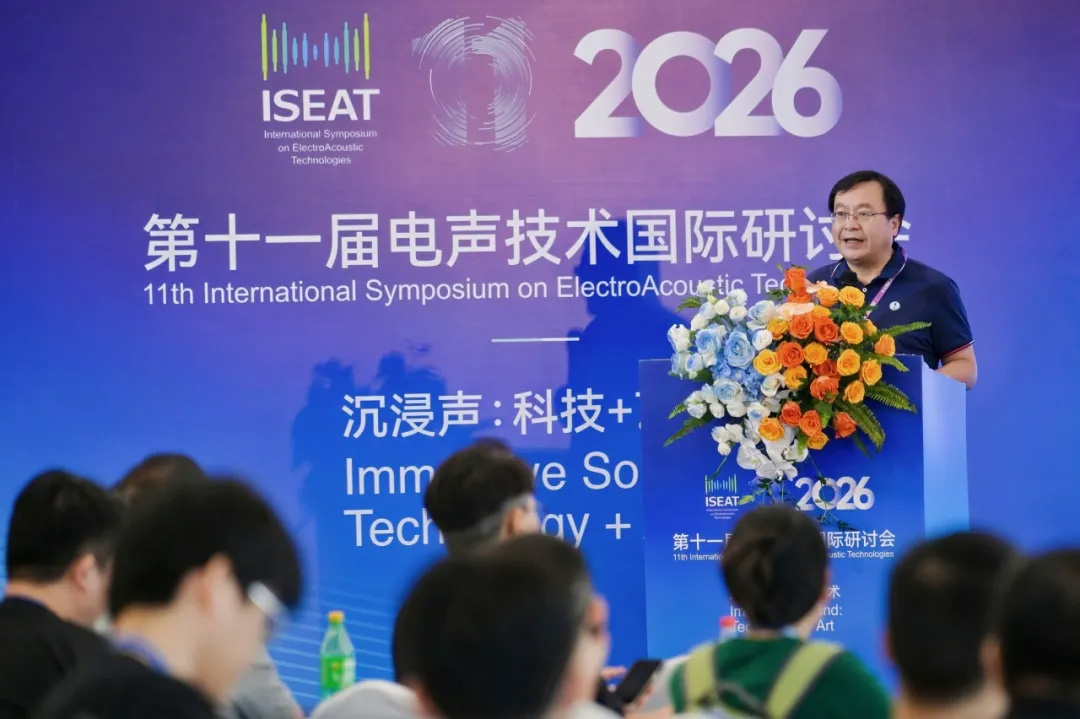
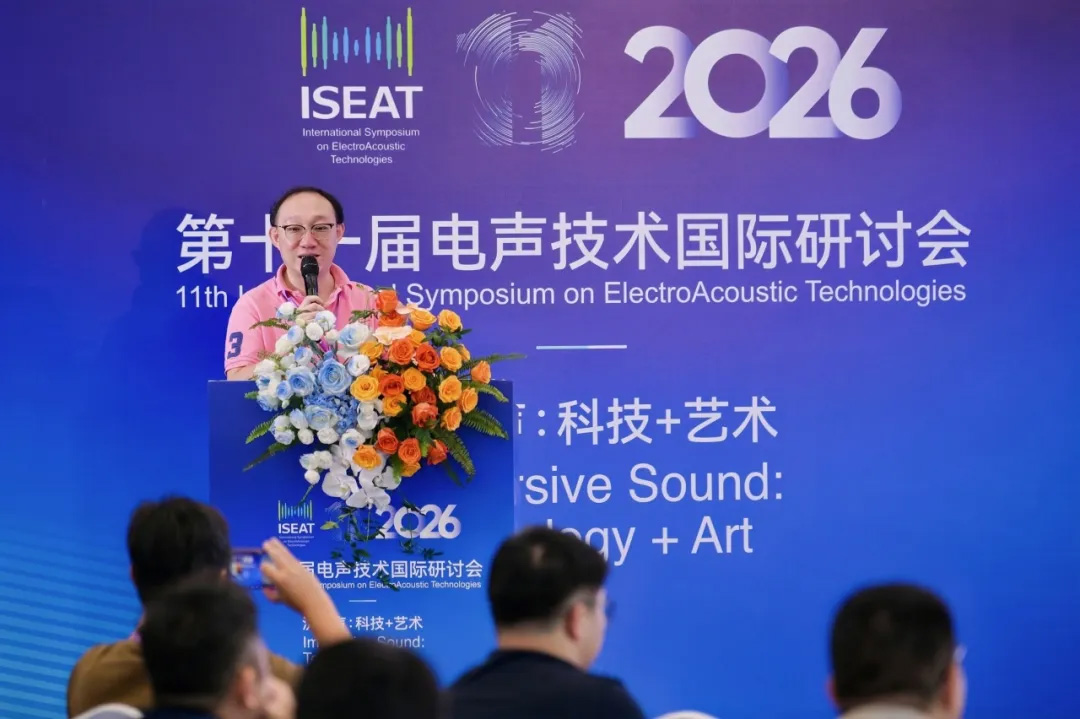
Focusing on "Immersive Sound: Technology + Art," the 11th ISEAT Concludes Successfully
Presentation Theme Distribution: Three Directions Converge at a Single Conference
Classifying the main public presentations of this edition, they broadly fall into three tracks. The first is acoustic structure and materials: 3D printing routes for cabinet forming processes, and decoupled finite element analysis for dome-diaphragm compression drivers. The second is evaluation methodology: speech intelligibility comparison between parametric arrays and electrodynamic loudspeakers in noisy environments, AI modeling of end-to-end speech perception quality, and spherical harmonic coefficient estimation for irregular microphone arrays. The third is in-vehicle and robot acoustics: in-vehicle spatial audio engines, and bionic hearing for humanoid robots. Notably, of these three areas, only the first corresponds directly to products; the other two discuss how to measure and how to evaluate.
The high share of evaluation-method topics is the signal most easily overlooked at this edition. Once acceptance criteria shift from judging whether a curve "looks good" toward reproducible quantitative metrics, the inspection takt, judgment rules, and data retention methods of the production line must change accordingly.
Structure and Materials: Optimization Descends to the Subsystem Level
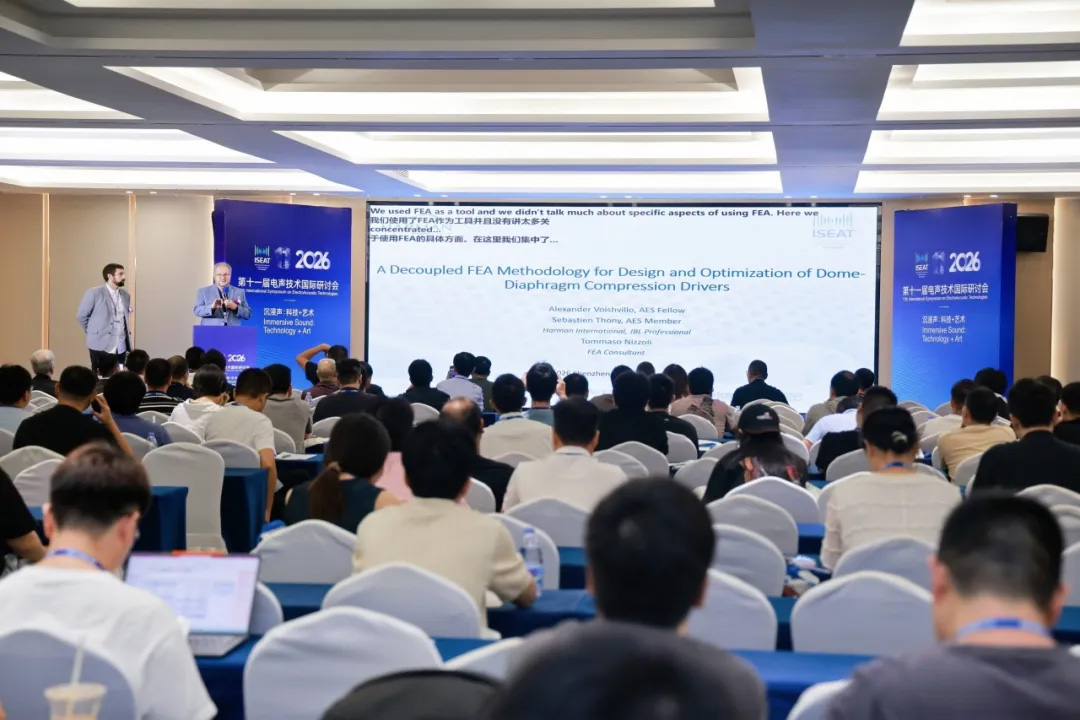
HARMAN technology lead Alexander-Voishvillo and JBL senior transducer engineer Sébastien-Thony delivered the featured presentation "A Decoupled Finite Element Analysis Method for the Design and Optimization of Dome-Diaphragm Compression Drivers"
A team from the University of Saint Joseph in Macau prepared loudspeaker cabinets using three materials — PLA, ASA, and PETG — and carried out objective testing and blind-listening experiments to assess the indoor and outdoor applicability boundaries of each material. The engineering teams at HARMAN and JBL, by contrast, decomposed the design of a dome-diaphragm compression driver into electrical, mechanical, and acoustic subsystems, solved each separately, and then reassembled the system for simulation and prototype validation.
Both developments point to the same shift: optimization of acoustic structure is moving from trial-and-error at the finished-unit level toward subsystems that can be iterated independently. For the production side, this means part-level process windows must be defined and verified independently, rather than waiting until the finished unit is assembled to learn which step drifted.
Measurement and Evaluation: Methods Change First, Production-Line Rules Follow
Yang Jun, Deputy Director of the Institute of Acoustics, Chinese Academy of Sciences, delivered the featured report "Comparative Study of Speech Intelligibility Between Parametric-Array Loudspeakers and Electrodynamic Loudspeakers in Noisy Environments"
A team led by Yang Jun of the Institute of Acoustics, Chinese Academy of Sciences compared speech intelligibility between parametric-array loudspeakers and electrodynamic loudspeakers under noise masking, and presented SRT (Speech Reception Threshold) test data. A team led by Mao Dongxing of Tongji University proposed an end-to-end AI modeling method for speech perception quality, aiming to bring evaluation results closer to the real perceptual experience of the human ear. A team led by Wu Ming of the Institute of Acoustics, Chinese Academy of Sciences discussed a methodology system for spherical harmonic coefficient estimation of irregular microphone arrays.
None of these three is a product specification; each concerns the evaluation methodology itself. Once the methodology changes, the inspection stage must answer three questions: which test conditions to use, at what takt to run them, and where to set the judgment thresholds. There are no established answers to these three points at present, so they can only be fixed in advance during the production-line planning stage.
In-Vehicle and Robot Acoustics: OEMs Start Presenting Their Own Work
Focusing on "Immersive Sound: Technology + Art," the 11th ISEAT Concludes Successfully
The automotive acoustics track of this edition was led by executives from several OEM and audio software companies, covering the current state and trends of smart cockpit acoustics, cockpit audio system design, subjective tuning concepts and mode definition, the current state of automotive audio chips and software architecture, among others; reports also appeared in the direction of bionic hearing for humanoid robots.
At comparable conferences in the past, automotive acoustics content was mostly presented by component suppliers. The large number of OEM faces at this edition indicates that acoustics is upgrading from a component-level specification to a whole-vehicle experience metric. Once acoustic experience becomes one of a vehicle's selling points, suppliers will be required to raise their acceptance standards, docking processes, and response speeds accordingly.
Geely Auto Chief Acoustics Scientist - Ma Guilin - "Advances in In-Vehicle Audio Processing"
Attendee and Exhibitor Lineup: A Checklist of Industry Focus Areas
From the exhibitor list, the companies present at this edition can be broadly grouped into four categories: acoustic module and finished-product manufacturers (AAC Technologies, Goertek, Luxshare Precision, Haoen Acoustics, Langde Technology, Rinqin Electronics, etc.); acoustic material and precision component suppliers (Sateri Glass Fabric, Boying Chuangchuang, Shengyi Materials, Yili Technology, Yingkai Mould, Fangbo Technology, Goertek Dyna, DKM, Soundflow Technology, etc.); test, measurement, and software vendors (HBK, Dirac, Listen, S&V Samford, COMSOL, USound, KLIPPEL, Bestec), plus some finished-product supporting companies. Exhibits were concentrated in acoustic modules and materials, precision components, smart accessories and finished products, humanoid robot acoustics, in-vehicle acoustics, and test/measurement/analysis.
The attendee roster covers an even broader range. According to the conference disclosure, it includes nearly one hundred organizations such as Awinic, Anker, Alibaba, Devialet, Fenda, Fantawild, Hikvision, HARMAN, Hisense, Huawei, Huaqin, Jiahe, Hangsheng, iFlytek, Tonnies, Jiuju, Leader Harmonious Drive, Lenovo, Lianchuang Optoelectronic, Marshall, Microsoft, Motorola, Novosense, Nothing, NIO, Primax, Chery, Sunwave, TCL, Tencent, vivo, Xiaomi, Amazon, Yikang, Great Wall Motor, and ThunderSoft — spanning terminal brands, internet platforms, automotive OEMs, and communications and home appliance companies. This composition alone indicates that electroacoustics is no longer a single-component industry, but an application field where multiple industries converge.
Four Requirements for Automated Assembly
Translating these signals into the manufacturing side yields four points. First, part-level process windows must be independently verifiable — subsystem optimization and iteration require the production stage to retain single-operation judgment capability, rather than only reviewing aggregate indicators at final inspection. Second, dispensing volume and curing windows must be measurable in line — compatibility issues between materials and adhesives manifest as gradual performance degradation, and only with process data traces can the cause be located. Third, inspection takt must match the new evaluation methods — subjective evaluation methods such as intelligibility and perceptual quality must undergo feasibility verification of takt and judgment thresholds before entering the production line. Fourth, judgment data must be traceable to batch — only after measurement definitions are unified do records become comparable across batches.
Jiuju AutomationIt provides complete sets of equipment for the automated assembly of speaker units (speaker unit / driver), including vibration systems (automatic assembly of surrounds and voice coils), dispensing and bonding, magnetic circuit assembly, and inline acoustic testing. The second and third of the four requirements fall exactly within our existing process verification and inline inspection steps. Specific solutions and process windows can be discussed according to product form.
**Related Recommendations:**
—
*Still worried about hiring difficulties and unstable quality? Jiuju has focused on speaker automation for 16 years and is the choice of more than 2,000 customers. Call now: 400-626-8699 or 134-2897-6919 Book a free solution consultation, or[Schedule a factory tour in Shenzhen/Dongguan], and witness the real efficiency of an automated production line with your own eyes!*
 Speaker automation jiujuauto












 简体中文
 English
 Tiếng Việt
 日本語
 한국어
 ไทย
 हिन्दी
 বাংলা
 Français
 Español de Perú
 Русский