JiuJu Automation focuses on the intelligent upgrading of the whole process of speakers, integrating the four core technologies of visual inspection, precision assembly, AI quality inspection and data traceability to provide customized solutions for TWS headphones, car audio, multimedia smart audio speakers, etc., and achieve production capacity increase of 300%+, yield rate of 99.8%, and reduce the comprehensive cost of 60%, completely solving the pain points of the industry, such as manual dependence, stable quality control and delivery cycle. dependence, unstable quality control, long delivery cycle and other industry pain points. Based on the product characteristics and production scenarios of speakers, it creates a full-process automation system from the entry of raw materials to the release of finished products from the warehouse, covering the three major categories of micro, small and medium-sized, and adapting to the needs of multi-specification and multi-batch production.
A TV speaker may seem to have only a few core parts such as "basket, magnetic circuit, diaphragm, voice coil", but its assembly process includes 12 precision steps, any of which can affect the final sound quality. And inJiuju Automationized atTV Speaker Automation Line Assembly Linewe can clearly see the efficient, standardized birth journey "from parts to finished product".
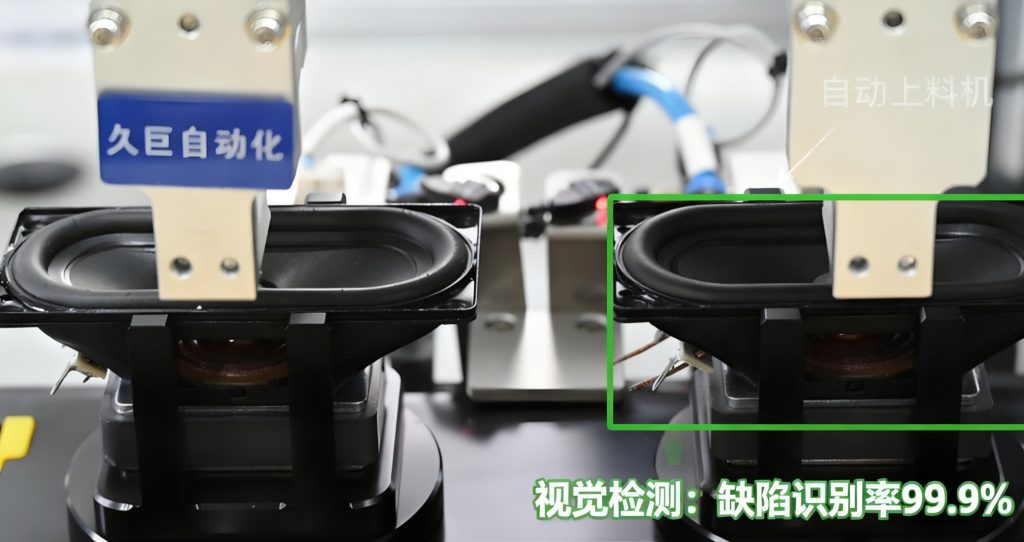
The process starts withIntelligent Loading Stage: Parts such as the basket and magnet are precisely conveyed to the station by the automatic feeder; the vision recognition system equipped on the equipment first detects appearance defects of parts to prevent defective products from flowing to the next process — this step alone replaces 3 manual quality inspectors, with a detection accuracy of 99.9%.
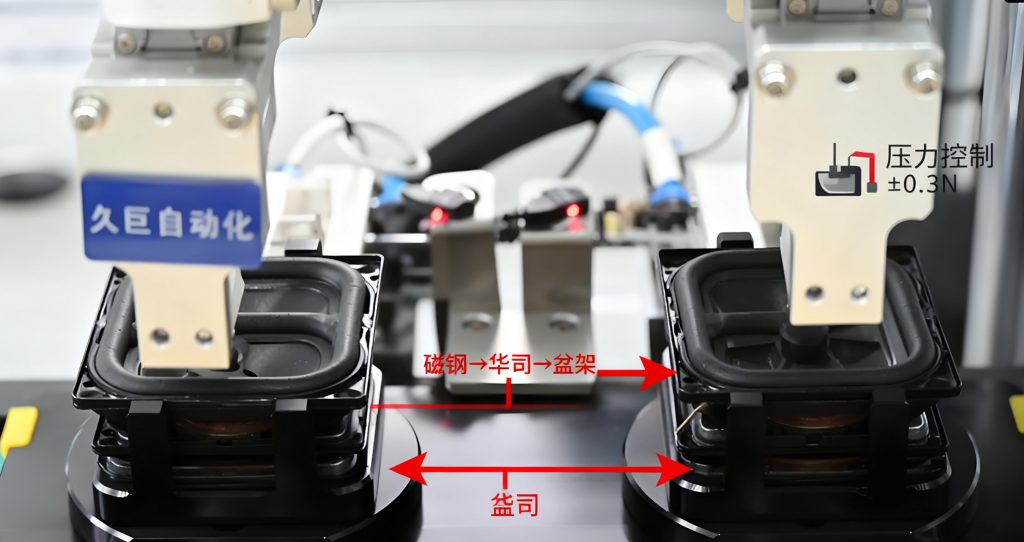
Next isMagnetic Circuit Assembly Process: The robotic arm places the magnet steel and washer sequentially at the designated positions on the basket, while the equipment applies constant pressure (error ±0.3 N) to ensure tight magnetic-circuit fit. 'When assembling the magnetic circuit manually, magnet steel often shifts due to uneven force, affecting magnetic-field uniformity,' a Jiuju technical engineer explained. 'Our equipment enables every unit to…Speaker Magnetic Circuit Machinethe magnetic circuit gap is controlled at 0.15mm±0.01mm, which is the key to ensuring sound quality stability."
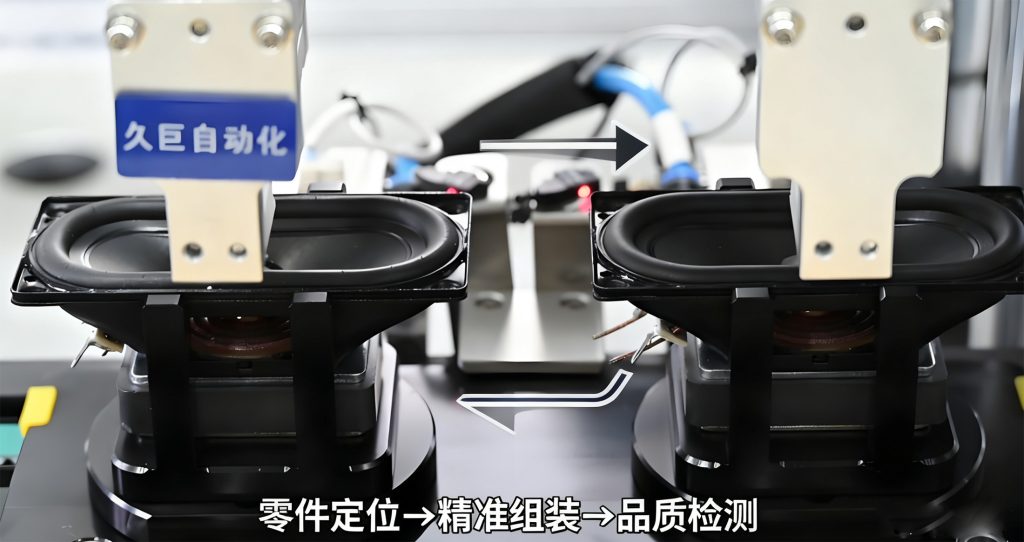
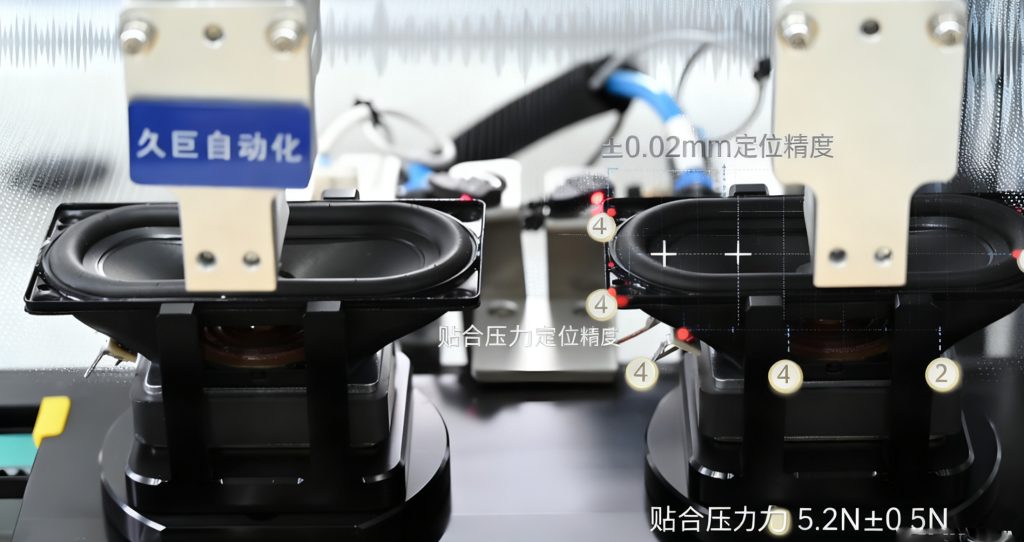
The core diaphragm-bonding stage is exactly the scene shown in the on-site image: dual-station robotic arms simultaneously grasp diaphragms and align them with the frame at 0.02 mm positioning accuracy, while pressure sensors provide real-time feedback on bonding force, ensuring the bonding error between diaphragm edge and frame is less than 0.05 mm — this step directly determines the consistency of the loudspeaker's frequency-response curve; manual assembly errors usually exceed 0.2 mm, causing obvious sound-quality differences among different loudspeakers.
Subsequent processes such as wire soldering and dust cap assembly are also automated: the automatic soldering machine's temperature is controlled at 350℃±5℃ to avoid cold joints or burning components; after the dust cap is fitted, the equipment performs an airtightness test to prevent dust from entering the speaker and affecting its service life.
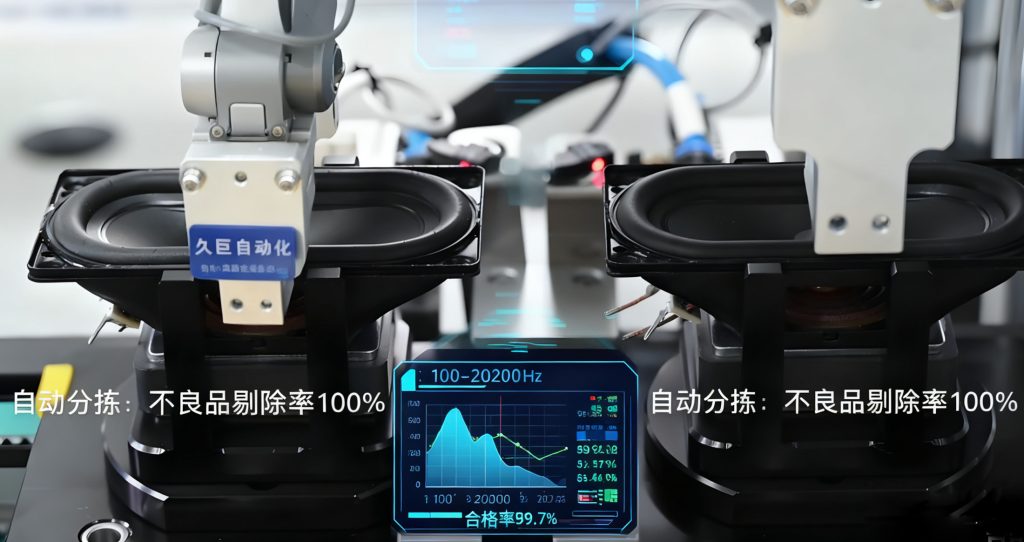
FinallyFinished Product Inspection Stage: After each loudspeaker is assembled, it automatically connects to the acoustic testing system, which collects the frequency-response curve from 100–20,000 Hz and compares it with the standard curve; non-conforming products are automatically sorted out — the entire process from parts input to finished-product output takes only 90 seconds per unit, with no manual intervention required throughout.
After a certain audio manufacturer introduced this line, it not only achieved "zero manual assembly" of TV speakers, but also raised the finished product sound quality pass rate from 89% to 99.7%, and end customers' sound quality complaints dropped by 92%.
 Speaker automation jiujuauto










 简体中文
 English
 Tiếng Việt
 日本語
 한국어
 ไทย
 हिन्दी
 বাংলা
 Français
 Español de Perú
 Русский