JiuJu Automation focuses on the intelligent upgrading of the whole process of speakers, integrating the four core technologies of visual inspection, precision assembly, AI quality inspection and data traceability to provide customized solutions for TWS headphones, car audio, multimedia smart audio speakers, etc., and achieve production capacity increase of 300%+, yield rate of 99.8%, and reduce the comprehensive cost of 60%, completely solving the pain points of the industry, such as manual dependence, stable quality control and delivery cycle. dependence, unstable quality control, long delivery cycle and other industry pain points. Based on the product characteristics and production scenarios of speakers, it creates a full-process automation system from the entry of raw materials to the release of finished products from the warehouse, covering the three major categories of micro, small and medium-sized, and adapting to the needs of multi-specification and multi-batch production.
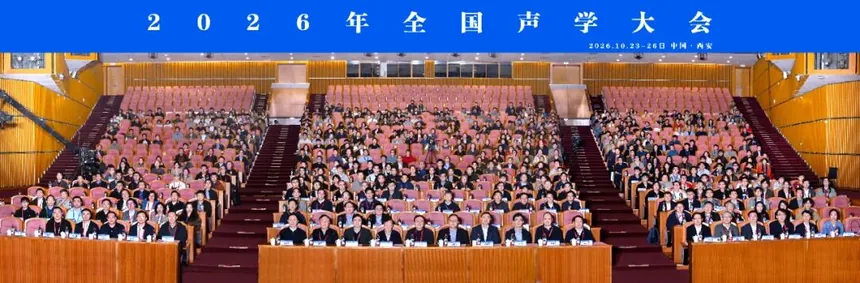
The 2026 National Acoustics Conference was held from October 23 to 26 at the Qujiang International Conference Center in Xi'an. The event was hosted by the Acoustical Society of China, organized by Northwestern Polytechnical University, and co-organized by Shaanxi Normal University, the Shaanxi Provincial Acoustical Society, the Xi'an Acoustical Society, the Shaanxi Key Laboratory of Underwater Information Technology, and the Shaanxi Key Laboratory of Ultrasonics, under the theme "Acoustics Without Boundaries, Intelligence Connecting the Future." More than a thousand delegates from universities, research institutes, and acoustics-related enterprises attended the three-day event, which featured 17 special forums.
Most coverage stops at the level of scale and celebrity. For those of us manufacturing electroacoustic components, the more valuable signal lies in how the agenda itself is structured: the way this conference divides its forums tells us which engineering scenarios acoustics is moving into.
The opening ceremony, with over a thousand delegates from universities, research institutes, and acoustics companies in attendance.
1. Signals from the structure of the agenda
The 17 special forums at this year's conference cover almost every major branch of acoustics: biomedical ultrasound, deep-sea and underwater acoustics, micro-acoustics, inspection acoustics, computational acoustics, power ultrasonics, environmental and architectural acoustics, intelligent speech and hearing technology, and audio engineering. This arrangement says one thing clearly: acoustics is no longer a discussion confined within a single discipline. It has entered a stage of full-scale engineering and industrialization.
The opening ceremony was chaired by Yang Yixin, Vice Chairman of the Acoustical Society of China and President of Nanjing University of Science and Technology. Addresses were delivered by Song Baowei, President of Northwestern Polytechnical University and Academician of the Chinese Academy of Engineering; Wang Yunbo, Vice President of Shaanxi Normal University; Ni Peigen, Deputy Director of the Department of Mathematical and Physical Sciences at the National Natural Science Foundation of China; Lü Jianjun, Vice Chairman of the Shaanxi Association for Science and Technology; and Yang Jun, Chairman of the Acoustical Society of China. Academicians Zhang Renhe, Zheng Hairong, and Yang Kunde were also in attendance. During the ceremony, the list of doctoral candidates selected for the 2026 Young Science and Technology Talent Cultivation Program of the China Association for Science and Technology was announced, and certificates were awarded under the Acoustical Society of China's 2026 Doctoral Dissertation Incentive Program.
The awards ceremony for the 4th "Shenghua Cup" Acoustics Technology Competition was also held during the opening. The competition has four tiers — Excellence Award, Third Prize, Second Prize, and First Prize — and the winning teams came from Wuhan University, Nanjing University, Southeast University, Tongji University, Yangzhou University, Dongguan University of Technology, the Institute of Acoustics of the Chinese Academy of Sciences, and other institutions. Placing a technology competition in the main venue of the conference is itself a statement about the value of putting knowledge to practical use.
2. The real signal lies in one cabin acoustics report
For speaker manufacturers, the most informative session was a report at the Audio Engineering Forum — "Cabin Acoustics Application Trends and In-Vehicle Audio DSP Design," delivered by Miao Haibo, Chief Technology Officer of Judi (Shanghai) Technology Co., Ltd.
According to the report, the upgrading of in-vehicle cabin audio experience is bringing a series of new challenges to DSP design, spanning compute capacity, memory optimization, low-latency design, toolchain usability, and ecosystem openness. Translated into language that manufacturing can act on, this means the competitive focus in in-vehicle audio has shifted from whether sound can be produced at all to whether it can be precisely controlled within a complex sound field.
3. When standards rise, speakers bear the load first
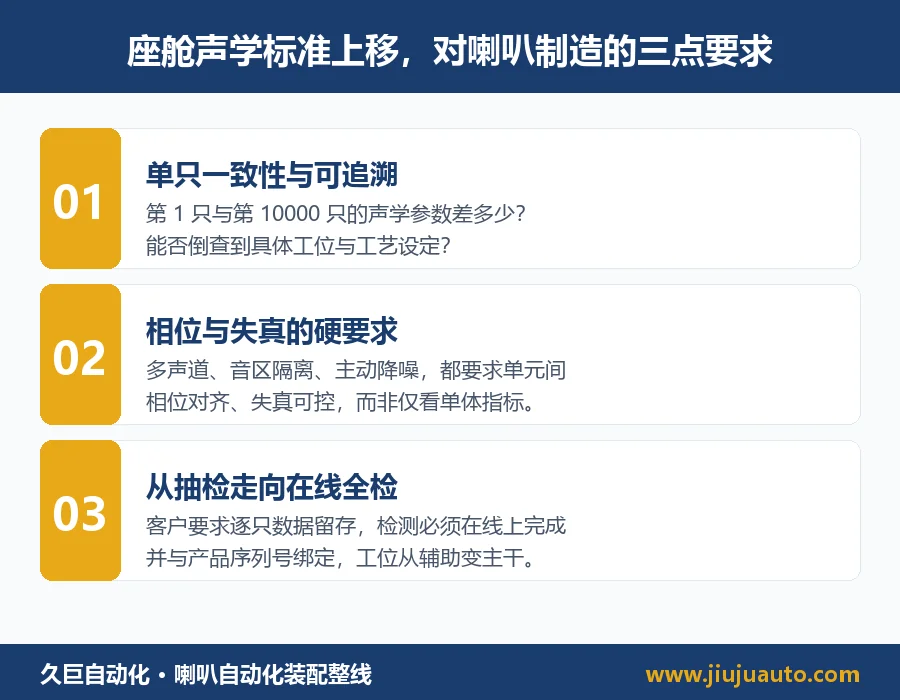
Standards raised on the algorithm and chip side must ultimately be absorbed by hardware. Cabin acoustics places at least three requirements on speaker manufacturing.
Three requirements that rising cabin acoustics standards place on speaker manufacturing.
First, consistency and traceability must reach down to the individual unit.When algorithm teams design on the assumption that every device can be recognized accurately, manufacturing has to answer a harder question: how much do the acoustic parameters differ between the first unit and the ten-thousandth unit of the same batch? And if something goes wrong, can it be traced back to a specific workstation and set of process parameters?
Second, phase and distortion move from reference items to hard metrics.Multi-channel playback, sound zone isolation, and active noise cancellation all depend on phase alignment and controllable distortion between units. Looking only at a single unit's frequency response curve is no longer sufficient. The matching relationship among multiple speakers within the same vehicle is becoming a new dimension of acceptance.
Third, inspection is moving from sampling to full in-line testing.Parameters such as impedance, frequency response, and abnormal noise used to rely on manual spot listening. When automakers require per-unit data records, testing must be completed automatically on the line and bound to each product serial number. The inspection station therefore shifts from a supporting step to a backbone of the production line.
In response to the three requirements above, Jiuju's approach is to connect process parameters with inspection data directly on the line: assembly stations record the critical parameters, the inspection station performs full acoustic testing, and once the data is bound to each product it becomes traceable. This allows the question of how much the first unit differs from the ten-thousandth to be answered in production, rather than discovered only when a customer complains.
Date: October 23-26, 2026 Venue: Qujiang International Conference Center, Xi'an Theme: Acoustics Without Boundaries, Intelligence Connecting the Future Host: Acoustical Society of China Organizer: Northwestern Polytechnical University Co-organizers: Shaanxi Normal University, Shaanxi Provincial Acoustical Society, Xi'an Acoustical Society, Shaanxi Key Laboratory of Underwater Information Technology, Shaanxi Key Laboratory of Ultrasonics Scale: over a thousand delegates, 17 special forums
This article is an industry commentary prepared by Jiuju Automation based on publicly available conference information and official press materials. It is not published by the conference organizers and does not represent their views. For the official agenda, speakers, and award lists, please refer to the organizers' announcements.
Source Acoustical Society of China. "The 2026 National Acoustics Conference Opens in Xi'an." Official website of the Acoustical Society of China, October 24, 2026.
 Speaker automation jiujuauto










 简体中文
 English
 Tiếng Việt
 日本語
 한국어
 ไทย
 हिन्दी
 বাংলা
 Français
 Español de Perú
 Русский